
247: It's on the Server Somewhere
Your project history is worth something. So why can't you use it? Listen to AEC tech industry experts on where the data lives, who governs it, and what AI-ready means. This is episode 2 of Arc 3 of the Next AEC Tech Stack series.
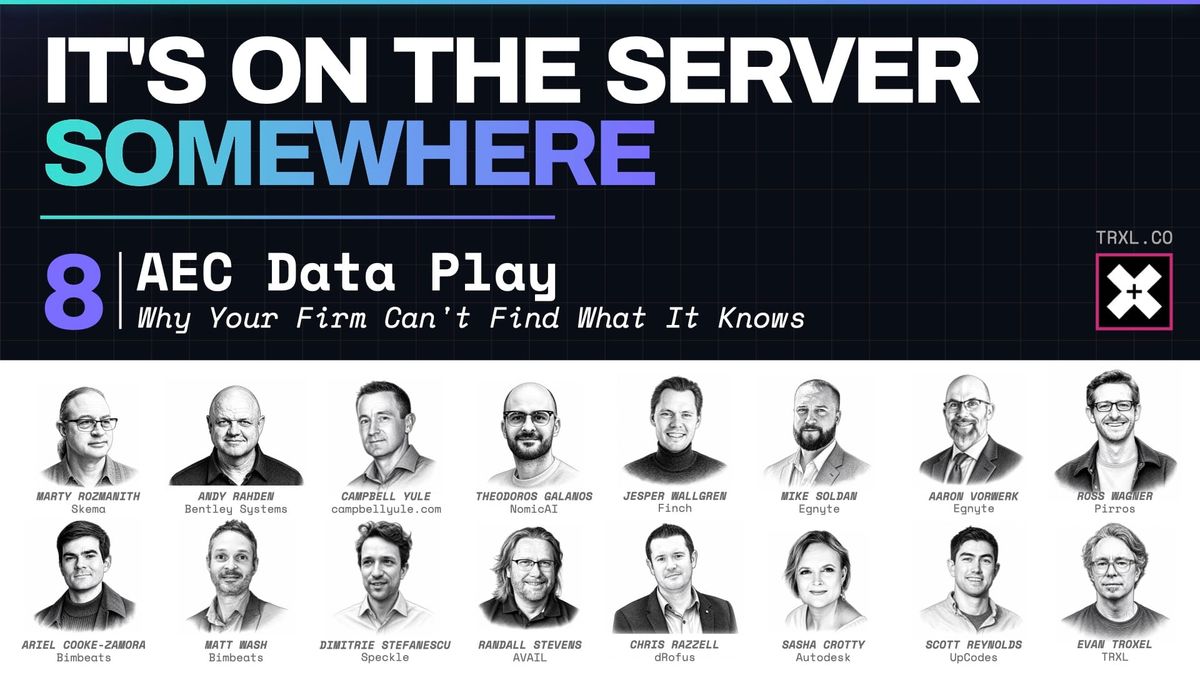
The last episode made the case that your project history is worth something. This one asks why you can't use it. Two reasons keep coming up: the data means different things to different systems and different people, and it's scattered across far more places than anyone planned for.
Ariel Cooke-Zamora at Bimbeats explains how a data dictionary keeps an AI from misreading your data, and I add a caveat about keeping it pruned. Randall Stevens at AVAIL describes a customer running 180 applications, and says the best information is at the edges of the network. Aaron Vorwerk and Mike Soldan at Egnyte cover where the reasons behind a project's decisions end up, and why governance has to come before AI touches your files. Ross Wagner at Pirros asks how a firm captures what its one all-knowing person knows. Sasha Crotty at Autodesk talks about getting data out of Revit files and how much confidence you can put in it. Andy Rahden at Bentley, Dimitrie Stefanescu at Speckle, Chris Razzell at dRofus, Marty Rozmanith at Skema, and Jesper Wallgren at Finch take on shared language, minimum standards, and where the data should live. Matt Wash at Bimbeats, Scott Reynolds at UpCodes, Campbell Yule, and Theodoros Galanos add the habits, the documentation, and the reasons Theodoros says RAG doesn't work.
This episode is especially relevant for CIOs, BIM managers, and design technologists who've been told to get their data AI-ready and want to know what that means on a Monday morning.
Original episode page: https://trxl.co/247

Watch This on YouTube:
| Arc 3 presenting sponsor | |
 |
Speckle makes design data actually usable across projects, so your team can trust it, own it, act on it, and make better decisions faster. |
| This series brought to you by | |
 |
Graitec provides AEC software, training, and expert support to help architects, engineers, and construction teams design, build, and manage projects more effectively. |
| With support from | |
 |
AVAIL's content management system (CMS) helps architecture and engineering teams find, manage, and reuse their Revit, AutoCAD, Civil 3D, and other technical content in one place. |
Episode Links:
The Series
- The Next AEC Tech Stack — Series hub · Arc 3: The AEC Data Play — Arc 3, episode 2 of 3. Arc 3 is presented by Speckle.
Previous episodes in the series:
- TRXL 238 — Half Your Day Isn't Design
- TRXL 239 — You're Not Going Home Early
- TRXL 240 — I've Got to Get My Project Out on Friday
- TRXL 241 — From Autocomplete to Agent, Where AEC Actually Is
- TRXL 242 — Designing for 100 Years… in 100 Seconds?
- TRXL 244 — Who Signs When the AI Is Wrong?
- TRXL 246 — Someone Already Figured This Out
Voices in This Episode
- Ariel Cooke-Zamora — Product Operations Lead, Bimbeats — LinkedIn · Bimbeats
- Matt Wash — CEO, Bimbeats — LinkedIn · Bimbeats
- Randall Stevens — CEO and Founder, AVAIL — LinkedIn · AVAIL, From Project Knowledge to Capital Resources
- Aaron Vorwerk — AEC Practice Leader, Architects + Owners, Egnyte — LinkedIn · Egnyte
- Mike Soldan — SVP, Global Technology Solutions, Egnyte — LinkedIn · Egnyte
- Ross Wagner, Assoc. AIA — Head of Industry & Product Strategy, Pirros — LinkedIn · Pirros
- Sasha Crotty — VP, AEC Data, Autodesk — LinkedIn · Autodesk
- Andy Rahden — Chief Revenue Officer, Bentley Systems — LinkedIn · Bentley
- Dimitrie Stefanescu — CEO & Co-Founder, Speckle — LinkedIn · Speckle
- Chris Razzell — Managing Director & Chief Revenue Officer, dRofus — LinkedIn · dRofus
- Marty Rozmanith — CTO & Co-Founder, Skema — LinkedIn · Skema
- Jesper Wallgren — CPO & Co-Founder, Finch — LinkedIn · Finch
- Scott Reynolds — CEO & Co-Founder, UpCodes — LinkedIn · UpCodes
- Campbell Yule — LinkedIn · Website
- Theodoros Galanos — Generative AI Leader — LinkedIn
Where the Data Actually Lives
- Bimbeats on the data dictionary — Bimbeats — Ariel Cooke-Zamora on writing definitions so an LLM doesn't misread your data, using the two ways Bimbeats logs Revit warnings as the example. Matt Wash on the Outlook and Teams habits that let his time sheet categorize itself.
- AVAIL on the tech stack survey — 2025 AEC Technology Stack Survey, full report · Results announcement — Randall Stevens on the survey of what firms run, the customer with 180 applications, and the finding that about half the firms still bridge design data to ERP by hand. The 2026 survey is on its way, so watch for it.
- AVAIL on capital resources — AVAIL, From Project Knowledge to Capital Resources — Randall Stevens on his white paper, capturing intent when information is created, and why he'd start with the last five hospitals instead of the twenty-fifth.
- Egnyte on where the "why" lives — Egnyte — Aaron Vorwerk on the share of project data that never sits in a delivery platform, auto-classification, auto-extraction, and the context layer. Mike Soldan on project graphs and why governance has to come before the AI pipeline.
- Pirros on the person who knows everything — Pirros — Ross Wagner on audit trails, the one person at a firm who holds the answers, and how to capture what a person does well before it walks out the door.
Opening the Data Up
- Autodesk on the AEC Data Model — Autodesk AEC Data · Autodesk Forma — Sasha Crotty on getting data out of Revit files, querying doors across every model in a project, adding cloud-native properties without touching the model, and mapping properties with a confidence score.
- Bentley on shared meaning — Bentley — Andy Rahden on why a firm needs enough shared meaning for data to move across disciplines without forcing a single standard, and where the Bentley Information Schema fits.
- Speckle on a lower minimum — Speckle — Dimitrie Stefanescu on how an AI agent can work through inconsistent naming, why design needs to link to numbers, and the standards a general contractor wants to enforce on its design partners.
- dRofus on the federated data layer — dRofus — Chris Razzell on the difference between documents, files, and data, why he calls "common data environment" a misnomer, the golden thread, and using dRofus to harvest historic projects. An MCP server is on the way.
- Skema on a reusable back catalog — Skema — Marty Rozmanith on the lawyer comparison, why a back catalog is your IP, and why he says your data doesn't need cleaning before you start.
- Finch on the plan library — Finch — Jesper Wallgren on spaces as the main element, customers building their own plan library, and a graph model that predicts a room's type from its relationships.
- UpCodes on writing it down — UpCodes — Scott Reynolds on why AI can handle messy data but can't use a decision nobody recorded.
BIM 3.0, Open Formats, and RAG
- Campbell Yule on what comes after BIM 2.0 — LinkedIn · Website — Campbell on why a digital twin needs spaces, volumes, and location more than wall construction, and on the translation problem between IFC and newer formats.
- That Open Company — That Open Company · Fragments documentation — Co-founded by Antonio González Viegas, who Campbell discusses. His Fragments format is the example for a new format that still has to translate back to IFC.
- TRXL 225 with Antonio González Viegas — TRXL 225 — A Nuclear Bomb Moment, with Antonio González Viegas — Antonio's earlier episode on this show, on open source tools for working with BIM data.
- Theodoros Galanos on RAG — Executable Standards · LinkedIn — Why he says retrieval-augmented generation works in only two cases, and why pairing an agent with a plain database gives the same answer every time, as he wrote in his executable standards article. See also Retrieval-augmented generation for the basics.
- IFC — buildingSMART, Industry Foundation Classes — The open standard behind the IFC-to-Fragments translation Campbell and Chris Razzell discuss.
Tools and References Mentioned
- Arcol and Snaptrude — the front-end conceptual design tools Campbell Yule says produce the simple spaces model a digital twin can use.
- Autodesk Forma — where Sasha Crotty places the data foundation for the AEC Data Model.
- Archicad — Chris Razzell's example of a platform that can hold a single model instead of 100 files.
- Bluebeam Studio — the document collaboration tool Chris Razzell names, a sister brand of dRofus.
- Deltek — the ERP system in Randall Stevens' project name example.
- Knowledge Architecture — Chris Parsons' firm, which Randall Stevens names when he talks about the knowledge management layer.
Series Partners
These companies took part in Arc 3 of The Next AEC Tech Stack.
- Speckle (Arc 3 presenting sponsor)
- Graitec (foundation partner)
- AVAIL (supporting sponsor)
- Autodesk
- Bentley
- Bimbeats
- dRofus
- Egnyte
- Pirros
- Skema
- UpCodes
Every voice in this episode is on trxl.co/guests with their own bio.