
244: Who Signs When the AI Is Wrong?
A conversation with AEC industry leaders about AI liability, trust, verification and future hiring in architecture.
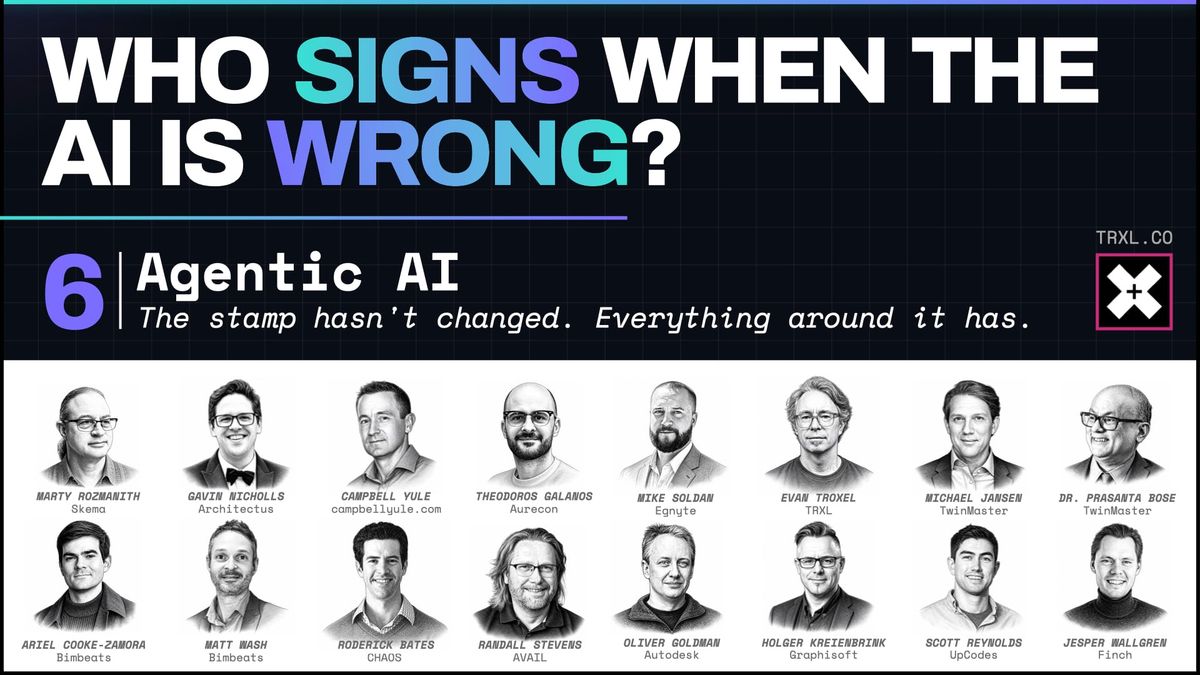
This is the last episode of Arc 2. The first two asked what these tools can do. This one asks what happens when they get it wrong, who is still on the hook when they do, and what that means for the people coming up in this profession.
Mike Soldan says the bigger risk now is reference content that's five years old, not a hallucination. Randall Stevens points out that running automation across a whole drawing set can leave someone checking every piece of it. Oliver Goldman says the accountability stays with whoever delivers the work, whatever tools they used. Holger Kreienbrink expects people to check AI output less and less until they sign without looking. Scott Reynolds tested its review against the 1981 Hyatt walkway collapse and the Champlain Towers collapse. Theodoros Galanos asks whether we hold AI to a standard we've never measured ourselves against. Then the harder question: who do firms still hire, and how does the next generation learn when the grunt work goes away? Roderick Bates, Marty Rozmanith, Matt Wash and Ariel Cooke-Zamora, Prasanta Bose and Michael Jansen, Jesper Wallgren, Gavin Nicholls, and Campbell Yule weigh in, and close on the firm of 2030 and why billing by the hour gives the productivity gain away.
This episode is especially relevant for principals who put their stamp on drawings, firm leaders deciding how much to trust these tools, and anyone responsible for training the next generation when the work they learned on is disappearing.
Original episode page: https://trxl.co/244

| This series brought to you by | |
 |
Graitec provides AEC software, training, and expert support to help architects, engineers, and construction teams design, build, and manage projects more effectively. |
| With support from | |
 |
AVAIL's content management system (CMS) helps architecture and engineering teams find, manage, and reuse their Revit, AutoCAD, Civil 3D, and other technical content in one place. |
Watch This on YouTube:
Episode Links:
The Series
- The Next AEC Tech Stack — Series hub · Arc 2: Agentic AI — Arc 2, episode 3 of 3. Arc 3 starts next week.
Previous episodes in the series:
- TRXL 238 — Half Your Day Isn't Design
- TRXL 239 — You're Not Going Home Early
- TRXL 240 — I've Got to Get My Project Out on Friday
- TRXL 241 — From Autocomplete to Agent, Where AEC Actually Is
- TRXL 242 — Designing for 100 Years… in 100 Seconds?
Voices in This Episode
- Mike Soldan — SVP, Global Technology Solutions, Egnyte — LinkedIn · Egnyte
- Roderick Bates — Senior Director, Product Operations, Chaos — LinkedIn · Chaos
- Randall Stevens — CEO and Founder, AVAIL — LinkedIn · AVAIL
- Matt Wash — CEO, Bimbeats — LinkedIn · Bimbeats
- Ariel Cooke-Zamora — Product Operations Lead, Bimbeats — LinkedIn · Bimbeats
- Oliver Goldman — VP, Software Architecture, AEC Solutions, Autodesk — LinkedIn · Autodesk
- Jesper Wallgren — CPO & Co-Founder, Finch — LinkedIn · Finch
- Scott Reynolds — CEO & Co-Founder, UpCodes — LinkedIn · UpCodes
- Holger Kreienbrink — Director, Product Intelligence & Partnerships, Graphisoft — LinkedIn · Graphisoft
- Prasanta Bose — CEO & CTO, TwinMaster — LinkedIn · TwinMaster
- Michael Jansen — Chief Business Officer, TwinMaster — LinkedIn · TwinMaster
- Theodoros Galanos — Generative AI Leader — LinkedIn
- Marty Rozmanith — CTO & Co-Founder, Skema — LinkedIn · Skema
- Gavin Nicholls — National Computation Lead, Architectus — LinkedIn · Aussie BIM Guru on YouTube · Architectus
- Campbell Yule — LinkedIn · Website
Liability and the Stamp
- Egnyte on where a human still verifies — Egnyte — Mike Soldan on firms setting their own checkpoints, and why stale reference content is now a bigger risk than a fabricated answer.
- Chaos on why building is hard, licensed or not — Chaos — Roderick Bates on licensure, risk, and why the physical work of building a building doesn't replicate easily.
- AVAIL on trust and the stamp — AVAIL — Randall Stevens on an industry that runs on trust, and why automating across a full drawing set can leave someone checking every piece of it.
- Bimbeats on where liability lands — Bimbeats — Ariel Cooke-Zamora on liability routing to the stamp, insurance for AI agents, and the Waymo parallel. Matt Wash on the digital stamp that already goes on sheets nobody opened, and on AI as an extra check rather than an excuse.
Trust and Verification
- Autodesk on accountability and staged changes — Autodesk · Autodesk Forma — Oliver Goldman on why warnings get clicked through, presenting AI output as work in progress, a read-only MCP server for Revit, staged changes you approve, and bringing a firm's own agents into the loop.
- Finch on rules you can trust — Finch — Jesper Wallgren on live key figures, a "spell check" for plans, and who writes the rules (the firm, not Finch).
- UpCodes on flagging without deciding — UpCodes — Scott Reynolds on why a human verifies everything, why the review won't be made more "forgiving," and testing against historical failures.
- Chaos on the double standard — Chaos — Roderick Bates on checking work you don't have the knowledge to judge, deterministic tools that teach, and users "rolling the dice" on outputs.
- Graphisoft on trust decay — Graphisoft — Holger Kreienbrink on checking less and less over time, and a generation raised on answers it doesn't question.
- TwinMaster on verifiable agents — TwinMaster — Prasanta Bose on agents that show their reasoning so a person can check them. Michael Jansen on the questions firms ask once they get serious about agentic tools.
- Theodoros Galanos on who's liable, and how good humans are — Why we're always liable today, how embedded verification could change that, and why we demand 99 percent from AI without knowing our own number.
Who You Still Hire
- Graphisoft on knowing the logic of building — Holger Kreienbrink on needing someone who knows where the water goes, and what happens to junior work.
- Egnyte on business process analysts — Mike Soldan on who the large firms are hiring to map their processes before AI touches them.
- TwinMaster on judgment, writing, and growth — Prasanta Bose on why architects need to be good writers. Michael Jansen on what the outsourcing wave did to headcount.
- Autodesk on what happened to software jobs — Oliver Goldman on programmers getting far more productive while the number of jobs kept growing.
- Theodoros Galanos on the middle of the ladder — The cohort educated before ChatGPT and hired after it, and what education should teach instead.
- Bimbeats on capturing knowledge and proving competence — Matt Wash on capturing senior knowledge as mentoring time shrinks, and assessing students out loud. Ariel Cooke-Zamora on generalists who orchestrate. — Knowledge Architecture — Chris Parsons' firm, which Matt Wash names on who to hire.
- UpCodes on AI brain rot — Scott Reynolds on showing the rationale and code sections so junior staff build the skill, not only the answer.
- Skema on raising the bar — Marty Rozmanith on the move from AutoCAD to Revit, and why it raised the bar on what you had to know.
- Gavin Nicholls on the about-face — Architectus — On years of teaching manual methods meeting AI that codes well, a PDF binder shipped in two prompts, and why a firm needs someone close to full-time on this.
- Chaos on what the profession could lose — Roderick Bates on losing the artist's eye, clients as critics, and the tragedy of the commons in training vendor systems.
The Future of the Profession
- TwinMaster on business models beyond the fee — Michael Jansen on new service lines, and why a fee ends when the job does.
- Skema on the standard of care — Marty Rozmanith on why the hours-to-standard-of-care equation is breaking.
- Bimbeats on what this costs later — Matt Wash on human capital versus AI capital, and the token bill nobody plans for yet.
- The firm of 2030 — Oliver Goldman, Mike Soldan, and Theodoros Galanos on productivity, the person down the hall with 30 years of answers, and taking out intermediation. Roderick Bates on what to stop doing, Scott Reynolds on what to start doing.
- Campbell Yule on fee structure — Campbell Yule — Why billing hourly gives away the productivity gain, and how lower risk lets firms fix the fee on front-end work.
Tools, Events, and References Mentioned
- OpenAI GPT-6 Astra — text to geometry, named in the episode open, along with Anthropic's Opus 5.5, SpaceX’s Grok Bot, OpenAI Dots, and Meta’s Muse.
- Y Combinator — where Ariel Cooke-Zamora saw a company selling insurance for AI agent mistakes.
- Waymo — Ariel Cooke-Zamora's self-driving liability parallel.
- Bluebeam — the digital stamp in Matt Wash's segment.
- Claude Code — Oliver Goldman's example of calibrating trust in an assistant.
- Perplexity — Holger Kreienbrink's example of skipping pages of reasoning.
- Hyatt Regency walkway collapse (1981) and Champlain Towers South collapse (2021) — the historical cases Scott Reynolds tested against.
- NCARB — "Arch-e didn't go through NCARB," in Michael Jansen's list of client questions.
- V-Ray and Enscape — Chaos' renderers, in Roderick Bates' segments.
- D5 Render — named with Enscape when Evan says renderings became free.
- AIA — the AIA National talks where Roderick Bates saw pro-AI statements booed.
Series Partners
These companies took part in Arc 2 and agreed to be asked hard questions about their own AI.
- Graitec (foundation partner) · Autodesk · AVAIL · Bimbeats · Chaos · Egnyte · Finch · Graphisoft · Skema · TwinMaster · UpCodes
Every voice in this episode is on trxl.co/guests with their own bio.