
228: 'What Did You Actually Do Today', with Steve Burrows CBE
A conversation with Steve Burrows about why the construction industry rewards dysfunction, the pitfalls of time‑billing, the promise of value‑based billing, modular construction challenges, and how AI is reshaping engineering work.
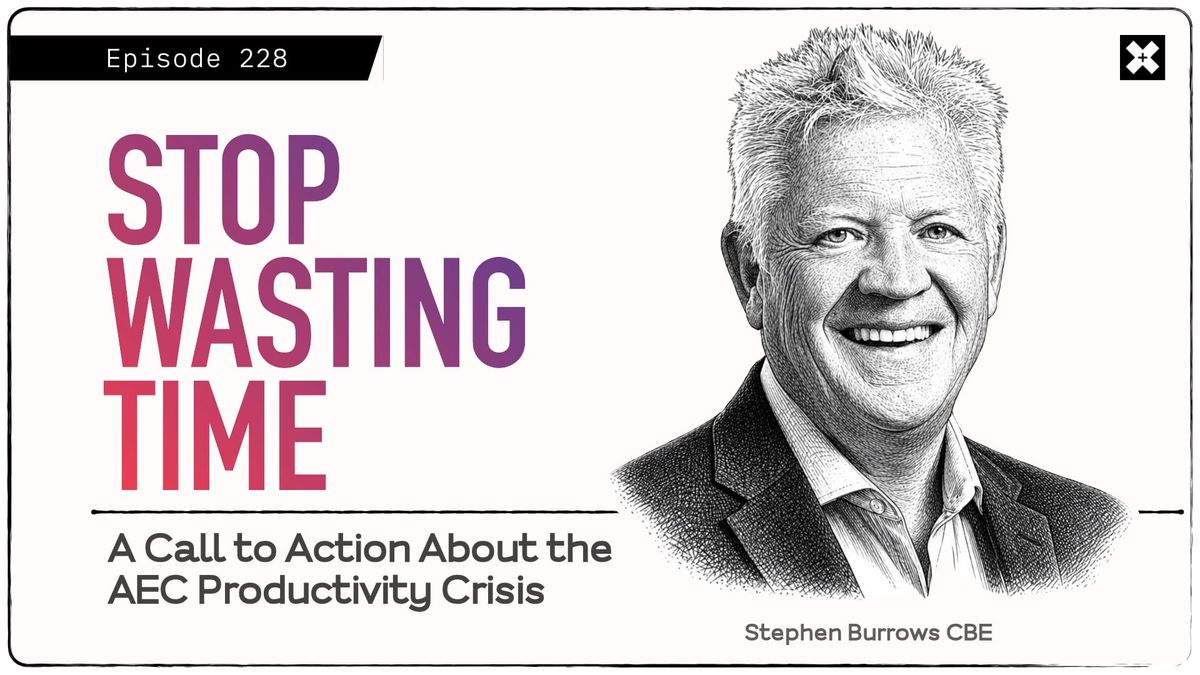
Steve Burrows CBE joins the podcast to talk about why the construction industry keeps rewarding dysfunction instead of fixing it. We explore the gap between selling time and creating value, why startups keep failing to change construction by trying to change all of it at once, and what the collapse of Katerra actually taught the people who were in the room when it happened.
This episode is especially relevant for firm leaders and engineers who feel trapped in the cycle of meetings, emails, and change orders, and who suspect the system they're operating in was never designed to produce great work. Steve makes a blunt, practical case for starting with what you can control, and his perspective is shaped by decades of working on some of the most complex structures in the world before walking away from the corporate path to figure out what comes next.
Original episode page: https://trxl.co/228

Watch This on YouTube:
Connect with the Guest
- Steve Burrows, CBE, P.E., CEng, FICE, FASCE, MIStructE, LEED-AP
Companies and Startups Steve Is Involved With
- Gropyus
- Gropyus Website
- Why it's relevant: Steve discusses his involvement with Gropyus as an example of focused problem-solving in modular construction. The Austrian-German company uses an 86%-automated factory to build multifamily housing cheaper than stick-built construction in Germany.
- DTE Materials
- DTE Materials Website
- Why it's relevant: Steve mentions DTE Materials as a startup he's involved with that's creating sustainable, carbon-negative fiber to replace sand in cementitious products. It's his example of laser-focused problem-solving done right.
BIM 2.0 and AI Engineering Tools
- Augmenta
- Augmenta Website
- Why it's relevant: Evan names Augmenta as one of the companies attacking the codification of engineering workflows, the trend Steve warns will push engineering fees toward zero if firms don't shift to value-based billing.
- Consigli (acquired by AECOM)
- AECOM Acquires Consigli — AEC Magazine
- Why it's relevant: Evan references AECOM's acquisition of Consigli as a signal that AI-driven engineering automation is already reshaping the competitive landscape. Steve's point: if AI does the standard work, how will engineers get paid?
- BIM 2.0 — AEC Magazine
- Defining BIM 2.0 — AEC Magazine
- Why it's relevant: Evan references BIM 2.0, a term associated with Martyn Day at AEC Magazine, to describe the new wave of tools tackling early-stage design automation.
Offsite and Modular Construction
- VBC (Volumetric Building Companies)
- VBC Website
- Why it's relevant: Steve highlights VBC and CTO Helena Lidelöw's focus on connectors rather than boxes as the key breakthrough needed for offsite construction.
- Katerra
- Katerra — Wikipedia
- Why it's relevant: Steve's time at Katerra is central to this episode. He describes it as a company that tried to change an entire industry as a single company, a fundamentally flawed concept.
- Sears Modern Homes (1908–1940)
- Sears Modern Homes — Wikipedia
- Why it's relevant: Steve points to Sears catalog homes as proof that modular construction has worked before.
AI, Productivity, and Industry Transformation
- KP Reddy / Zero RFI
- KP Reddy Co.
- Why it's relevant: Steve names KP Reddy as someone doing interesting work in trying to create an AI-enabled business that can plug onto existing firms and supercharge them.
- McKinsey Global Institute — "Reinventing Construction" Report (2017)
- Reinventing Construction — McKinsey
- Why it's relevant: Steve references the oft-cited McKinsey report as the standard startup pitch deck opener.
Knowledge Management
- Knowledge Architecture
- Knowledge Architecture Website
- Why it's relevant: Steve describes looking into Knowledge Architecture's platform after being embarrassed in a client interview where they were asked to demonstrate their knowledge management system in real time.
- TRXL Episode 190: AI + KM = Smarter AEC Firms, with Christopher Parsons
- Episode 190 — TRXL
- Why it's relevant: Christopher Parsons, founder of Knowledge Architecture, previously appeared on TRXL to discuss the evolution of knowledge management in AEC.
People Referenced
- Frank Gehry
- Frank Gehry — Wikipedia
- Why it's relevant: Steve quotes Gehry's line that "90% of architecture is shit" to set up his argument for standardizing the routine 90%.
- Michael Marks
- Michael Marks — Wikipedia
- Why it's relevant: Steve describes Katerra CEO Michael Marks and his meeting culture of asking people why they're in the room.
Media
- Dream Big: Engineering Our World (2017)
- Dream Big Film Website
- Why it's relevant: Steve Burrows appears in this IMAX documentary narrated by Jeff Bridges that celebrates engineering innovation.
- Time Scanners
Frameworks and Concepts
- RACI Matrix
- RACI Matrix — Wikipedia
- Why it's relevant: Steve references the RACI framework as a tool for aligning authority with responsibility.
- Biomimicry
- Biomimicry — Wikipedia
- Why it's relevant: Steve mentions being a big proponent of biomimicry and highlights materials innovations like using mushrooms to replace leather.
About Steve Burrows CBE:
Steve Burrows is a structural engineer, startup advisor, and consultant who spent 29 years at Arup before leading building engineering practices at AECOM and WSP in the United States. He's worked on some of the most recognized structures in the world, including the Birds Nest Stadium for the Beijing Olympics, Apple's headquarters in Cupertino, and Stanford's Graduate School of Business. He was awarded a CBE (Commander of the Order of the British Empire) in 2009 for his civil engineering contributions overseas. After a stint as Head of Engineering at Katerra, where he got a front-row seat to both the promise and the pitfalls of trying to reinvent construction at scale, he launched B2Burrows, his own consulting practice focused on helping firms and startups prepare for a future the construction industry hasn't built yet.