
226: 'Think Slower to Move Faster', with Charles Portelli
A conversation with Charles Portelli about bridging the gap between architecture and software, the importance of foundational data infrastructure, and how patience in building internal tools can lead to more effective project management within large architecture firms.
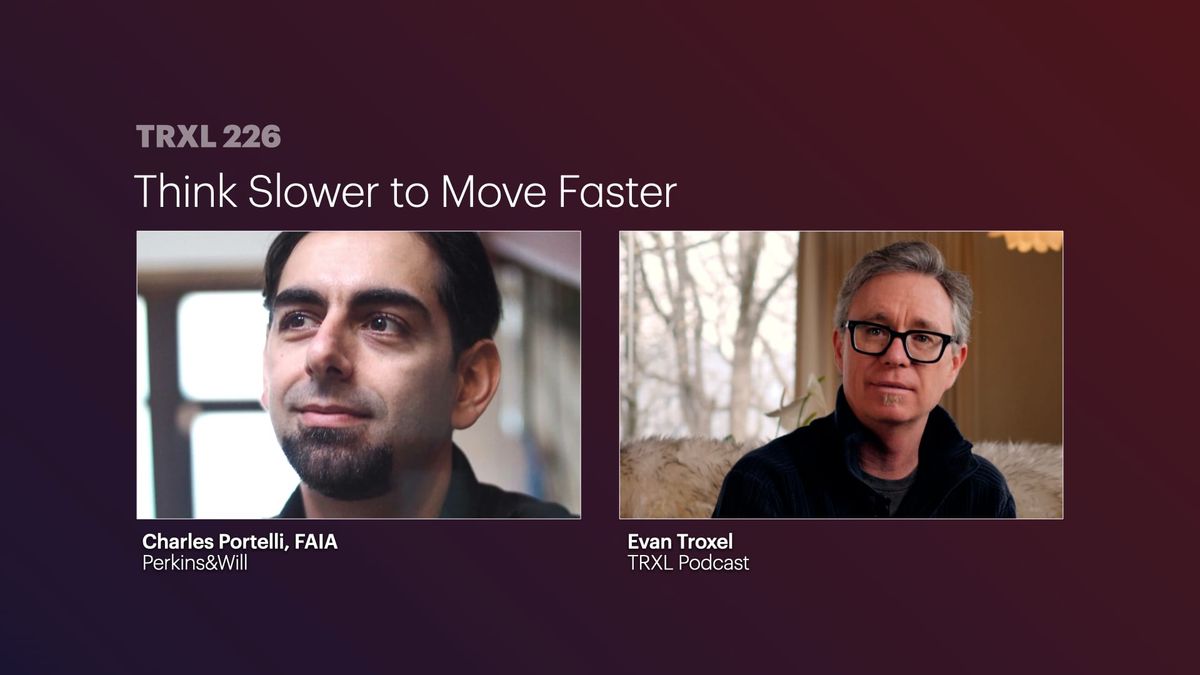
Charles Portelli joins the podcast to talk about what you learn when you leave architecture to build software, and what you bring back when you return. We explore the gap between how buildings are designed and how they're actually fabricated, why the most valuable work inside a large firm is often the least glamorous, and what it would take to build an AI-powered project assistant that actually knows everything about a job.
This episode is especially relevant for design technology leaders, firm principals, and anyone working on the internal tooling side of architecture. If you've felt the tension between chasing the next new capability and keeping everyone from drowning in an ever-growing tool stack, Charlie names that problem clearly and talks about what a more patient, intentional path forward looks like.
Original episode page: https://trxl.co/226

Watch This Episode on YouTube:
Some links on this page help fund our work, and we may earn a commission from purchases at no extra cost to you.
Connect with the Guest
- Charles Portelli, FAIA, RIBA, CDT
- Website
- RPI Faculty Profile — Charles teaches Environmental Parametrics at Rensselaer Polytechnic Institute's Center for Architecture and Sustainable Ecologies (CASE), part of nearly 20 years of teaching across multiple universities.
Firms and Organizations
- Perkins&Will
- Website
- Where Charlie currently co-leads the IO group, building internal tools for project setup automation, specification integration, and the eventual AI-powered project assistant discussed in this episode.
- Kohn Pedersen Fox (KPF)
- Website
- Where Charlie led computational design for close to a decade, working on skyscrapers, airports, and fabrication-forward projects including the Loop the Loop chair line with designer Bill Paterson.
- Thornton Tomasetti CORE Studio
- Website
- The R&D arm that incubated KONSTRU and other software products. Charlie joined as the KONSTRU product lead, later inheriting the whole operation when his co-lead departed.
- AIA College of Fellows
- Website
- The AIA's highest membership honor. Charlie was recently elevated to fellowship, and used his acceptance remarks to call out the absence of a "technology" category among the seven fellowship objects — making the case for digital practice leaders as legitimate FAIA candidates.
- AIA Fellowship Objects — AIANYS explainer — A breakdown of the seven submission categories and what they require. Charlie applied under Practice Technical Advancement, but argued publicly that a dedicated technology/digital practice object is missing.
Products and Startups
- KONSTRU
- Thornton Tomasetti page
- The structural interoperability platform Charlie ran while at Thornton Tomasetti. Originally developed within CORE Studio, it spun out as its own entity. Provides bidirectional model exchange between structural engineering applications like Revit, Rhino/Grasshopper, SAP2000, ETABS, and Tekla.
- T2D2 (AI Building Inspection)
- Website
- Thornton Tomasetti page
- One of the TT-incubated startups Charlie worked alongside. T2D2 uses deep learning and drone imagery to detect cracks, spalling, and facade defects, making NYC's Local Law 11/FISP inspections faster and 50% cheaper than traditional scaffolding-based methods. It expanded from facades to bridges and infrastructure.
- Flux
- ArchDaily overview — Flux emerged from Google X and became the defining interoperability platform for AEC for several years. Charlie joined as the only architect on the team and became product manager. The company ultimately struggled with monetization and pivoted to scan-to-BIM before closing.
- Bricks & Bytes post-mortem — A retrospective on what Flux got right and where it went wrong.
Tools and Platforms
- Rhino / Grasshopper
- Website
- Charlie used Grasshopper extensively throughout his career for curtain wall rationalization, computational geometry, and interoperability workflows. Evan and Charlie both geek out on the moment you first understand parametric constraint logic.
- CATIA / SolidWorks
- CATIA / SolidWorks
- The parametric modeling tools Charlie learned in graduate school, including coding into CATIA's VBA-based SDK. His early experience building custom features in CATIA is what shaped his understanding of parametric logic as a craft.
- GenerativeComponents
- What is GenerativeComponents?
- Bentley's parametric design environment. Charlie learned it in grad school and used it professionally at KPF. One of the early parametric tools that preceded Grasshopper's dominance.
- Autodesk Construction Cloud (ACC) / BIM 360
- Website
- The project collaboration platform Charlie's team is integrating into Perkins & Will's connected data infrastructure. Reconciling project naming and numbering between ACC and the firm's internal business platform was an early, unglamorous, foundational task.
- Tekla
- Website
- Structural modeling software that KONSTRU connected into. Charlie described how column splice locations differ between Revit and Tekla in ways that break analytical models if not corrected.
- AVAIL
- Website
- 2025 AEC Technology Stack Survey
- Evan referenced AVAIL's 2025 AEC Technology Stack Survey, which found that large firms commonly juggle 150 to 200 distinct applications across their workflows — the proliferation that Nick Cameron and Charlie's team actively resist adding to.
People Mentioned
- Nick Cameron, FAIA — Principal and Director of Digital Practice at Perkins & Will, Charlie's colleague and co-lead for the broader digital innovation effort.
- Neil Katz, FAIA — Longtime computational design leader at SOM, cited by Charlie as an inspiration for pursuing FAIA through a technology career path.
- Heath May, FAIA — Design technology leader at HKS, also FAIA, and part of the small cohort of technology-track architects who've reached fellowship.
- Brian Gillespie — McNeel associate and Rhino/Grasshopper developer. Charlie quoted his line: "If I do my job really well, you'll never notice" — the philosophy behind unglamorous infrastructure work that this whole episode is about.
- Rob Otani — Longtime Thornton Tomasetti leader and Charlie's longtime friend and collaborator. Charlie has known him longer than he's known his wife.
- William (Bill) Pedersen, FAIA — Founder and designer at KPF who led the Loop the Loop chair project, the fabrication story that opens the conversation about design-to-making pipelines.
About Charles Portelli:
A licensed architect based in New York City, Charles has strong interests in exploring new methodologies that link computation, design, and fabrication. Currently, he is an Associate and Digital Innovation Strategist for Perkins&Will’s I/O group, where he focuses on envisioning 3D models and data as a focal point for project design and delivery strategies. Charles also teaches Environmental Parametrics at Rensselaer Polytechnic Institute’s Center for Architecture and Sustainable Ecologies (CASE) program, where he focuses on combining parametric modeling, optimization, and daylighting as a strategy to inform design. Previously, he has taught, and guest lectured at multiple institutions, including Pratt, CUNY College of Technology, and MIT.
Previously Charles was a Vice President at Thornton Tomasetti’s CORE studio where he headed up operations for a TTWiin startup called Konstru, focusing on BIM interoperability for structural engineers. Charles was also Senior Product Manager at Flux.io where he developed the product roadmap and oversaw multiple teams for the development of streamlined AEC integrations for a common data environment.