
225: 'A Nuclear Bomb Moment', with Antonio González Viegas
A conversation with Antonio González Viegas about the open source infrastructure for BIM software, the collapse of legacy vendor barriers, and how AI is enabling small teams to match the development speed of large companies, resulting in a "nuclear bomb moment" for the AEC industry.
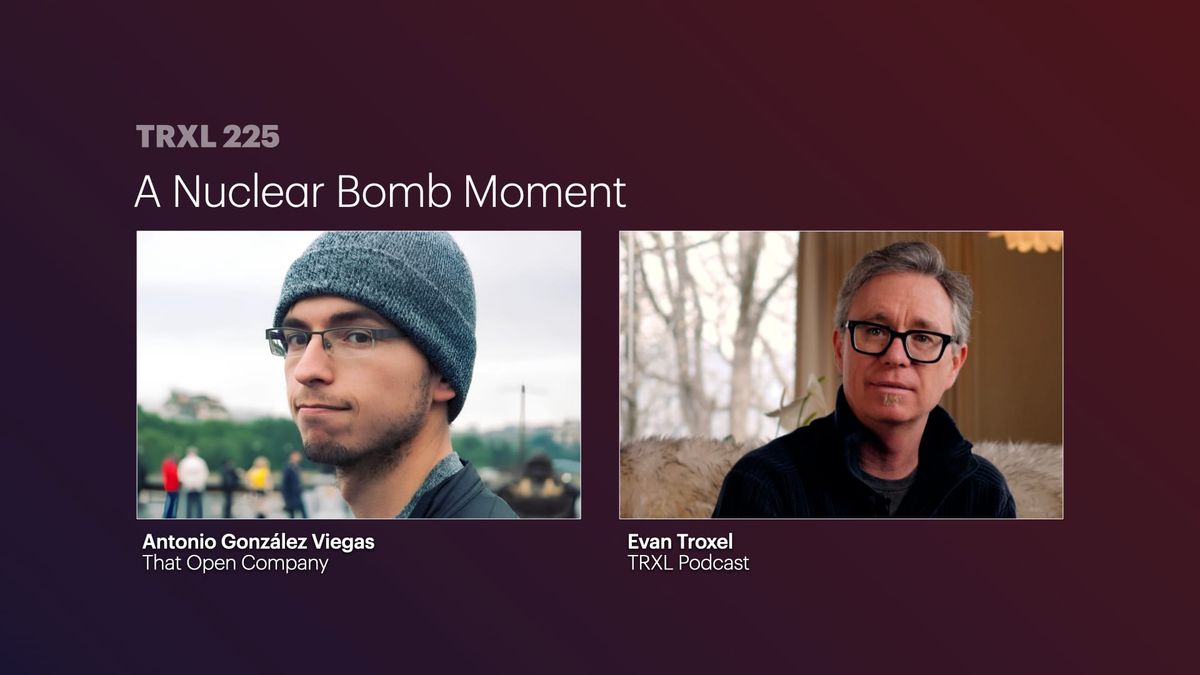
Antonio González Viegas joins the podcast to talk about the open source infrastructure layer he's building for BIM software and why the barriers that have protected legacy vendors for decades are collapsing faster than most people realize. We explore why every BIM company has been forced to reinvent the same foundational technology from scratch, how That Open Company is giving those pieces away under an MIT license, and what happens when AI compresses years of development into weeks. Antonio coined the phrase "nuclear bomb moment" to describe where BIM software development stands right now, and the conversation pushes hard on whether that framing holds up.
This episode is especially relevant for firm leaders, BIM managers, and design technologists watching the AEC software market shift beneath them. If you're weighing vendor lock-in against emerging alternatives, or wondering whether small teams with AI can actually compete with established platforms, this conversation will sharpen your thinking.
Original episode page: https://trxl.co/225

Watch This Episode on YouTube:
Episode Links
Some links on this page help fund our work, and we may earn a commission from purchases at no extra cost to you.
Connect with the Guest
- Antonio González Viegas
That Open Company
- That Open Company
- Website
- GitHub
- Documentation
- Why it's relevant: Antonio's company is the central subject of this episode — it builds free, MIT-licensed open source libraries that provide the foundational pieces any developer needs to create web-based BIM software, without starting from scratch.
Open Source BIM Tools & Libraries
- IFC.js (now That Open Engine)
- GitHub – IFCjs
- Why it's relevant: IFC.js was Antonio's original hobby project — a web-based 3D IFC viewer he started in 2020 to learn to code — which grew into the foundation for That Open Company and its current engine.
- Fragments (That Open Company's open BIM format)
- Documentation
- GitHub – engine_fragment
- Why it's relevant: Antonio describes Fragments as That Open Company's own open source binary format for BIM models, capable of loading a 2 GB IFC file as an 80 MB fragment in seconds, directly in a browser — one of the key technical milestones he discusses in the episode.
- Three.js
- Website
- Why it's relevant: Antonio cites Three.js as the open source JavaScript 3D graphics engine underlying That Open Company's tools, and notes that major AEC platforms including Autodesk ACC and the Trimble viewer likely use it as well — illustrating exactly the kind of shared open infrastructure he advocates for.
- IFC (Industry Foundation Classes)
- buildingSMART – IFC Standard
- Wikipedia – Industry Foundation Classes
- Why it's relevant: IFC is the open standard at the heart of Antonio's work — he built IFC.js on top of it, and the episode covers why open, vendor-neutral formats are essential to a healthier BIM software market.
Web Platform Technology
- WebGPU
- Wikipedia – WebGPU
- MDN Web Docs – WebGPU API
- Why it's relevant: Antonio points to WebGPU as the reason serious BIM software in the browser is now possible, describing it as orders of magnitude more powerful than WebGL and already capable of Unreal-like graphics in real time on a phone.
People Referenced
- Scott Adams (creator of Dilbert)
- Wikipedia – Scott Adams
- Why it's relevant: Antonio references the "skill stack" idea from Adams — the argument that combining two or three competencies is often more valuable than being world-class at just one — to explain how his unusual combination of architecture training and self-taught coding gave him an edge.
- David Heinemeier Hansson (DHH)
- Personal Site
- 37signals
- Why it's relevant: Antonio cites DHH's philosophy on sharing polarizing opinions as the model for how he approaches his own LinkedIn presence — only say something if a meaningful percentage of people will push back on it, otherwise it's just noise.
Books Referenced
- How to Fail at Almost Everything and Still Win Big — Scott Adams
- Amazon
- Why it's relevant: Antonio references this book's core idea — that combining multiple skills creates outsized advantage — as the accidental strategy behind his own career path from architect to BIM software developer.
Key Concepts
- MIT License
- Wikipedia – MIT License
- Open Source Initiative
- Why it's relevant: That Open Company releases all its code under the MIT License — the most permissive mainstream open source license — meaning any company can build commercial products on top of it with no obligation to ask, credit, or share back.
- Open BIM / Interoperability
- buildingSMART International
- Why it's relevant: The case for open interoperability standards is the philosophical backbone of Antonio's work — the episode covers how vendor lock-in drives up costs and limits competition, and how open infrastructure could change that.
- Sunk Cost Fallacy
- Wikipedia – Sunk cost
- Why it's relevant: Antonio references this concept when asking whether established BIM software vendors will be willing to abandon proprietary geometry engines once That Open Company's free equivalents become available — or whether they'll keep investing in them out of institutional momentum.
- Vibe Coding
- Wikipedia – Vibe coding
- Why it's relevant: Antonio and Evan discuss "vibe coding" — AI-assisted programming where someone with little technical background can generate working code by describing intent — as a contrast to Antonio's more directed, expert-led approach to using Claude for serious engineering work.
About Antonio González Viegas:
Antonio González Viegas is a BIM software developer and former architect. After joining CYPE, daily breakfasts with engineers shifted Antonio’s perspective and sparked a deep dive into software development.
To learn to code, Antonio started IFC.js—an open 3D IFC viewer—which quickly attracted a community and grew into a larger effort. Antonio went on to found That Open Company to build full time.
At That Open Company, Antonio and the team build free, open-source BIM software so others don’t have to solve the same problems from scratch. Antonio believes the major vendors have accumulated decades of proprietary advantage by building and acquiring isolated stacks, and that new players often lose not because their ideas are worse, but because they’re forced to start from zero. Antonio’s goal is to make that foundational technology available in the open so anyone can compete on ideas rather than legacy—and to keep building until the barrier is gone.