

222: 'You're Automating the Wrong Thing', with Mirco Bianchini

A conversation with Mirco Bianchini about AI automation in the AEC industry, focusing on operational efficiencies, the importance of knowledge management, and how to move beyond individual automation to firm-wide tools for better data utilization and collaboration.
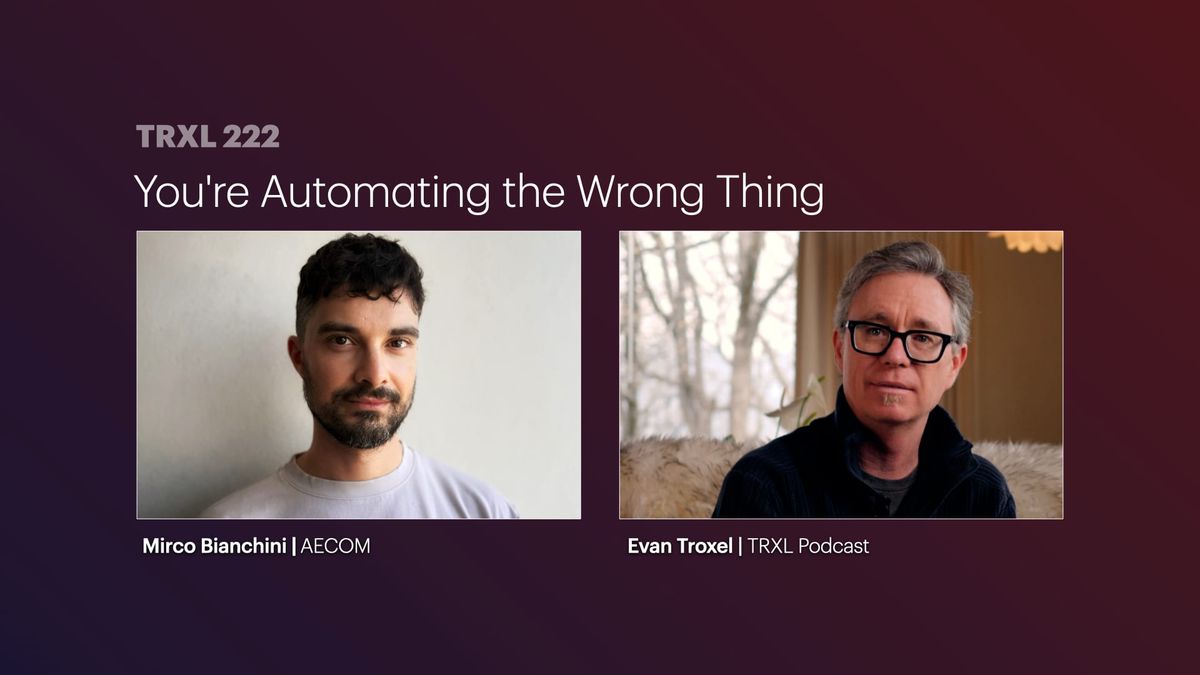
222: 'You're Automating the Wrong Thing', with Mirco Bianchini

Mirco Bianchini joins the podcast to talk about where AI automation is actually headed in AEC and why the industry is likely focused on the wrong problems. We explore the gap between Grasshopper prototyping and real product deployment, why LLMs are about to democratize computation far beyond the specialist niche, and how MCPs could finally connect a construction industry that has always been fragmented by tool silos.

This episode is especially relevant for BIM managers, computational designers, and design technologists who are experimenting with AI tools but unsure how to move from individual automation to something the whole firm can use. Mirco argues the real opportunity isn't in generating models but actually in the unglamorous operational work: capturing knowledge across projects, reducing email overhead, and building the organizational second brain that firms have always needed.

Original episode page: https://trxl.co/222


Icons of podcast platforms where you can find TRXL
Listen wherever you get your podcasts.

Watch This Episode on YouTube:


Some links on this page help fund our work, and we may earn a commission from purchases at no extra cost to you.

Connect with Mirco Bianchini


TRXL on YouTube


AI Tools and Platforms

  • Claude Code
    • claude.com/product/claude-code
    • Anthropic's agentic coding environment. Central to this episode — Mirco explains how it opens automation possibilities for AEC practitioners, even those without a development background.
  • Claude Desktop
    • claude.com/download
    • The desktop app for Claude, which Mirco recommends as the more approachable entry point before moving to the command line interface.
  • ChatGPT Enterprise (OpenAI)
    • openai.com/chatgpt/enterprise
    • Evan references Turner Construction's rollout of ChatGPT Enterprise to 15,000 employees — a real-world example of firm-wide AI access enabling individuals to build their own small automations.
  • OpenAI Codex
    • github.com/openai/codex
    • OpenAI's CLI-based coding agent, mentioned alongside Claude Code as one of the emerging platforms for hosting and running skills and agents.
  • Gemini CLI (Google)
    • github.com/google-gemini/gemini-cli
    • Google's command-line AI tool, mentioned as another platform where skills can be deployed — part of the broader trend toward standardizing how agents are packaged and distributed.
  • Notion
    • notion.com
    • Evan uses Notion as his example of an MCP integration — connecting his podcast workspace directly to Claude for natural-language queries across episodes and projects.
  • GitHub
    • github.com
    • Where skills and agents can be published and shared. Mirco discusses the emerging ecosystem of installable skills on GitHub as an analog to Grasshopper plugins.

Model Context Protocol (MCP)

  • Model Context Protocol — Official Docs
    • modelcontextprotocol.io
    • The open standard introduced by Anthropic that allows AI models to connect to external data sources and tools. Mirco explains MCP as a practical wrapper around APIs — lowering the barrier for AEC practitioners to query models, databases, and workflows without writing custom integrations.
  • Anthropic's MCP Announcement

Agentic AI Concepts and Resources

  • Compound Engineering (Every.to)
  • OpenClaw
    • OpenClaw website
    • The open-source multi-agent framework Evan and Mirco refer to — a project that went through several name changes before stabilizing. Sparked industry conversation about what practical multi-agent systems can look like.

Parametric and Computational Design Tools

  • Grasshopper
    • grasshopper3d.com
    • The algorithmic modeling environment for Rhino, and where Mirco's AEC technology journey began. Now built directly into Rhino 7 and later.
  • David Rutten — Creator of Grasshopper
    • LinkedIn
    • Lead Grasshopper development at McNeel & Associates. Evan and Mirco give him credit for building the platform that sparked computational design adoption across the industry.
  • McNeel & Associates (Rhino)
    • rhino3d.com
    • Developer of Rhinoceros 3D and Grasshopper. Widely used for computational and complex-geometry design in architecture and engineering.
  • Dynamo
    • dynamobim.org
    • Open-source visual programming environment, primarily for Revit, mentioned alongside Grasshopper as part of the computational design landscape that LLMs are beginning to supplement.
  • Finch3D
    • finch3d.com
    • Generative design tool for early-stage architecture that grew from Grasshopper roots into a standalone product — Evan's example of what computational tools can become when built for scale.
  • Giraffe
    • giraffe.build
    • Urban planning and real estate design tool with Grasshopper lineage, cited as another example of the AEC tool ecosystem that emerged from parametric design.

Firms and Organizations

  • AR-MA (Sydney)
    • ar-ma.net
    • Sydney-based computational design and digital fabrication practice where Mirco worked early in his career, focused on full automation of the fabrication delivery pipeline.
  • Mott MacDonald
    • mottmac.com
    • Global engineering and development consultancy where Mirco led a computational design team, working to scale parametric solutions into reusable internal products.
  • Turner Construction
    • turnerconstruction.com
    • One of the largest general contractors in the US. Evan references Turner's ChatGPT Enterprise rollout as a case study in firm-wide AI access unlocking individual-level automation.
  • Thornton Tomasetti CORE Studio
    • thorntontomasetti.com/core-studio
    • The computational R&D arm of structural engineering firm Thornton Tomasetti, and the organizer of the AEC Tech Conference referenced in this episode.

Events

  • AEC Tech Conference
    • aectech.us
    • Annual AEC technology conference organized by Thornton Tomasetti CORE Studio, held in New York City. Evan references a session from the conference involving Turner Construction's AI rollout.

Episode Sponsors:

AVAIL

AVAIL's content management system (CMS) simplifies access to your firm's content in one easy-to-use platform. Search and access files from anywhere, create standards-compliant models, streamline documentation, and onboard new hires faster. Try AVAIL for free and request a demo at https://getavail.com

Confluence

Join AEC industry technology leaders at Confluence, a series of in-person events and a podcast fostering conversations between firms and tech companies to support innovation. Learn more, explore upcoming events, and listen to podcast episodes at https://confluence.getavail.com

TRXL+Membership


About Mirco Bianchini:

Mirco Bianchini is a Digital Product Manager at AECOM Australia, where he leads technology development for the global Computational Design team. An architect by training, he's spent nearly 20 years moving progressively deeper into the technology side of AEC — from early Grasshopper work and digital fabrication to applied AI, backend development, and product strategy at some of the largest engineering firms in the world. His focus is on the gap between prototyping and production: building tools that actually get adopted, embedded, and scaled across organizations.
Connect with Evan


Episode Transcript:

222: 'You're Automating the Wrong Thing', with Mirco Bianchini

Evan Troxel: Welcome to the TRXL Podcast. I'm Evan Troxel, and a little bit of housekeeping before we get into today's episode. The TRXL YouTube channel has been a mess for the last couple years, ever since Google changed the way that they do podcasts. So it used to be Google podcast. Since then, it's all moved over to YouTube and I unwittingly played along and added my RSS feed of the podcast to my main channel, and that's when things pretty much became unhinged. And the reason I bring this up is because if you've been getting the podcast version of this show from my main YouTube channel, that audio is no longer there. I've moved it to a new audio only channel. You can still get the video version of the show on my main channel.

Anyways, there are links in the show notes to both channels, and I could really use your help building TRXLs YouTube presence by going there and subscribing. It's totally free and it's a great way to help get the show exposed to more people in our industry.

Okay, in this episode, I welcome Mirco Bianchini. Mirco is an Italian architect who relocated to Sydney about a decade ago and has spent the years since going progressively deeper into the technology side of AEC. He was an early grasshopper adopter, one of the first wave, and that curiosity about automation.

Pulled him out of design and into fabrication, then into backend development and product management inside some of the largest engineering firms in the world. For the past 15 plus years, he's been working at the intersection of computation and construction, and lately his attention has landed squarely on what AI tools can actually do.

For the people who build things. In this episode, we talk about the pace of AI development and why AEC technologists are underestimating it. We get into LLMs democratizing computational design, model context protocol, MCPs, as a practical bridge between siloed data and everyday workflows. The intimidation of the command line interface and how to get past it and the concept of the second brain for firms sitting on mountains of unstructured project knowledge, they've never been able to use. What I found most valuable from this conversation is Mirco's argument about where the industry has its attention pointed. The AEC conversation around AI tends to focus on the glamorous outputs, Model generation, renders, automated deliverables.

Mirco keeps pointing at the operational layer underneath email threads reports institutional knowledge that walks out the door with experienced architects and engineers, fragmented project data that never talks to itself. That's where he sees the real untapped opportunity, and he's also sharp about what actually separates firms from one another over the long run. It's data, the quality of it, the depth of it, how you've used it to make decisions and serve clients.

As usual, there's an extensive amount of additional information and links in the show notes. So be sure to check that out. You can find it directly in the podcast app if you're a paid supporter of TRXL+. And if you're a free member, you can find them over at the website, which is TRXL.co. So without further ado, I bring you my conversation with Mirco Bianchini.

Mirco, welcome to the podcast.

Mirco Bianchini: thanks Evan. a pleasure to be here.

Evan Troxel: before we jump into your story, your, your journey in AEC, like. The last time we talked, we talked, uh, what, like a month ago?

Mirco Bianchini: I think it was before Christmas time.

Evan Troxel: That's right. Okay. Okay. So nothing's happened since then, right? It's all, I'm just thinking like we were talking about Claude Code since then. Like even, even today, new models out today, right? Uh, that makes things cheaper to use. And you, you were pretty excited about Claude Code and you're like, oh my gosh, you know, MCP's and, and this and that.

And I, I think there's a, some things that, that the AEC profession is kind of, you know, technologists in the AEC profession are, are, are sleeping on, right? Like, it's not, they're not really aware of the, the potential here. Um, I'm just thinking of like what's happened since, you know, in the last two months it's been absolutely kind of, kind of incredible, like the pace at which things change, which I think, you know, a lot of our conversation today could just be about. Just kind of trying to stay current so that when the new things come out, like you're ready to look at the new things because the longer you wait, it's moving so fast that you're, you're, you're gonna have a lot to catch up on if you just continue to kind of stand on the sidelines and watch. I would just love to hear your comments on that.

And then, then let's get into your story.

Mirco Bianchini: Yeah. Um. uh, on the technical side, I think stuff they are going very fast. You also, I dunno if you follow the story of the multi agent, uh, Mo Mo Molo, uh, how you call it, they changed the name four

Evan Troxel: Open Claw now

Mirco Bianchini: open Claw.

Evan Troxel: new name? Yeah. Right.

Mirco Bianchini: name, uh, that has, you know, he, he, uh, now he is start to work for OpenAI, but yeah, you have every day something new every day.

A a a new model

Evan Troxel: from multiple companies at the same time, like within 20 minutes of each other. New models coming out. Claude launched Cowork since we talked. Right? Which is a

Mirco Bianchini: that is an interesting, uh, an interesting thing, I, I, I was looking to test it in particularly to see if he's able to. work on software, I mean, to man, um, uh, you know, clicking on, uh, on uh, on, on software that we have in, um, on, on our laptop. And so try to automate some of the tools that are not automateable, you know, that

like that the one that you are not able to, uh, use an API or they don't have an SDK, that you can automate the, the, the famous legacy programs that we have in this industry that, uh, are still very used across many, many department.

And, uh, and, um, that is something that I was really thinking to try and very curious to do, to, to look at the, the possibility that is another branch of where AI can help literally automate all that aspect of, uh, legacy softwares.

Evan Troxel: It's really cool to see. I mean, I don't think I've had this much fun playing with, with technology in a long time. Where, where, you're right, it's like now, now because you can control things on your computer with it through natural language. I think, uh, like wow. We're, we're starting to see some really interesting things for kind of, kind of normal people to use.

Right. Like it, it's a new interface for interfaces that we've been using for maybe decades. Right. Which is kind of interesting.

Mirco Bianchini: Yeah. And on the other side, uh, as you, as you were saying, Claude Code keep, keep adding, keep adding new, new things. Uh, I think the, there are massive opportunity there. I, you know, the other industry seems they go faster, uh, has opposite of ours, but that is, you know, our industry, how it works. but I think, you know, the, there is.

Big opportunity. I mean, the opportunity is literally try and, and, and it should, it shouldn't be related potentially of what we do. I think we, we have now the opportunity to learn more on try these tool on stuff that are not related exactly of our work. Uh, always, you know, uh, uh, try with things that, uh, we, we need every day.

Most of the people they just chatting but then try to do something more. And, uh, I guess, uh, Claude Code have, give this environment that allows you to, to try multiple things. And then, you know, as you were mentioned, MCP skills that they can open even more. The possibility that we can look for.

Evan Troxel: well, we'll talk, we'll get into that. We'll get into the name Claude Code and how it's kind of, uh, not a good name for maybe everything that it can do. Right. Um, but, I wanna learn more about you. So Mirco, maybe you can give us an introduction more to yourself and kind of your journey in AEC.

Mirco Bianchini: Yeah. So, uh, I study as an architect as many of our, I'm a p people that come in, in, in a, in a strange journey at some point. But, uh, yeah, I study as a, a, a, an architecture and, and then I start to work, uh, for, um, a very big firm in, in Italy for a, a, a couple of, uh, years. And, uh, and during that period I also start to discover computational design.

And I was very keen to try to, uh, understand on how to automate aspect of the design, uh, part of, uh, of, of the projects. Uh, and so I, I, I, I was lucky to have a, um. A person introduced me in a, in a, in a, in grass opera, show me what it was, grass opera. And then I start to build up on there, you know, have, uh, make course, try to understand how to use it, how to expand it.

Um, but uh, at some point I realized that yeah. It's fun, the design aspect and also the communication aspect of, uh, of the project. But I was seeing a lot of potential to take that, uh, learning at the end of the chain. So on the, on the fabrication aspect. And, um, and so, uh, I start to look around and, uh, I find, um, uh, a very interesting firm, uh, in Sydney, the, that the name is Arm.

And so I moved here, I moved in Sydney, where I'm, uh, still, uh, living after 10 years, uh, I start to work for Arm. And, uh, the, the, the, the core of the business was literally de de delivering, um, uh, automation in, in, in, in the fabrication stage. So we were, you know, uh, taking all the information from the, the builders, the architect, and make the fabrication drawings for, uh, the, the, the final consultant.

Uh, but through a very detailed model that we manage with fully automation also in the delivery part. And then along that journey, we were having the opportunity to work with, um, big partners. And that is where I start to, uh, dip my hands in, uh, coding even more backend coding, learning about, uh, about, uh, you know, product manager, uh, working in Agile way with, uh, uh, different team, different skills, different uh, different knowledges.

And, um, and from there I saw another opportunity. I say, okay, I see architect. They, they tend to try more of these things. I think the market is a little bit shorter, I would say, in, in that side. So I look at more on, um, on the engineer, uh, aspect, uh, on the engineer side of the, all the supply chain. And so I, I moved to MOS Mod McDonald, uh, where, uh, I, I was, uh, leading, uh, a team of the competition and designers and, you know, we were trying to do what.

Everyone tried to do, go on project and try to, uh, automate aspect, extract that information, make more repeatable, make more reusable for other project, and eventually scale some of these solution to, uh, a product that can be reused. Uh, uh, uh, across, um, all the, all the business we were releasing, uh, uh, uh, internal libraries, you know, the, the, the, the usual thing that we try to do has computational and developers inside these, um, uh, inside this industry.

And then from there, I, I moved to ACOM, where I'm currently leading a, uh, data science and, and developer team. Uh, has, uh, digital comp, uh, digital, uh, product manager. So again, looking to extrapolate, uh, repeatable opportunity in product that can be reused. So in, in, in the, in the real sense of product development, try to.

Create a product that can be used internally as much as possible.

Evan Troxel: So when you originally made that kind of, well, it, it was, it was, it's been a journey, right? So you started in Grasshopper, and then you went deeper and deeper and deeper down the rabbit hole of, of technology, coding, development, product, stuff like that. Give, gimme an idea of the timeframe that, that you've done that for.

Mirco Bianchini: Uh, more than 15 years. I'm close to 20

Evan Troxel: All right. So,

Mirco Bianchini: started very early in the process of grass opera. Uh, it was literally, I started after it came out, uh, a year, two year after that came out. Yeah.

Evan Troxel: and I mean, grasshoppers obviously still very much about geometry, right? So, um, it sounds like the things that you wanted to do were lower level than that. Like you're actually getting into coding applications that do specific things and, and I mean, that's probably a lot more powerful than what you can do with scripting and Grasshopper.

Right? So, I mean, obviously there's, there's code nodes, like you could do Python nodes and things like that in Grasshopper, but it sounds like you wanted to, to do stuff that was maybe more powerful than that. I don't know how you would describe it,

Mirco Bianchini: Um, uh, I I, I think the, the point is on the scalability of the, of the solution. So, um, I, I, I see Grasshopper a, a great tool for, uh, um, uh, do quick solution, uh, uh, prototype, quick solution. Yes, they can have, you know, the UI interface, but are very difficult to maintain in a sort of sense. If you, if you think about the versioning is very complicated.

There are solution. We, we saw some solution that can help to identify where there are the changes, but it's no, it's no code. Okay. I mean, is code, but in another level. And so, uh, that aspect of the versioning is very complicated. The aspect of, you know, also, uh, releasing and adopting and using the solution has a sort of complication in, in, in itself because you need to be in Revit and use Opper.

So at least you need to, uh, teach the final user to open Rhino,

Evan Troxel: There's a lot of

Mirco Bianchini: Revit, open Rhino. Yeah. Open Rhino and Open, you know, grasshopper run the application. And if something happen, yeah, you can, you can have messages, you can try to explain what's happened. The easy part, of course, is that you already in the application, you can jump and fix it, but you have to know how to do it.

And, you know, there are multiple levels that I, I, I is not a fully product that you can. Control and maintain. Yes, you can add things, but they tend to become more a sort of frankest kind of elements that is very complicated to to, to maintain.

Evan Troxel: Yeah. Like you said, it's great to prototype and it's, it's great to tinker with, right? It's great to have one, like the ability to get under the hood and, and like rewire something or, or try different ideas out and things like that. But when you need to deploy it to a larger organization, it starts to get really complicated to keep those things up to date.

Who authored it? Who knows how this works? You can't, it's harder to audit, right? It's like all of those kinds of things.

Mirco Bianchini: But also also the, you know, tracking the, the usage again. Okay. You can have. Components that they can do it. But it seems always very, it seems always that you had extra layer of a sort of complexity, uh, is more plugging elements instead of trying to have a, a proper flow of, um, of, uh, a, a, an, a proper orchestration of a product with, you know, all the, uh, abstraction that you need, all the, uh, infrastructure and structure that you need.

And also, you know, the, the, the working for big enterprise, you have the aspect of, uh, uh, releasing the, these, these tools in, um, in a, in a compliance way. They have to be secure. And so that is a complexity that is very difficult to maintain in a, in software definition or dyna definition. But for prototyping and for quick iteration, for quick testing, for extracting the knowledge is testing on project making robust that you have the solution.

You have, you know. What you need I think are amazing, amazing tools. The, the point now is what is going on with, you know, the advance of large language model. That is something that it will be interesting. Okay.

Evan Troxel: So we pay our respects to David Rutten and Grasshopper and the, the Rhino team. I mean, absolutely. Like you said, in incredible and, and huge respect. And it's also interesting to see what kind of tools have blossomed out of some, a place that started like, like Jesper, Walgreens, Finch, right? For example, I mean, one of the, it's a tool that started as a bunch of grasshopper scripts and now it's something.

Huge way beyond that, um, other tools like Giraffe have come out of, you know, people who were originally grasshopper tinkerers. Right. Um, it, it's absolutely incredible to see some of the stuff. So, okay. So let's talk about l lms. Let's talk about what's really exciting for you right now, because when you, when you originally, when we, when we connected first, it was like, wow, there, there's something here.

Um, with the potential with LLMs and with Claude Code, maybe more specifically. And, um, you have built several different tools that, you know, I, I know that are kind of AEC specific, but you said also things that are just everyday life kind of things as well, right? Just to solving problems using a tool like that.

And that's pretty interesting, right? To have access to a tool that on some level, um, operates with normal language commands and conversation almost, right? Like, uh, you're bouncing ideas back and forth and. It can basically span the gamut of highly professional things to everyday things. I think that's, that's pretty incredible.

So let, let's talk about what, what has been kind of your passion in the last few months, I guess, or maybe years that that is really getting you excited about where technology's going?

Mirco Bianchini: Uh, um, I mean that, that,

Evan Troxel: It's a big list.

Mirco Bianchini: that, that is a big list. But that, um, if, if we start from the aspect of large language model, I, I really like the possibility that they are going to open to. Uh, one democratize some aspect of automation, and that is, you know, get related a bit of, uh, on, uh, the, the Grasshopper and Dyna aspect, you know, the possibility of, uh, I, I, I, I think EE they make computation, make everyone computational designers.

So

computational design is not going to be any more related, I think, to a specific tools. Uh, has, it was the Beam has, he's the beam manager that is, you know, tendencies to say Beam Manager equal Revit or Computational Design Equal Grass Opera and Dynamo. Um, I think there is going to, there democratize more that aspect because then you, you can, everyone can literally with large language model, create little automation and help on what they need to do on the spot and create little auto little portfolio for themself that they can use, you know, uh, on, on the day to day.

Of course open other conversation that is. Uh, we should try to understand the, the, how, how these automation can be taken and, uh, move it to a, a, a, a level that have been reused by everyone. The one that are more, you know, consum that have more similarity. Yeah. It open all these conversation, but at the same time, there is the aspect that now you can really quickly create this automation that potentially is li is literally consume and destroy, consume and redo and, and, and so is, is literally a very fast create use and destroy or redo readjusted.

So it it, it changed, it changed the, that, that, that, that, that level of conversation. The other aspect that, uh, I, uh, I'm, I'm very interested is on, um, the opportunity on, um, uh, expand or make connection. Uh, uh, to a different level. When I say connection, I'm thinking more connecting, um, data between different teams.

Uh, so one of the aspect of, you know, the, of, of this industry is that there is a lot of fragmentation. Many teams work with different tools, different and different format. Having the possibility of agents in between that help on, uh, flow this data, uh, in the right way because they do the, that sort of, uh, translation for you or they extract only the part that you need.

Is, is something that, uh, I'm not saying it's, it's possible right now. I mean, it's possible, obviously has limitation because the technology is growing, but I, I, I, I see, uh, the value of investigating on that side.

Evan Troxel: Could you give kind of an example maybe of a potential kind of a connection that you're talking about? Just, just to help people visualize maybe an idea? It could be anything.

Mirco Bianchini: Yeah. So, one of the simplest thing that I, I, I think about is, you know, um, there is this concept of MCPs that is model content protocol that, uh, in a, in a very simple way, has been always described as sort of wrapper around APIs. APIs is this as, is this technology that these industries still, I think, scratches his hand in a sort of way.

They, they know the existence, but the, the usage is not, um, so diffused as it should be. Um, and, uh, and every time that we talk about API is very, you know, related to development, uh, you need someone maybe an it, someone with. Uh, development knowledge is to, to do something. And so that is something that is, is where the conversation start to, uh, slow down.

There is a problem of obviously of budget, everything that is related on that. So MCP is that create this wraparound, the API and then it can, uh, connect with, um, um, can be, is is a tool used by the larger language model open the possibility of using in a, in a, in plain English, some APIs and so directly, uh, interact with some information that you can extract.

So example, you rapid a a an API for extracting data from models. And, and so very, very, in a simple way you can just ask, okay, go to this model, extract these, these data or, or specific, uh, metadata that you have in the model and, and. And, and now on the fly, because there are other cps or large language model is able to, um, to construct XML, uh, and, and visualize that data, you can also have, uh, visualization dashboard, uh, or uh, or uh, uh, app because now there is MCP app that takes the data and convert that data in a, in a, in an app on fly, uh, on the fly.

And so you have that interaction, um, on, on the information that you instruct. So, um, and once you identify, for example, part of that information, you can take it and push it using another MCP to someone else, or, or, or, or converted in, in a, in a format that you want to, to present. So there is this way of consuming, converting, pushing, and managing data that I think it, it would be very interesting, uh, to.

Uh, discover more to, uh, uh, uh, you know, going a little bit deeper on that.

Evan Troxel: Yeah, I mean for, for example, like so, so because of your initial kind of. Catalyzing conversation with me. It pushed me to install Claude Code, install a notion, MCP. So I, my whole life is inside of Notion. All of my show stuff for the TRXL podcast is inside of Notion, ev, everything, everything's inside of Notion.

And so now, because I installed the Notion MCP, I can, of course I could use AI in Notion, but if I wanted to connect it, say to Slack or some other tool and talk to it, so, so now it's, it's pretty interesting because I can actually. Take a look at some what's inside of a project in Notion, and I can talk to it in Slack, for example, because of the connection that I've made.

And I can just say like, Hey, find me the episodes where I talked about large language models, for example, and it'll pull up a list and then I can have a conversation with it about, about these kinds of things. And, and I built that not by knowing how to code, not by building an app, but just through conversation.

It's like, well, just show me this. Oh, well then, okay, if you can show me that, then it starts to get your gears turning. Like, oh, what? What can I do with this? And then you can start to kind of dig and dig and dig. And I think what's so interesting is. You can tell it to do something like a command, but you can also ask it to show you how to do something.

It can also teach you how to do it so you don't have to go out to the internet and dig through forums and dig through podcasts or dig through Reddit boards or anything like that. And, and very trial and error, right? You can just say, Hey, do this. And I think what's then super interesting, it's like, okay, go ahead and do that, and it will try to do it.

And if it can do it, great. And if it can't, it'll look for another way to do it. It'll say, oh, that didn't work. I'm gonna try, I'm gonna come up with a new strategy and I'm gonna do that. And I think it's really fun to watch. You can actually watch it think because it's telling you as it goes along what it's doing, what it's trying, what's working, what's not working.

You would've gone through all of those same steps yourself, but it's doing it very quickly and, and I find that it's, it's just. Kind of freeing to feel like, oh, I, I'm helping orchestrate. It's a collaborator in that sense. Like it's, it's doing things on your behalf. It can go out and do research, it can come back, it can show you the results.

You can, it can give you some questions. You can make a decision. It's like, do you want to do this, this, or this? Oh, I want to do this. Okay. Or you could say, no, I wanna do a combination of these two things. I think that's what's so interesting about it is kind of the collaborative nature of using tools like these.

Mirco Bianchini: Yeah, no, absolutely. And, and also, um, on doing that, you, you discover what you need. And so that is the moment where you start to think about, you know, creating your custom agent, creating your skill specific to do something. Uh, maybe, you know, you have a specific template and so you create the skills that, that, uh, follow the template that you want or, or you create an agent that orchestrates multiple skills and commands to do all, all the workflow that you want for.

And a specific task that you identify. Um, so, um, in, um, based on this point, um, I'm, um, there is, uh, this idea of, uh, compound engineering that has been shared through, uh, um, a team that is called every, and then DZDA is also transitioning inside, um, CLO code teams. And, uh, and, and, and that way of developing is literally based on multiple agent calling skills, calling commands, and doing, uh, and what you have to do is just following the steps that you are, you, you, you, you, you already, you, you were already doing in the past, but obviously manually thinking through it, but, but

Evan Troxel: Yeah, very linearly, right? You did this step and then this step and this step, and now you can just say, do those steps and, and you can basically say, okay, I wanna do all these steps, but I want to call. It's a skill. That skill gets a name, whatever that command is, and then, and then it just does it, right?

It does all those things in that order exactly as you have done it in the past, except now it's all in one command. It's like a button. It's like you made a button.

Mirco Bianchini: But, and, and going through that process is very interesting because you know that you have the brainstorming process, so you brainstorming your idea, then you have these, you know, MD file, markdown file, or whatever file you want. You read it through it. You try to understand you, maybe you tweak it or you iterate, and then you go in the plain mode where you, you know, you try to have the full plan of what you need to do.

And then you go in the, in the, the, the work stage where you do, you know, the, the of, of, of course the agent is going to do the, the, the work. Um, I, I think the only part that at the moment I, I hear about, and also I am experienced, is that there is a. At the moment, your brain is not capable to, to control multiple, you know, workflow that they goes, uh, in parallel because you can literally work on multiple workflow in parallel.

Uh, and plus there is a lot of reading, uh, before to, you know, commit on, on, on an operation if you want to be sure or otherwise has, there are other, um, other flow of thinking is that, no, I don't check anything. I don't want to know what what there is the code behind. Go

ahead.

Evan Troxel: go, go, go.

Mirco Bianchini: exactly. If it works, it works.

Uh, but on the connection that you were, uh, explained before, that is another topic that I really like because it is, uh, the creation of your second brain. The possibility of, you know, start to collect all your thought or your listening on podcast or, um, paper that you read, books, whatever you collect in one place and then you create.

Um, uh, your helper, your agent that help you to search, to think about it, to, to connect points, dot patterns, and, uh, and that is, that is very interesting. And I guess he has an interest, interesting correlation with, uh, the, the construction industry as well, where we have a lot of emails, a lot of communication.

And so that is a topic where I would like to see more people discussing about it. I think the industry is just jumping on talking about how to automate the model, you know, the, all this, the, the, the usual stuff that is the, out the outcome that we know, sorry, the output that, that we know that is model, uh, reports, uh, images and, you know, the industry jump on that, that yes is the cool part, but I'm, I like to, I, I like to solve the boring things and uh, and uh, I think there is.

A, a massive things to do it over day, you know, managing email, how you can address all the big volume of email or the possibility to go and, and collect all the emails on specific, on a specific topic and, and try to extract what's happened, uh, um, on the past. And then start to create, you know, uh, knowledge is on that because we, we have the opportunity to retain knowledges from the project.

Start to think about these stuff, create dedicated skills, f uh, from the knowledges that we have from engineers, that they work on that in that company for 10 years plus, you know, that most of these information are, are unfortunately lost and, uh, and not retained. And that then connect to your point, the possibility of learning from there.

So you start to create a, a, a library, a a, a, a bank of knowledge. Uh, of knowledge is that they can be consumed, you know, in, in a different way with a, an, an agent that goes and ask, and you can ask, has a enter, has a new, new, new person in the company understand things? I, I, I think all these aspect is, is, is, uh, is very interesting and is an, is a topic that it should be discussed a little bit more in, in, in the construction.

Evan Troxel: One of the things that's really interesting to me with this new, with the kind of the Claude Code, Claude Cowork model is that it sits on your local computer. It's not you. You could of course, chat with it through the web as as well, but I think the real secret sauce, if you wanna call it that, is, is that it's local.

And what's good about that is it's actually using local files and it's storing its information in text files, basically on your computer. Because I think a lot of the holdback is like, I don't wanna invest in a new tool because like we said earlier on in this conversation, things are changing so fast and so why, why invest into a tool?

um, there's gonna be a different, better tool in a month that I'm gonna have to completely migrate to and will I even get to bring my data along with me? And so kind of the idea of portability, of, of the information and, and that it is, these are the information is being stored in text files on your system that are portable.

They're yours. Right. And I think that's what's so interesting is that it's going through and it's, it can be updating, it can be keeping these, these thing, these instruction sets basically current. But they're in text files on your computer and it's very easy to just take those. And, and I've seen many examples now.

I mean, if you search YouTube, if you wanted to move from chat GPT to Claude code for example, and you wanted to bring your history with you, you actually can do that. And, and so I mean, is there anything that, that really insightful that you have kind of in that realm of things to just kind of ease people's minds to get into start playing with these things because they're not actually gonna be having to do it again all over from scratch in a new tool in a month because there is this aspect of portability to these kinds of tools now.

Mirco Bianchini: Yeah, the aspect of distribution of, of, of this tool is, uh, is great and uh, also. You know, Dio, the CEO, he was literally saying in a, in a podcast a couple of days ago that that is what they help them to enter in different market very easily. Because the fact that they are able to, um, install a, a solution that yeah, is, is, is very small, is very is and, and he doesn't have many things that you have to control, I would say in the surface because then, you know, in the moment that you start to, um, play a little bit more with the, all the agent, the structure and the things require the fact that you are learning all that aspect.

But yeah, the portability of creating your agent, and you can use it in Codex for example, or, or Gemini, CLI, they they are, they are, they're trying to standardize as much as possible that, that is another aspect that is, is very interesting to see how these evolve and they try to, uh, meet. In, in a, in a, in a standard that in meeting at one point altogether.

And you know, at the moment we have agents, MD and CLO Cloth md, but you can make them, uh, be the same thing, but at least agents and skills start to, and particularly skills, they has been already identified as a Stan Standard and they need to be defined in a specific way. Uh, and where they, they they sit and how they have been, they and, and how you describe it.

So, uh, that aspect also help. Um, I think what, uh, is scares people is that is a CLI and when you open

ACL I,

Evan Troxel: let's talk about that. because

Mirco Bianchini: yeah, you think it's

cold.

Evan Troxel: You, you, you think? Yeah. You think, uh, you think like, oh, this is like hacking computers, right? It's the, it's low. It's the very lowest level of like, you know, the Unix, the DOS operating system windows. Like you wanna open PowerShell, you wanna open terminal on the Mac, whatever it is.

And, and yeah, you just have this cursor and it's like a blank screen and it's kind of intimidating, right? Because like, what are the exact commands? Um, but, but I think what's so different about this is it's really forgiving versus like the traditional sense of command line interface. CLI. Is, it's not forgiving at all.

It's like if you type the wrong thing, you could nuke your whole computer. Right? And that was always the fear, right? And so, and now it's like you actually just say, Hey, I want to do this thing. And it's like, okay, here's what we need to do. It's not, it's not like, and it'll even ask you if you, if you type something in, are you sure you want to do that?

Right? It, it's, it gives you kind of, it's asking for permission and, and you get to say no if it's not what you wanted. And I think that that's what kind of takes away that in intimidation. But just the hurdle of opening the command line interface is so foreign to very visual people. Like, let's be honest, right?

Our industry is very visual people. We like ICON's, we like dragging wires between nodes. We like graphical interfaces, things like that. Um, it is, it is a kind of a foreign concept and that that is a hurdle that needs to be overcome. And, and I guess we can get to the point where they've now come out with cloud cowork where they've actually put it in a desktop app.

You can access Claude Code in a desktop app to kind of get over that hurdle. But, but there's still some interesting things that you can do in the CLI interface that you can't do there. So talk, talk about that, because I think as a developer you were more comfortable with that, but, but maybe you have some insight into how people can get over that or, or maybe some of the things they could try to do to get into that thing and just see what it's all about.

Mirco Bianchini: Uh, I would say, I, I think first you can, you know, you, you, you should start with, uh, cloud desktop is, is literally there. You know, It's a,

Evan Troxel: a better place because it's, because it's here. Start there.

Mirco Bianchini: yeah. Is there, you, you, it's. Is more approachable and you have everything you can play with agents, you can play with skills, you can, and, and also the visualization of the information is already, uh, is, is managed.

You know, the, the, the, how they are presented is there is already, uh, uh, a control on how the information, uh, tend to, uh, present in and describe. Plus the hazard was saying the introduction on some specific MCP. They also able to, uh, show you, uh, or connecting with viewer, uh, or, uh, or, uh, presenting, uh, graphs.

So, uh, you know that I think, uh, it helps plus, uh, cloud, um, clo, um, desktop has code and now coworker, so you can also do the same thing that you're doing the CLI in the desktop. So,

uh, and in one app, and, and you have. What they call it, a project that, um, in, uh, in, in the CLI is more that you, you, you collect everything in a specific folder and you work on that folder specifically.

So I would say start from there and start to, you know, investigate and then that is, is the most approachable and, and less scary, uh, you know, uh, um, entry point. The CLI, for me has the, the, the flexibility that I can, um, open multiple where I want on specific folders. Uh, um, uh, also, uh, what I found very, very interesting to try was, uh, write a code that it was then reviewed by another CLI, uh, and

Evan Troxel: So yeah, you can have, you can have one terminal window running code. You could have another one reviewing that code. You could have as many open at the same time as you want. You could maybe color code them so that you know which one's which. But, but yeah, that's, that's pretty cool because you can do a lot of things at the same time.

Then, and, and even further, your kind of potential at, at, you know, as far as like what you can get done at the same time.

Mirco Bianchini: Yeah. Uh, and you, you know, and I think it's also based on, um, uh, the final output that are you, are you looking, so, uh, you know, if it's more, let's say PowerPoint or, um, or, uh, or, or, um, you know, the, the, the, um,

Evan Troxel: like a Word

Mirco Bianchini: document or word doc, what exactly I

mean Yeah. Uh. The, the D desktop application can help you at least to visualize immediately what it could be a a, a, the result have in India, and then it can generate it because, uh, clo um, tropic create all these skills to manage PDF PowerPoint, Excel.

Uh, they are pushing a lot to enter in the Excel, you know, to open the financial market, but potentially also for the construction industry

Evan Troxel: Yeah, yeah. Let's, let's just talk about that for a second. So, so for example, you could say, create me. So write a report based on this podcast episode that, you know, outlines the conversation that we had. And then you could say, okay, now that you have this report, you know, and maybe you ask it to refine a few things here and there.

Then you can say, okay, now build me a 10 slide, um, PowerPoint deck that puts visuals to this, uh, conversation and. Then you can actually see it right there. You don't have to open it in PowerPoint. You can actually see it right there in the clawed application on your desktop, so you can see what it's building.

You can interact with it. You could say, change the colors, you know, use my brand, whatever. You know, my, my brand guidelines, if you have color schemes and things that you wanna work with, but you can actually, you just see it right there. You don't, which is again, kind of the benefit of the desktop interface versus the command line interface, right?

Mirco Bianchini: On, on, on that point. If you are, I mean. Uh, you are able to see some aspect. I don't know if you are able to open fully the, the PowerPoint, uh, um, but at least you have some, some ideas or what is going to do, uh, or eventually if the, if you want images, you know, you can, again, connecting to another, another services that create the images, you see the images that can be used.

So, uh, you, you, you have, I would say, a better understanding of what is going on. Plus it's very easy to interact with the chain of thought that is going through it because you are there. You can just open it, see what is thinking, um, that is possible in the CLI as well. But again, it, it is, it, it feels a little bit more geeky.

Of course, you know, you need to, you, you need to press control or, uh, to, to see it and then come back, you know, I different things. Um, uh, but, uh, they, yeah. So, uh. I, I would say that that is the entry point to, to, to, to initially try. And what I, I, I see from, uh, for me, the interesting part is that other industry, they really start to use it for everything.

And, and I would like to feel the same in, in, in the, in, in the construction industry, that they start to use it for everything. Uh, that is not creating a model. I don't know what I, I have to say, but you know, that that is not ex the, the purpose is not

Evan Troxel: Hmm

Mirco Bianchini: immediate output of what is a, a, a usual delivery.

Uh, but everything that is before that,

Evan Troxel: Work. Yeah. Like the process that leads up to that. Right.

Mirco Bianchini: Yeah. All, all the, all, all the operational aspect that can be. Uh, that can be related on working with, uh, with an agent, you know, uh, creating reports, uh, um, reviewing reports, create, uh, um, uh, um, learning from, from absorbing skills from previous project that can be used.

Extracting data, passing data and communication, helping you to manage communication, uh, uh, recording as much as possible. So you create that work brain. You know,

where you start to

see this. Yeah. The second where you start to talk, where you start to see patterns in your day-to-day and start to say, oh, okay, maybe, maybe there is possibility to doing better this part on this automation.

I know, I know. May, um, it can be a little bit naive obviously, because there is also the aspect of, um, security and is, is not an easy integration that you can do it immediately, you know, in, in the, in the construction industry that there is also this fear of IP and data that they can leak at outside. Uh, but, uh, the, the only way is to try.

So more we are able to create or working in sandboxes or, um, uh, you know, environment that are protect and make people to use it, uh, is, um, is, uh, is the best way to go.

Evan Troxel: One of the topics that came up at the AEC Tech Conference in New York City that was put on by Thornton Thomasetti Core Studio was with Turner Construction. Turner Construction, um, released. Gave their entire staff, I think it's like 15,000 people access to chat, GPT enterprise level, right? And one of the things that came out of that was that people were writing little programs to do things for themselves.

So, so automations, skills, how, whatever you want to call them. So this is not just like an episode all about Claude Code, right? Like the, there, there's diff, there's plenty of tools out there that can do things like this. You can get 'em from Google, you can get 'em from open ai, you can get 'em from Anthropic and, and I'm sure many others, but it, but it was like, oh, there's people in accounting, writing little programs to do things for them that, that help them be more productive.

That they would've never known who to go to, to ask to do it. They would've never got on somebody's schedule to build that thing, right? Because every developer is, they're already overloaded with projects to do. Right? And, and, and. their current workload. And so it kind of gives that agency back to people just to solve their own problems in, in pretty approachable ways that, that we've never had the ability to do before.

And I think that, that, it's just kind of an, an an example of, you know, it's not like you have to solve giant problems, right? And you're saying like, let's focus on the low hanging fruit. Let's focus on the stuff that leads up to design. Let's focus on pulling insights out of the program for the building.

Let's talk about the financial aspect. Let's talk about, you know, getting buy-in and getting all the stakeholders on board. And maybe there's ways that we can use these tools to kind of, you know, look across all of our email and all of the planning documents and, and really help keep us on track. There's things like that that we can use these tools for, and we can look for little things that we do all the time that take a lot of time out of our day and keep us from focusing on Probably problems that we'd rather be doing anyway, like the more challenging stuff, the bigger stuff, that off of our plates and put it into a little app that, you know, there's no way I would've got a developer to build my little time tracking app or whatever it is that I needed to do for, you know, a day-to-day basis.

And, and it just gave people agency to be able to do that.

Mirco Bianchini: Yeah, and I, I think your point touches two things that, um, uh, they need to be discussed at some point. One is on give agency and a, a sort of empowerment of everyone to create their little automation. Then of course, potentially from there, something can build it up in a more, uh, I mean, scale it a level of, uh, tools, uh, and the possibility of developing that tools with, uh, um, a AI coding tools need to put the, the perception that potentially.

The development is going to rapidly increase inside the company. And, uh, and so, so that is also something that I will very interesting to see how they respond and react the startup on that side. Because in the moment that you have, uh, enterprises, offices that they are able to create the tools that they need, you know, you, you, you, you start not to look in outside for the, for, uh, for the solution.

And, and in particularly when the solution need to, you know, accommodate many, many stakeholders, you know, accommodate many, many users. And most of the time, every, every offices has they own, own to do things. So they want that application, but with a slight twist, uh, that application, but without, I dunno, 60% of, uh, all, all, all the rest that they have because they don't need it.

So in the. That, that, that is a very interesting moment where, you know, you, you start to have, uh, these offices start to shift it and make realize that they can't build internally this solution. That is one point. The, the other point is, and is very interesting that, that that company, uh, allow everyone to work on open ai because I believe, I, I mean, I would like to see more partnership with Open AI or Tropic from the construction side.

Maybe they are happening, but they're not, you know, they're not, uh, visible or uh, uh, shared. Um, uh, across, uh, what at the moment is happening is more that these two giants are partnering with other industry. And so they are going very vertical in this, in this industry where they don't have the skills, but what they, they provide is the platform.

And so. That, that is the advantage. If you partner with these guys, you have the platform, you have all or most of the building blocks to create automation, to create custom agents that your, uh, employees can use it. And then on top of that, you can create more little building blocks and knowledges that are useful for your company.

Uh, so I think, you know, also that, uh, start, start to thinking on, on platform side, create that level of knowledges, create that level of building blocks to allow you to then develop a, a series of commod, uh, commodities tools that we know at some point everyone is going to have it. That that is the thing.

Evan Troxel: You just reminded me of like everybody's, uh, stadium generator, right?

Mirco Bianchini: Yeah, exactly.

Evan Troxel: the, it was, it was totally ip, totally. Like this is our thing and everybody has built one, right? So it's, it's not actually, uh, ip it's like everybody's got the same, this, they ended up, you know, taking all the time it takes to learn how to do that and then to build it and to deploy it when somebody's already built that tool, right?

Like that there's something wrong with that situation.

Mirco Bianchini: Yeah, yeah. No, the, the, so I, I, I'm looking to these two aspects very, uh, in a very interesting way in particularly, you know, how is going to impact that development, uh, process internally and also with external relation from, from startup or how the startup, they're going to react on that.

Evan Troxel: Okay. Interesting. Kind of maybe tangent is just about like the, the sharing process with this technology. And so you've talked about skills, right? And, and you can basically publish your skills to GitHub and other people could just, in the command line interface, just install it. You can just copy and paste the command in and it just pulls that skill into your, into your instance of.

Claude code, for example, or Codex or whatever. So can you talk about how that works and, and because like, like going back to the grasshopper example, yeah. You could like package your stuff into a cluster and then you could put that cluster on the server and somebody could down that and put that cluster into their grasshopper and then they could use it.

That was kind of a process, right? I think we've definitely taken a lot of the friction outta that process with this, but it's kind of the same idea where it's like you can package up a skill and then other people can use that skill and you could update that skill on your GitHub and then they would be able to pull those updates down, right?

Like the, the interconnectedness and the ease of sharing like the friction is, is way less than it ever used to be with this kind of thing.

Mirco Bianchini: Yeah. Um, and are very similar in, in, in a sort of, um, in the sort of concept with, you know, when you package or, um, uh, a, a, an extra plugin for Graso,

uh, or, or Dynam. They, they, and. I think they need to work in that direction, in the sense they need to be generic to be consumed by everyone. And so this is where you see the development industry and um, and, uh, also the, the, the, yeah, the product industry in general, product, uh, the software product industry, that they, they start to create so many skills because they have the, the, the, the advantage that they can create generic skills, uh, for development.

And, and you have many languages. So CR, Python, uh, you know, uh, JavaScript, um, c plus plus many. And, and that skills are tailored to review code, help you, help you to write code, help you to write, test, review, test, you know, and are generally created based on standards and knowledges that are, are known, are, are, are, you know.

From ages used by any, any developer. Uh, I, I, I was trying to do the same for, for this industry. When I, I, I create the, the repository where I start to collect and command, uh, command prompts, agents, whatever. Um, but then I start to realize that the problem is exactly on that abstraction. Uh, and, uh, uh, the difficulties to create skills that can be abstract to everyone.

What, what? And, and so, uh, and a part that the, the, the, the construction industry is very reluctant to share in general. You know, it's very, uh, um, the, the, it is very difficult to have, um, a community that openly share because obviously there are restriction and try to, um, um, um, try not to expose. Ips and things.

Uh, but that is where, uh, a skill or an agent is start to become complicated to, to share because, or you, you, you, you tailor your skill on how you work and what you are looking or otherwise in the moment that you make it more generic. I don't think it's going to have the same impact that it has for, uh, it, it can't work generically.

Okay. It can work like a library in a, in grass opera or a general library that they do function, um, in a, um, in a more generic way. Or the library is very specific for doing one thing specifically, but at that point, the risk is that you are literally, you know, releasing your extra knowledge that potentially you don't want.

But yeah, for me, the concept is, is, is is very similar. So I would say there is a great possibility to, uh, create that libraries internally. Where you start to retain that knowledges, that way of working and start and, and potentially arrive to a point where just chatting, you start to chain a list of skills and agents that they do a full, uh, work for you based exactly on every step that you need.

Uh, I'm, I'm, I mean, I'm, I'm, I don't, I don't know exactly, uh, maybe, uh, uh, some, um, some workflow from fire people or, uh, or, uh, or, um, uh, other, other parts of the industry. But I would say, you know, in the moment that potentially you work on Excel, you do some operation in Excel that help you to define some information or ex or design or, or, um, I, I identify some principle that the, uh, where the result is, uh, uh, a report that it could be literal.

You know, uh, uh, transform it in a series of skills with specific, uh, code that, that need to interact with the excel with logic inside that code. And so in, in that moment, your interaction is no more an excel with multiple, um, um, with functional operation. You know, you have these excel that they fly everywhere, but you have one centralized skill that does the same.

It does the same things and you can reuse it. So that, that shift is, um, is, it would be interesting plus centralizing this thing that can be also, you know, shared and, and, and distributed easily. Uh, because as you were saying, you just, uh, um, store it in Qtip, for example, and you can just, uh, in install it very easily from data.

There are other marketplaces, uh, now in, uh, uh, created by company has, uh, manuals or, uh, or uh, uh, uh, vessel and, uh, and they collect a series of skills, uh, that you can install. But if you go and search a very software driven,

Evan Troxel: Yeah. Not, not AEC driven skills. Yeah,

Mirco Bianchini: no, and I think it would be very difficult to have it that that is, um, that is, that is the point.

Evan Troxel: sure. Yeah. Too specific. So it, it is interesting to kind of think about the, the, I. The way that we operate nowadays, where it seems like information is shared so much more freely than it ever has be been before, but there's still like this kind of clinging on to the old way of don't share stuff, don't let it out, because there are def, you know, there's legitimate reasons for that, but there's also kind of a blanket statement wrapped around everything.

It's like you can't share anything because that's our ip. You've, you and I have probably both seen examples where that is starting to free up more and more in our industry, but it's still not quite there yet. Right. To where the industry benefits across the board from these kinds of developments, each firm is really protective over its own internal developments.

Do you have any, any thoughts about that? Like, or just insights on what you see happening out there or maybe where you see things going when it comes to this? Because I, I feel like this is one of the reasons our industry. Is quote unquote, you know, I'm using my podcast, air quotes here behind other industries is just kind of this real reluctance to put ideas out there and keep them internally.

What, what do you think about that whole situation?

Mirco Bianchini: Um, I, I think sometimes we need to make, uh, a clear distinction of, uh, talking about adopting technology opening, uh, uh, uh, openly, uh, talking about possibility of what technology does, uh, can help the, the, the, the industry. Uh. Uh, um, separated from, from the idea that is an ip. So sometimes most of the, the these two conversation, they blend together because I think, uh, there is a bit of a clarity on, on some, some level of, uh, you know, in, in the construction industry where showing, uh, uh, um, the technology because it's related, maybe a shock, uh, as use case.

Then you have, um, uh, you, you, you are showing something that is very related to the ip. I believe the IP for, for the industry is literally, you know, the workflow. How you, uh, how you, you, uh, uh, you design things. What are your strategy to design the things, how, what is the knowledges that you learn from the previous work and you operate to make your design difference or your process, or how you interact with the client in a different way.

How you make the client, uh, comfortable with the decision that. Um, uh, that you took based on the infrastructure that you, I mean on, on the workflow that you have on, on making decision. Okay. That, that I think is where your IP sits, you know, in, in that level of, uh, um, uh, differentiation. But it's not on talking, on showing the possibility of, uh, technology, uh, that, uh, can rehab some stuff that can democratize, that can help, uh, the industry to do something better.

Uh, I don't think, you know, uh, showing, um, uh, uh, a large language model, um, um, extracting data from, uh, uh, um, uh, yeah, from a, a Revit model is, uh, is uh, uh, is giving, is giving away any IP is just showing to the industry. Now we can do a that, so it means that. Go and start to thinking how you can reshuffle your way of working, rethinking your workflow in a different way.

Because now we can do it and uh, and I think free up this level of conversation. It will help industry moving a little bit, uh, in a different way, even if I know it's very constrained for multiple different aspects. It's,

Evan Troxel: it seems like a scarcity mindset, right? Like the, the idea of of sharing versus not sharing is, is we, we can't share because, because we're, we're so bred to compete, right? And, and there's only a little bit out there to compete for. The pie is very small instead of that kind of. Abundance mindset of like, there's plenty of work for everybody.

And, and to me, the, the thing that you're saying is that the IP is very much on the human side of things. It's very much on like the values, the communication, the, you know, what matters to us when it comes to design, what matters to our client and how we make that happen is that's the IP like that. And, and that is all about the people inside of the firm and how they operate and the way that they think and what they care about.

Right. Rather than the tools they use to get the work done.

Mirco Bianchini: and I will say also the data. The data they are going. Become more and more really your, your advantage, your, uh, your, uh, your ip, if you want to call it, or if you want to add it in that

Evan Troxel: Your

Mirco Bianchini: that is, yeah, that is your leverage. The, the how, the, the, the quality of the data that you have, that you use to, uh, you know, as was saying, uh, make comfortable the client in the decision showing why you arrived to that decision or, uh, you use for the next project, or you used to learning or you used to retain your knowledge that that is the real advantage that, that, that, but, uh, is not, yeah, it is not the, the technology that make you, uh, manage that advantage, uh, is, um, uh, I think are two different things.

But, uh, most of the time in this industry as, uh, are blended because, um, uh, you know, if we show how we quickly. Modify something in the model. Uh, we focus on the fact that the outcome is the, the model, because the tendency is that, that the outcome is the model. And so we, we, we think that that is the advantage of that company, be faster on modify something.

But, um, for me, the interesting part is, I mean, the IP is how they arrive to be at, at that point, to be faster. That is their ip. And you, you, you don't know, but the technology that they use it and how they show, how they use that technology to be faster, that is interesting because they show adoption or, or possibility or opening of experimentation that this industry need and it happened.

That is the, for me, the funny part is happen in this industry every day, every time, everywhere there is, uh, a, a proliferation and a, a, a generation of idea and, and solving. Problems that we have every day that is unbelievable, but is very little shared. And uh, and uh, and, and, uh, just because we have this idea that automating one thing is ip, uh, I dunno, I there is, you know, also that aspect of identify what is a commodity, as you were saying, you know, the, the, the, the stadium generator.

Yeah. I mean, at some point everyone knows that, you know, there was a stadium generator, but everyone has their parameter, their parameter to create a stadium generator. So we can talk clearly about that. There is a generator or we need a generator. Okay. How you do it, that generator is, is on, on, on, you know, on a, on on you internally.

But I don't see any, any problem on, um, talking about how you are able to create a generator with. The, the technology that you have and, and why you think is, uh, is, is the right solution. For example, even talking about why solution can be valuable for the, the industry, I think is a, is a very, uh, interesting sharing point.

You know, uh, um, coming back to the, the multi-agent story that, uh, we were talking about at the beginning, uh, that exploded in the, in the industry, the, uh, open cloud. So, you know, it is just a experimentation, but made people start to talk about that, start to realize that there is the possibility of, you know, not the possibility, you know, start to make multi-agent working in a different, different way.

Or we are very close to have, uh, uh, a, um, uh, a way of interaction with multi-agent in, in, in, uh, in, um, in. In something that it can be integrated on, uh, application as open AI and whatever. Uh, but that open a conversation, open a realization of something. It may made a step where, okay, from there we move on.

It doesn't mean that it's perfect. It doesn't mean that it's going to have an immediate impact, but is something, uh, that that is, is, yeah, that is what I feel. We should be a little bit more open in the conversation.

Evan Troxel: well, Mirco, the, I love that as a final thought, and so thank you so much for the conversation today. I'll put links to everything we talked about in the show notes for this episode, thanks so much.

Mirco Bianchini: Thank you. It was a, it was a pleasure. Very fun. Thanks Evan.