
221: ‘Architecture’s Busyness Trap’, with Joachim Viktil
A conversation with Joachim Viktil about architecture's busyness trap, exploring the disconnect between constant activity and meaningful progress, the impact of outdated business models on productivity, and strategies for creating healthier, more effective architectural practices.
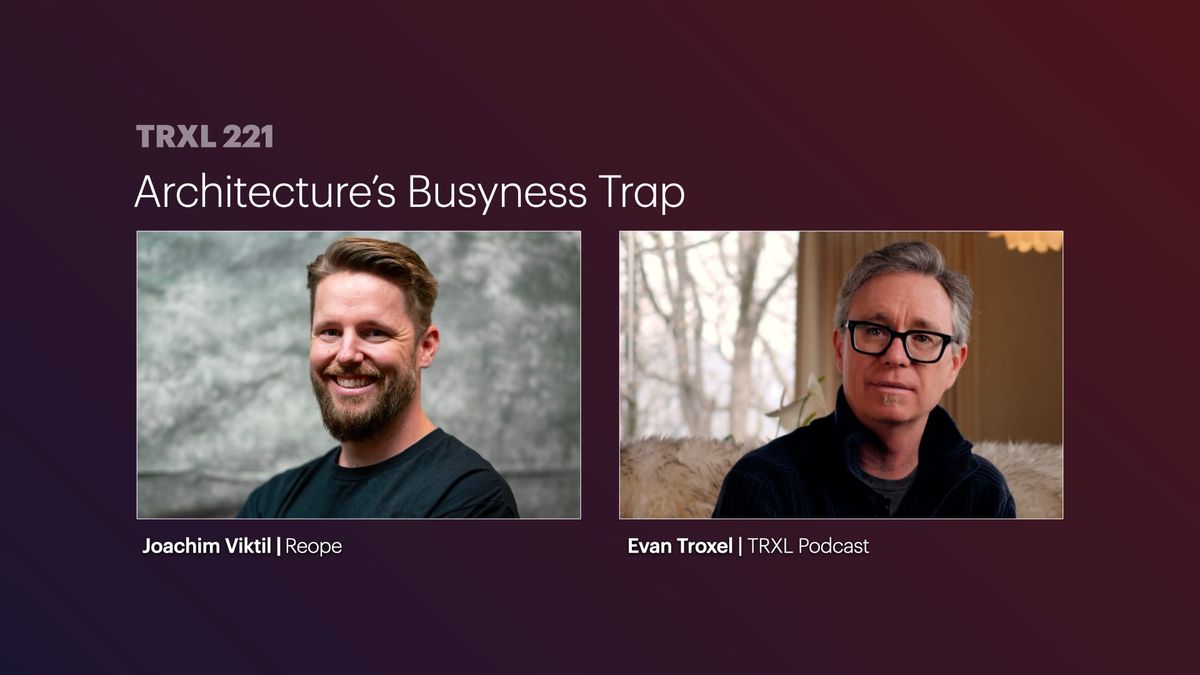
Joachim Viktil joins the podcast to talk about the growing gap between how architects are trained to think and how architectural firms are structured to operate. We explore the hidden cost of staying busy, the limits of billable-hour business models, and why architects, despite being trained as systems thinkers, are often confined to producing deliverables instead of improving the systems behind the work.
This episode is especially relevant for firm leaders and tech-curious architects who feel the tension between utilization and leverage, and are questioning whether the current structure of practice is setting their best people up to thrive.
Original episode page: https://trxl.co/221
Episode Sponsors:
AVAIL's content management system (CMS) simplifies access to your firm's content in one easy-to-use platform. Search and access files from anywhere, create standards-compliant models, streamline documentation, and onboard new hires faster. Try AVAIL for free and request a demo at https://getavail.com
Join AEC industry technology leaders at Confluence, a series of in-person events and a podcast fostering conversations between firms and tech companies to support innovation. Learn more, explore upcoming events, and listen to podcast episodes at https://confluence.getavail.com
This episode of TRXL is brought to you by TRXL+ members! Join our community of supporters to get exclusive benefits like ad-free episodes and our AEC Leadership Edge newsletter. Your support keeps these valuable conversations going. Click here to learn more and become a member today.

Watch This Episode on YouTube:
Episode Links:
Some links on this page help fund our work, and we may earn a commission from purchases at no extra cost to you.
Connect with Joachim Viktil
Reope — Architects Who Code
- Reope
- Website
- Why it's relevant: The Oslo-based team at the center of this episode — a small group of architects and engineers who build custom software for AEC firms, specializing in Revit add-ins, Rhino plugins, workflow automation, and developer experience work for in-house design technology teams.
- Håvard Vasshaug — Co-founder of Reope
- vasshaug.net
- Why it's relevant: Joachim credits Håvard's early reputation in the Dynamo community and his "phenomenal" work building early client relationships as the foundation Reope's international reach is built on.
- Dimitar Venkov — Architect and Dynamo expert, Reope team
- Why it's relevant: Joachim describes Dimitar as "an absolute legend in the Dynamo community" — someone who contributed directly to improving Dynamo's performance for Autodesk and whose expertise is a key reason major firms trust Reope with high-stakes tooling.
Books on Leadership and Motivation
- Drive: The Surprising Truth About What Motivates Us — Daniel H. Pink
- Buy on Amazon
- Why it's relevant: Evan references Pink's research on leadership and motivation — specifically the finding that a leader's choice to stay present with a team during a hard push, and simply name the difficulty upfront, produces a measurably different outcome than walking away. It's a direct touchpoint in the episode's extended discussion on what good leadership actually looks like.
AI Tools and the Coding Revolution in AEC
- Claude — Anthropic
- claude.ai
- Why it's relevant: Reope's team switched their AI subscription from ChatGPT to Claude — Joachim walks through the decision, which was grounded in concerns about how OpenAI has handled content creator rights compared to Anthropic.
- Cursor
- cursor.com
- Why it's relevant: An AI-assisted code editor Joachim points to as part of the shift toward "vibe coding" — where architects and engineers with no formal CS background can write and iterate on software with AI assistance.
- Zapier
- zapier.com
- Why it's relevant: Joachim uses a Zapier setup experience as the clearest example of what AI tooling should look like — AI-generated configuration followed by a precision layer where you can correct and adjust the details. He argues most AEC tools are still missing that second part.
- Model Context Protocol (MCP)
- modelcontextprotocol.io
- Why it's relevant: Joachim identifies MCP as the development that has most clarified where AI is actually headed for architecture firms — giving language models structured access to a firm's own tools, libraries, and content so they can start to be useful on real project work.
- Autodesk Forma (formerly Spacemaker)
- autodesk.com/products/forma
- Why it's relevant: Referenced as a Norwegian-origin AEC tool (acquired by Autodesk) that represents the next generation of web-based, context-aware design software — one of the acquisitions that put Oslo on the AEC tech map.
- Hypar
- hypar.io
- Why it's relevant: One of the web-based tools Joachim cites when discussing how the interface paradigm for AEC software is shifting — away from layered desktop menus toward context-aware, experience-centered design environments.
Architecture Software and Platforms
- Dynamo
- dynamobim.org
- Why it's relevant: The visual programming environment Reope has been embedded in since the company's founding in 2017. Joachim traces the arc from early Dynamo days through to today's text-based coding — the through-line of how computational design tooling has evolved.
- Rhino and Grasshopper — Robert McNeel & Associates
- rhino3d.com
- Why it's relevant: The other major software environment Reope builds for. Much of the firm's work with studios like Heatherwick involves Rhino-based workflows where complex geometry is central to the design process.
- Revit — Autodesk
- autodesk.com/products/revit
- Why it's relevant: The BIM platform underpinning a large share of Reope's client work, from content management tools across multi-model projects to the daylight compliance checker built for KPF.
- AutoCAD — Autodesk
- autodesk.com/products/autocad
- Why it's relevant: Joachim uses AutoCAD's decades-long precision as a benchmark when arguing that geometry is genuinely hard to solve well — and that people coming from outside AEC routinely underestimate it.
Firms and Studios Referenced
- KPF (Kohn Pedersen Fox)
- kpf.com
- Why it's relevant: A Reope client and the site of "KPF Tech Week" where Joachim spoke — the engagement that started their working relationship. Joachim details how KPF commissioned a daylight compliance checker calibrated to the New York Light and Air Code built on top of existing Reope tooling.
- Heatherwick Studio
- heatherwick.com
- Why it's relevant: Evan uses Heatherwick as a counterpoint to the efficiency argument — a studio where the depth of design craft appears incompatible with the relentless drive to do things faster and cheaper. Reope has also done collaborative work with the studio's computational tools.
- Populous
- populous.com
- Why it's relevant: Jonathan Nelson, Global Head of Digital at Populous, presented at AEC Tech on the question of hiring talent from outside the AEC industry — a position Joachim directly pushed back on, and a debate the episode follows in detail.
- TRXL 213: ‘The Rise of Tech-Driven Leadership in AEC’, with Jonathan Nelson, Nirva Fereshetian, Heath May, and Shane Burger
- Turner Construction
- turnerconstruction.com
- Why it's relevant: A Turner presenter at AEC Tech described rolling out ChatGPT to 15,000 employees with control-group methodology to measure actual productivity — an approach Joachim found surprisingly rigorous, even as he questioned whether the productivity gains were real or just more activity.
People Referenced
- Nathan Miller — Founder, Proving Ground
- Proving Ground
- Why it's relevant: Nathan moderated the AEC Tech panel and asked the question Evan calls the best of the conference: whether AI is making things faster and more efficient — and whether faster is the right goal at all. The episode doesn't have time to chase that question down, which is exactly what Evan says about it.
- Jonathan Nelson — Global Head of Digital, Populous
- Populous Team Page
- Why it's relevant: His AEC Tech presentation on hiring data talent from outside AEC is the direct spark for one of the episode's sharper exchanges — Joachim's methodical takedown of why industry-native knowledge matters more than raw technical skill for implementation-focused work.
Events and Conferences
- AEC Tech
- aectech.us
- Why it's relevant: The annual conference where several of this episode's conversations originated — including the Turner deployment presentation, the panel on AI and efficiency that Nathan Miller moderated, and the context in which Joachim met key people at KPF and other major firms.
Previous TRXL Episodes
- Episode 140: 'You Had Me at Anger' — Håvard Vasshaug
- trxl.co/140
- Why it's relevant: Joachim references a previous TRXL appearance by Reope's co-founder — this is that episode, where Håvard covers the founding story, the Dynamo community, and the problems Reope was built to solve.
- Episode 200: 'A Framework for Digital Transformation' — Nathan Miller
- trxl.co/200
- Why it's relevant: Nathan Miller's most recent TRXL conversation before this episode — deeper context on how he thinks about digital transformation in AEC, which shades how his AEC Tech panel question lands.
- Episode 135: 'Realizing the Potential' — Nathan Miller
- trxl.co/135
- Why it's relevant: An earlier conversation with Nathan on staying critical and honest about what new tools can and can't do — a through-line directly connected to the efficiency debate in this episode.
About Joachim Viktil:
Joachim Viktil is CEO of Reope, a team of architects and engineers who code custom automation solutions for leading international AEC firms including KPF, BIG and Heatherwick Studio.
Before joining Reope, he spent over a decade at Ramboll in engineering and design manager roles as well as part of the leadership as a director, head of digitalization, innovation, and M&A.
At Reope, Joachim focuses on leading a brilliant team that extend the developer community of firms, help retain talent, and implement automation that solves real project delivery challenges. He's a regular speaker at industry conferences such as Autodesk University and AEC Tech Symposium, where he explores topics ranging from AI's role in design to the democratization of coding in architecture and engineering.
Connect with Evan
Episode Transcript:
221: ‘Architecture’s Busyness Trap’, with Joachim Viktil
Evan Troxel: Welcome to the TRXL Podcast. I'm Evan Troxel, and in this episode I welcome Joachim Viktil. Joachim is an architect whose career path reflects a growing tension in the profession between how architects are trained to think and how they're actually allowed to work. This journey moves through practice, technology and product thinking, and along the way it exposes some uncomfortable truths about how architectural firms value, time, output, and innovation.
Joachim brings a thoughtful, candid perspective shaped by lived experience inside the system, not commentary from the outside. He's also the CEO of Reope, a company focused on helping architecture and engineering firms better understand how work actually flows through their organizations. Reope looks beyond surface level metrics like utilization and billable hours, and instead helps teams see where time, effort, and expertise are being lost inside complex workflows. The goal is not to make people work faster, it's to create visibility, alignment, and leverage. Keyword right there. Leverage. So firms can make smarter decisions about process staffing and technology investments.
Even though we get around to unpacking Reope later in the conversation, it's an important lens through which much of Joachim's perspective is shaped. In this episode, we explore the realities of architectural practice that rarely get discussed openly. We talk about the hidden cost of staying perpetually busy, why billable hours reward activity over leverage, and how architects, despite being trained as systems thinkers are often boxed into producing deliverables rather than improving the systems that create them.
A key theme from this conversation and many others on the podcast is the disconnect that comes up over and over, which is firms say they want innovation, But structure their businesses around utilization. They hire systems thinkers, then confine them to linear workflows. Over time, the people most capable of creating leverage are the ones who quietly start looking elsewhere.
So this episode has a clear signal for leaders. If your most curious people feel underutilized, that's not a retention problem. It's a systems problem.
As usual, there's an extensive amount of additional information on the show notes, so please be sure to check them out. You can find them directly in your podcast app if you are a paid supporter of TRXL+, and if you're a free member, you can find them over on the website, which is trxl.co, which is where you can also learn more about becoming a supporting member.
So without further ado, I bring you my conversation with Joachim Viktil.
Joachim, welcome to the podcast. Uh, it's great to have you. It's great to pronounce your name correctly. Maybe the first time from, for me it was the first time. Not for you. Uh, welcome. It's great to have you.
Joachim Viktil: Thank you. It's great to be here, Evan.
Evan Troxel: So you were telling me a little bit of your story, uh, ahead of time, and then I cut you off because I wanna hear it in real time, the first time. And it sounds like you've had an interesting journey to where you are now, uh, at Reope
Joachim Viktil: Yeah, so I, uh, trained as an engineer, um, a little bit of structures civil and got right into design management really, um, in a large engineering services company. And after a few years of that, um, good friend, I learned a little bit of each engineering discipline and a little bit of architecture, um, because a lot of the projects we did were engineering.
And, um, that brought me into a more sale marketing role and eventually into some strategy m and a stuff, and then people management. So over 12 years in engineering services, I got to take on a lot of different roles, um, in different countries. And at some point in time I got into digitalization and innovation a little bit by accident, but it really caught my interest when I saw the power of software, how it scales, and how the expertise of the engineers and architects I worked with didn't scale through humans alone.
But software came with that magic ability to bring your expertise, uh, around the world and to many people.
Evan Troxel: Could you elaborate on that, that experience that you had? I'm cuReopeus what, what it was that you saw there that was magic.
Joachim Viktil: Yeah, it's this challenge that you have in, I think all these knowledge based companies where you're trying your best as a leader to, um, bring your best people around to the most challenging projects. And there's, uh, a few people that are kind of at the peak of this pyramid of excellence, if you will. Um, and you just, you can't really clone them.
Um, you can't really ask them to work more and more and more, uh, than they burn out. And you don't retain them. They leave.
Evan Troxel: Wait, Wait, wait, wait, That sounds Scandinavian to me. That doesn't sound American to me. Right there. It, it, it is like, it literally is the reward for more hard work. For hard work is more hard work in the US I
think.
Joachim Viktil: yeah, I,
Evan Troxel: interesting that you say that as a leader, as a somebody who is transitioning into leadership and actually saying
that
out
loud.
Joachim Viktil: Yeah. I mean, it was, uh, I mean, back in school, of course, if you finished your, your math assignment, you got more math, so that, that part's familiar. Um, but I've also seen people, excellent people who just burnt out and, and can really do anything else. And I think as a, as a leader, that's, um, something that's kind of a, something you feel, um, I mean you care about the people that you are around you and the people you try to, um, lead and, and create interesting workplaces for.
Um, so, uh, that's something that's always kind of in, in the back of my mind, how do we balance this brilliance that some people just have in exuberance, uh, with the extreme need there is for this expertise. Um, and for me at some point along the road, um, when I was. Uh, you know, I was a kind of a head of department with 30 people, um, in my team for, for a while, and then got up to a director level with, uh, around a hundred engineers.
Um, and it was really hard to scale those, uh, people that I needed in every project to just get the project started in the right way and make sure when the hard stuff happens that they're there and fix things. And, and then somehow, you know, uh, you could codify their expertise and you can, parts of it, you can kind of bring it to software and bring it to everyone and all the teams so they can benefit from this expertise a little bit, at least.
Evan Troxel: You're not, you're not my generation. You're definitely younger than me, and so I'm cuReopeus. Okay. So, so, okay. There's two things that I want to talk about just to linger on this for for a minute. The first one is, you, you talked about seeing maybe people burn out or just trying to prevent it. And I, I think back to my experience and I think about, you know, what I just said about the reward for hard work is more hard work, and, and so the, the high achievers were definitely like. Overworked, but they hid it so well. I feel like you could see, you could sense it in the cynicism, you could sense it in the comments and but, but it was just expected, like, yeah, this is, this is what a professional is in architecture. And what I mean by they hid it was, it's like you, we didn't talk about burnout.
We didn't talk about the quality of their experience, the quality of their life, what was, what was enriching about it or not. And I feel like, you know, working really hard and spending all the hours, like kind of has some sense of enrichment to it. It's like the, the quality is your dedication to the work and that it's somehow feeding you to keep you going, which I think is completely different than what you're talking about.
And, and I think because I mentioned you're younger than me, that you saw that. and and again, another thing that I think that leads into the second point is you're leading a department of 30 and that's growing at a young age. And so is this more of a scan? This doesn't happen in the us It didn't used to for sure.
I mean, architects started leading teams much later in their career. Right. And so I'm, I'm just cuReopeus if that's more of a Scandinavian thing as well. Is that like bringing in or recognizing leadership ability and bringing that in early and giving you responsibility earlier?
Joachim Viktil: Um, potentially, but I think, you know, I had some, some really good leaders I worked for, uh, over the years, um, who recognized that, um, or gave me some chances. Um, and then, uh, some of those went okay. So, you know, I was always in the intersection of this. Technical disciplines, engineering disciplines, or software, uh, experts.
Uh, and I had kind of enough that I understood what was going on and then connected that to people. So I was able to go to some, uh, clients, uh, you know, varying degrees of, uh, under understanding of engineering or architecture and explain what this means to them. Uh, I was able to get engineers that, you know, some of them are fabulous at working together, some are definitely not.
Uh, and get all of those in a room and get them to work together. Uh, so this was kind of some of the skills that, that I was really focusing on. And that got noticed by one of the directors who gave me a chance that a role that, you know, was maybe, uh, 10 years before I naturally would've had that role.
And when that went okay, then I got some other opportunities as well. I think the company I was in was just really good at kind of building a leadership pipeline and, and giving young people, uh, the chance to try this, uh, leadership thing and recognizing that this is. In a way, a discipline in its own, um, you can become an excellent engineer or brilliant architect.
It doesn't necessarily mean you are great at leading people. Um, there's no, uh, ality there. Um, so I think it's a, it's a skill that anyone can build if they work on it, but it's not something that, you know, life experiences automatically makes you a better leader because then, you know, my wife's grandpa 94, he would be one of the best leader I would know, but, um, it's not, uh, necessarily the case.
Evan Troxel: What do you mean you focused on it? So was it actually something you were pursuing the study of? Was communication and leadership at that earlier
age
or was it just something that, that you just noticed and so therefore you were kind of more open to maybe developing that?
Joachim Viktil: Yeah, I, it was definitely an interest of mine. I remember, uh, during my master's degree a long time ago, I came across this paper that was ancient. Um, it was about communication, but it was written by an electrical engineer. Um, and it was just this super simple thing of how you, you have a sender and a message and a receiver, and it made sense in electrical engineering terms, and it made sense in communication terms.
And to me, like something clicked or something engineery that to communication as well, you can kind of distill it down to its part and then solve each part. Um, so that was something that always interested me, really. And then I, I got into a talent program and I got a mentor and, and a coach, a leadership coach after a while.
So I always sought to, uh, improve the way I was leading people.
Um.
Evan Troxel: something that you invested in monetarily like that, that leadership coach that, or was it something that just you sought out and you, through relationships you made happen? Because I think a lot of times I, I've been in this situation myself many times where it's just like even my wife will be like, I think you should, you should find somebody.
And that means paying somebody to do this, which is a valuable service to help me get better at something. And then there's just kind of this natural. Um, allergy to wanting to pay for that when obviously there's tons of information out there available, but I'd have to piece it together, et cetera. Um, you know, find a course, I don't know, find books, but, but I'm interested if that's something you paid for, if that was something that you really invested in yourself in that way.
Mm-hmm.
Joachim Viktil: Yeah. So, um, I, it was something that I invested time into, uh, but I did at the time go to my boss and say, I, I really, I need, I need this. Um, I was. It was maybe January, 2020. I was stepping into my first directory role. Um, and then I had kind of three leaders reporting to me. And around, uh, in our teams, there were around a hundred people across three countries.
Uh, and then, you know, the pandemic happened. Everyone stays at home. Each country has its own rules. Um, and it was a lot to take on in that kind of first role as leading other leaders. And, um, and I also realized the three people working for me, uh, were all men. My boss was a man, his boss was a man. Um, and I actually went to my boss and say, Hey, I, I have someone in my network.
At that time, I also spent a year away from the business to take an MBA full time. And in the alumni network, I found someone who was. A very experienced leader, uh, in a completely different field like biotech and pharma. And she had lots of experience, uh, in leadership and then turned into leadership coaching, uh, towards the end of her career.
Um, and she was a tremendous help to me. Uh, just the conversations and being able to talk about everything and anything in the business without guarding what you're saying and without, uh, always having in the back of the mind like, is this information that will come back to me in a way or somehow hurt my, uh, standing or position?
Um, when you're on each level of leadership in a large organization comes with new challenges, so you always have to be a little bit careful who you trust with what.
Evan Troxel: Interesting. Well, I, I'm, I'm glad we did that little digression there because I mean, that's pretty fascinating that, that you sought that out again, because I think a lot of times there's kind of this, I don't know, maybe it's just ego, it's just something that is just like, oh, I don't really need that. But to your point, like what it's led to in the opportunities through building those skills intentionally, and I agree, leadership is a skill.
It's not an innate. Thing, like you can develop it and it should be treated that way, I believe, because it is a burden, like I've talked about it on the podcast before, leadership is not like something that many people should or want to aspire to because it's difficult and you take the responsibility for the people who are reporting to you and people that you're interacting with because like, I mean, that's comes with the role and, and because it's a role, I do be believe that it's a skill that can be learned.
It's not something that you should just jump into willy-nilly because it's not, I don't know what, what, what do you think about that as far as like being a leader and, and just feeling that burden?
Joachim Viktil: Yeah, I think a lot of people are kind of thrown into leadership without really having any interest in it. Um, or necessarily, you know, having the interest to devote time and energy into bettering themselves in this field. Um, and then I think it, it has the potential to hurt people around them. Um, and myself, I'm a very relationship oriented person.
I value the people I meet, uh, the relationship I forge. And, and lately actually, I've been thinking a lot about the value of kindness. Uh, some of the people I meet conferences or, uh, working in the customer organizations or in my team, you know, are kind, and it's noticeably different than average. So it is kind of kinder than average
in a
Evan Troxel: Noticeably. Yeah. That's the key word, right? Yeah.
Joachim Viktil: Exactly, and, and it's, uh, you know, it's free. Uh, it doesn't cost you anything. Um, and just a, a heartfelt conversation, uh, around the topic that you and the person you're talking to cares about. You know, devoting a little bit of your energy and focus, um, doesn't necessarily cost you anything. But having that capacity to be kind is something I've come to appreciate more and more.
Um, especially also working internationally. You rely, rely even more on people you know and can trust. Um, if you stay in your, um, corner of the country, then it's maybe a little bit easier to say We're from the same corner of this country. You can probably trust each other. Um, but then you go abroad and you find that, you know, people are different everywhere and, and people are, are really, really brilliant and good at what they do.
Um, but you need to find people you can trust in them. I think kindness goes a long way.
Evan Troxel: Do you feel like that's cultural and regional in any way? Like I've definitely heard of people say, well, I went to X City and the people there were so nice. Or I went to X City and it was hor a horrible experience. It was just more of a vibe. Right? More like that's why I kind of linking it to culture of an area where people are influencing each other in certain ways.
Do you, do you feel like it's something like that? Or do you feel like it's really more disparate and disconnected?
Joachim Viktil: Yeah, I think it's to some extent, but it's also quite like individual. Um, when you kind of also, like, I do a fair bit of recruiting, um, and during recruiting as well. The, the way people talk about others, um, is kind of as indication if they're as individuals are generous or if they're more, uh, focused on, on the negative sides of people or, uh, hung up on, you know, uh, really, uh, boosting their ego and promoting themselves, or if they're more interested in contributing to a team and being part of something.
Um,
so I, I
Evan Troxel: it's more of a personal
value.
Joachim Viktil: Yeah. And I was, I was
actually surprised back in May, I came over to New York, uh, for KPF Tech Week and I had a bunch of meetings with different architecture firms in the city. Uh, and there I found like lots of generous people, uh, which I, you know, was surprised.
I was kind of from the other side of the ocean. Europe is a strange place. Um, I found people there were kind of referencing me to other people I should talk to. So going to talk to someone in, in, uh, big. Then they said, oh, you should meet this guy in shop. And then, you know, it kind of, my, my week of meetings got more and more intense.
This longer the week went, which was really nice.
Evan Troxel: You know, people were looking out for you and try like they saw something that they thought, yeah, I mean, of course you wanna share that around. That's why I wonder if it's cultural, because I've been in situations in offices where attitudes are contagious in some way. Right? And, and so somebody's really cynical and negative and whatever, and you can see it affect a team and start to bring everybody on that team down.
And then you can also see the opposite because, and, and it takes a level of vigilance, I think, to maintain. The kindness that you're talking about, because it is so easy to be influenced by others. Um, you have to really hold the line when it comes to that to say like, no, the bar's here, and we have to keep it at the bar or higher, because you can also see the opposite.
You could see that starting to bring the level up around you as well. Right. It it is an influence that you can also have.
Joachim Viktil: Yeah. And I think as a leader, you, you can direct and push to get things done, um, and you can lead from the front and you can do all the things, but, um, it matters how you do it as well. Um, if you listen to people and, and bring their ideas in, even if you think that you might have the best idea in the room, uh, there could be value to listening to other people in the room.
Um, they might surprise you. And, and some people I find have very little interest. If they have the right answer, they'll, they're gonna stick to it and just, um, you know, kind of lead from the front in a way. But, uh, sometimes just shutting their airs to what's behind them. Um, and I don't think that's the, the right way of doing it.
I think you should listen to the people around you, um, and bring them, bring people along instead.
Evan Troxel: And why, I mean, you said how, and I think why is another thing where it's like, what, what's, what's the point? Why are we doing this? And there's gonna be some reasons that resonate better than others when it comes through, like how that information is delivered. Like, okay, you're gonna push your team to do something.
Why are we doing this? And, and, and there's a, there's a book called Drive from Daniel Pink, uh, you know, famous book in, in leadership circles for sure. And he talks about motivation and he talks about. Even like what great leadership looks like in certain situations when you know there's a deadline, okay.
And the leader could choose to hang out with the team and help get things done, or they could go home for the night because they're not technically having their hands in the work. They're kind of overseeing and orchestrating. And he just talks about kind of a subtle shift with a leader to say, look, guys, this is gonna suck, right?
It's gonna be difficult. We are going to have to push, do whatever. But, but just acknowledging it upfront made such a huge difference in the outcome to say, okay. Like, like, because there's a, there's a, what, what's the right word? It's like, um, it's like morale, right? Morale of the team. Again, kind of referencing this contagion idea of it bleeding into others.
If you can say, okay. Look, everybody, this is gonna be difficult, but we're gonna do it. I'm gonna be here with you. I'm gonna be the person who gets you whatever you need. I'm gonna cut the red tape. I'm gonna get the pizza. I'm gonna get the coffee. I'm gonna run the prints for you. I'm gonna do whatever you need me to do.
Because they don't necessarily have their hands in the work, but they're there and they're saying, this is gonna be hard, but we're gonna do it together. We're gonna achieve it. That boosts the morale in a much different way than saying, see you guys in the morning. I'll hope you hit your deadline. Right? I mean, that, those are two very different ways to approach the situation, but just even acknowledging it upfront that it's going to be difficult, but we're gonna do this together.
What made a huge
difference?
Joachim Viktil: Yeah, I really like that. I think it's, you also touched, you know, briefly on the, the why side of things. Like, um, it also needs to be meaning in there somewhere. Um, I think it's, and in the industry we are in, you know, there's, um, and you know, I'm gonna sound very judgmental now, but, uh, I think there are good and bad, um, like end goals to pursue in a sense where, you know, we always want a better built environment.
Um, that's always kind of what we're striving for in a way. Um, and then.
Evan Troxel: with the way things are,
maybe?
Joachim Viktil: Yeah.
you could, you could say that. And I think it's, you know, um, if you look a little bit further, we're trying to prevent, you know, there's, uh, the risk of the sixth extinction, the biodiversity loss that we're facing. There's the whole net zero thing as well with the climate crisis that's coming. And if we, as you know, designers and shapers of the built environment are not, have that as our end goal, that like somewhere in our mindset that needs to have some space and be kind of, that's why we're doing things.
We're not doing things to, you know, sell a little bit more single use plastic cups. Now, that's not the industry we're in. We're trying to make buildings that, you know, stand there for longer so we don't have to rebuild all the time and we're trying to use better materials and better design processes and all these things.
But I think it matters that, you know, what's that why at the end of the chain of whys in a sense. Um, so that you don't, uh, just do tech because software's cool and you like tech, but the tech's gonna be used for something and hopefully it's gonna be used for something that ends up with a better built environment.
And hopefully that's gonna have a positive impact on the climate crisis and the biodiversity extinction.
Evan Troxel: Yeah. The, the tech part, it should not be the why. It should be in service to the why. I don't think anybody, well, I, I should not generalize because I don't know. I, I just speak for myself. I guess. Like I didn't get into the tech side of architecture to do more tech. I didn't get into it so that I could play with these tools all the time or try to. Enforce them, their use upon others, for example, like that a lot of people have to do. No, like the, the purpose is architecture. The purpose is to create things that elevate, enhance people's lives. I mean, that's the what architect, the value of what space can do for people in different ways is the kinds of projects that I worked on.
And that is what you're ultimately in service to. And these, this happens to be the, you know, okay, that's where we're going. How do we get there? And then technology has, plays a role in that. Right. So to get back to that, why, and, and what, as a leader, do you keep bringing that up? Because to me that is like the North star, but we have to keep reorienting people toward the North Star because it's easy in the day to day to kind of take our eyes away from that.
Joachim Viktil: Yeah, and I think it's, um, for a lot of people, and you know, myself included the, the first few years, um, you know, I was just wanted to work in challenging fun projects and, you know, get design done and see what is happening on the construction site. Uh, it's fun to go out and be amongst the machines and, and see the digging going on and the concrete coming up and all that.
But after like the years wore on a little bit, I came to appreciate more and more that there was some kind of, um, long-term vision for the company I was in. Um, you know, it was to. Uh, help societies and nature flourish. And, um, you know, that became more and more important for me. It became like, uh, over the years, a reason to stay longer with that company.
Um, so I think it's, uh, of course you need to have fun challenging thing to work on, um, and that's gonna sustain you for a while. Um, but hopefully you kind of mature into someone who cares about the, the meaning of the work you do and at some point, the legacy that you leave behind as well. And then I think it's important that also aligns with your values, um, and that it is something that's, you know, sustains you and is positive for, for the world around you as well.
Uh, so I think that's hugely
important.
Evan Troxel: how generic was that purpose? I, I'm cuReopeus because there's some companies who have really generic taglines that they are applying to their culture as the purpose, and I wonder if that matters. I mean, I guess that's my, my question is
what, what was that, that, what was that value system that aligned with you, and how specific was it?
Or wasn't it?
Joachim Viktil: Yeah. In this, uh, at least the management theories I've seen is, is a bit, um, I mean, it's not super inspiring to be frank. It's, uh, you know, as long as you have values, you're okay. But what the values are doesn't matter. Uh, they, they need to be there. Um, but if you, if you go more for the, like, the long term vision, I think you need to be very precise on, on what you do and what you offer.
Like in Reope, we have a very small niche. We're, you know, some of the best people in the world when it comes to coding for geometry and helping architects with that. That's, you know, what we do. It's very precise, it's very specific. Um, but then we also have this ambition to, you know, some of the talent. We free up some of the computational designers, architects, engineers that they get to spend their time on, you know, creating a more sustainable environment.
And then when we see opportunities to work with sustainability oriented projects, we jump on those, we pReoperitize those when we talk about which projects are sensitive to overruns, like we spend too much on this project. Yeah. But there's a benefit to the sustainability side. So we're a much more tolerant to letting that project run over than another project where there's nothing that could, uh, boost that.
I think those small decisions in the day to day, um, can signal that like, this is important in the long run. We're not gonna solve it this month. But it's something we want to contribute to a little bit in all the small decisions that we do. And that's really hard if you don't know at the end of the line, at the end of all those why's that you kind of stack up.
If you ask why enough times, like my 3-year-old daughter ask why all the time? At some point you always get to it because that's how it is, uh,
business. I hope you get to that because we need to save the planet. Um, and there's a couple whys in between, but um, it needs to be in there.
Evan Troxel: Yeah, I, I tend to agree with that too. I think it, if it's, if it's too generic, if it's just like. Design because design, you know, it's great. It's better. Um, I don't feel like it's, it's enough because it's too open to interpretation and it's hard to actually know what you're aligning your values to when there's so many different ways that could be interpreted.
And, and I love this idea of kind of working at a place that you align with their values. That to me, makes it more than a job at that point. Right. It's, it's something that feeds your soul in some way and is not just a thing because you have to go do it. And, uh, there's a lot of that in this industry, but there's also a lot of the opposite.
So, um, it, it's, it's tricky. And so how, how big is your team at Reope?
Joachim Viktil: So now we're 10 people becoming 11 in February. So it's a very small team, but, um, it's, someone told me the other day we're crunching above our weight, uh, which is, uh, I don't box myself. I, I take it as a compliment. Um, we, um. Yeah, we, uh, and you know, one of the things I, I like some examples of the work we do.
Um, over the last eight years, we've built a lot of, you know, Revit, uh, add-ins, rhino plugins. That's kind of the, the thing that we have done a lot of, some web stuff. Um, and then, you know, we have, you know, 101, 102, uh, repositories in our GitHub account with things we built over the years. Um, so in like half a year ago, we had a chat with, uh, KPF and they said, oh, we saw that you have this daylight compliance checker that checks against this building code.
Now, could you, uh, retrofit that to work for the New York Light and Air Code? And for us, since we kind of already did that work, uh, at the deep kind of technical side of it, it was a small job for us to fit it to exactly KPS workflow and make it, uh, useful to them. So some of the. Uh, really easy projects for us are easy because, you know, my team, I'm an engineer myself, but the rest are all trained architects.
They worked in architecture companies. They know how architectural workflows and processes work. We don't have to teach them the industry. And then we have a lot of, uh, history that we can build on and, and adjust and tweak to tailor the software to exactly the process that's already there.
Evan Troxel: Can you talk about what your values are then because I know you're in this, you're serving firms that are out there to help them solve problems. But if you, what's your kind of mission statement? I, I don't like to use that word, but what, what's your, what are your values?
Joachim Viktil: Yes, we're, uh, we're architects who code. Uh, that's the kind of the short
tagline.
Evan Troxel: Okay.
Joachim Viktil: Yeah. And then, um, what we try to do is to, uh, reduce that frustration that, you know, waste of talent when people are just clicking around in their software, not really doing architectural engineering, they're just moving data around.
Evan Troxel: Mm-hmm.
Joachim Viktil: And the purpose of doing that is that, you know, these people, uh, you know, they, they live a better life. It's more fun to do engineering and architecture if you, you get to actually do it and not just click around it, your software, but also that they're able to then create better projects and better projects, you know, can meet a lot of different things.
You can make them more profitable. Um, but. We also kind of look for opportunities where there is some kind of sustainability benefits, so you know, better, um, carbon footprint or better biodiversity or other kind of topics. Um, we are fortunate, you know, it's this very small team. We get to kind of, uh, pick which customers we pursue and which countries we pursue them in.
So we stay away from, uh, some countries where we really don't want to work. Uh, we stay away from some companies that don't really align with, uh, the things that we believe in, uh, which is, you know, a bit of a luxury as a small team. Um, but that's, you know, important for us to stay motivated and, and contribute and spend our expertise in a, in a good way.
Evan Troxel: How did KPF find you? I, I can imagine that KPF is always looking for solutions to whatever, but I'm cuReopeus, were they just cruising your GitHub and saw that, or do they, are there personal relationships? Because I'm, I'm just cuReopeus how you made that connection
with
them.
Joachim Viktil: It was a bit by chance. I reached out to someone there and, and we, uh, had a conversation and I was showing some of the stuff we made in the past and they were like, oh, that could be useful. Um, and then we got that, uh, I went over to speak at the KPF Tech week and we kind of got it slow, uh, adjustment going.
Um, I mean, it helps of course, like, uh, one of my colleagues is di Diar Vanko, and he's been with the company from the beginning and he's an absolute legend in the Dynamo community. And so if anyone who uses Dynamo, which you know, 10 years ago was a small little thing for visual programming and now it's, I think hundreds of thousands of people use it every month.
So it's become quite huge. Uh, so he was very early on contributed to that whole movement. So lots of people know him. So when he jumps into. Uh, a conversation then, you know, there's no question in Dynamo or Revit or like software related to those programs that he couldn't answer. Um, so talking to him as well, they're convinced that, okay, these people know what they're doing.
Um, and, you know, they, he's at this level in the world where we get contacted by Autodesk to make Dynamo run faster for Revit. So then we did this profile optimization thing on Dynamo and got it to run much faster, um, which is, you know, a level of expertise that you don't, uh, find it everywhere then you don't necessarily have access to in your internal teams.
Um, but then you kind of, we work with internal teams and we help, uh, bring that expertise to exactly where is needed in the right portions.
Evan Troxel: I, I, I'm thinking of you guys as like this special operations team, like a skunk works almost. Uh, except, except you're, everybody knows who you are. Maybe, um, and you're not like a secret, but it would be kind of cool if you were like a, a, the, the, the special ops team that solves people's problems and then walks away and, and nobody ever hears about it.
That, that sounds kind of intriguing. But, but can you talk about the, the inception of Reope, like where it started? I mean, it sounds like you guys have done a lot of different kinds of projects for a lot of different firms, and, and you are on some stance, like a special operations, like it's really custom maybe to what they need, but you also make tools, I assume, that are available more widely than that.
So let's, let's hear
the story
about
Joachim Viktil: of the tools, and I think if I, em, a few years ago, Hovar came on the podcast and maybe there's an episode actually where he goes through the, some of the founding stories as a founder. I mean, I stepped in a little under two years ago. Um, and what attracted me at the time was, you know, this is excellence in the team and, and the generosity of the, the people in there and whoever, of course, um, he's great.
Um, yeah, we've done like some, a lot of the stuff we've done in Revit, um, has, we retain the rights to it. We license it out. But for us, the product license thing is kind of, 10% of our revenue is very small side thing. The main thing is that we don't have to do things again and again. So we can kind of, if you want a specific tool and it's something that we made before, you can just, um, get access to that.
And we have architects in New Zealand who uses it. We have architects in California who uses it, um, which are time zones that are hard for us to support, uh, a business in. So we tend to stay, stay in Europe, in the east coast of the US for now. Um, so, and then the stuff we've done for Rhino and Web is mostly stayed with those customers.
We worked, uh, quite a lot on the tools that Hedwick Studio uses. Had a great collaboration with them for years and years. Um, it's, you know, different things. There are a lot of firms out there who have really, uh, developed in good creative processes and they spent a long time developing those creative processes.
And then somehow the software they use fall short. Um, and if we're able to bring that software a little bit closer to the creative process, that's optimal, um, then that, you know, a little bit of investment each month in getting closer to that, uh, is, it's really, really valuable.
Evan Troxel: And so when did Reope begin and how long have you guys been doing what
you're doing? So you've been there for two years, but it's been going on for longer than that.
Joachim Viktil: So it started back in 2017, um, so eight years ago and got started on big government project here in, in Norway and Oslo. Uh, and then, uh, Harvard did a f phenomenal job of getting some international architects interested and, and winning them over and, and having a few people come in that could really help, um, around like dynamo stuff in the beginning and then gradually making more software.
And I think it's, you know, being part of that early days of, uh, visual programming and moving into more tech space programming was, uh, a little bit ahead of the curve or of most of the industry. Um, and it was supporting a big change. I mean, now, you know, 15 years ago, we, I don't think we have any role called computational designer.
It wasn't, wasn't a thing really. And then Grasshopper came, and Dynamo came and, and now we're seeing this new shift come in again where. Um, you know, there's vibe coding where, you know, suddenly all the architects and engineers can write their own software and you can decide to build a lot more in the company.
Instead of just buying from all the software vendors and having dependencies to hundreds of different software vendors, you can build a few things yourself and reduce some of the dependencies. So that like shift that was in the beginning into Dynamo, uh, was a really good development and it turned into, uh, really, uh, excellence, also c sharp applications over the years.
And now we're actually working, you know, more on applications, but also, uh, with some customers we work in kind of developer experience in architecture.
So you have, in an architecture firm, you have design technology teams, you have computational designers, and, um, people are interested in tech, in architecture.
And they are now exploring more and more the text-based coding that you do in, in software development. And they get help from AI and lots of people use Cursor or Claude, um, to get help to write code. Um, and then it's a little different. Like I remember being an engineering firm, we had this kind of script hub where everyone shared their scripts and we could kind of get access to them and nobody documented anything and nobody trained anyone, so nobody could use any of
that
stuff.
Evan Troxel: it's a free for all and it doesn't, yeah, it does nothing. It goes
nowhere.
Right.
Joachim Viktil: Exactly. And
Evan Troxel: and what now? I'm just gonna spend a few hours trying to figure out what this does to see if it applies to something. Maybe no,
Joachim Viktil: It does, doesn't work. Uh, and, you know, you can still do amazing things with, with scripting and, um, but then now we have this opportunity, now that we work a little bit more text-based in coding, that it has the potential to scale. Uh, it still requires us to write a little bit of documentation that requires us to maybe do some videos or, or some explainers, uh, or, you know, uh, make this information available to ai so it can explain people how to use this.
But we, we talked to some of these teams, like, okay, how do you, uh, collaborate on code? Um, how, what, what are good coding practices that you should have
when you
Evan Troxel: don't have those skills, right? Like they don't have computer science degrees, they have design
degrees
or
Joachim Viktil: No, I mean, to be fair, neither do we, but we've learned over the years how to do it, I think.
Evan Troxel: Good. Nice disclaimer. That's awesome.
You're like, we understand your pain because we were there. Yeah.
Joachim Viktil: Uh, you know, we, when we do recruit, we, I, I always look for people with the industry experience because
engineering architecture is extremely hard. It's very, very, very difficult to design a building. Um, it's also difficult to do software, but it's much easier for us to teach software development than to teach structural engineering.
Like as a structural engineer, you train for five years and then you work for five years until you are moderately good at it. Uh, you know, it takes 10 years to even get into it and you're still clicking around on your software, wasting your time, probably, um, software you can get into much, much quicker.
Um,
Evan Troxel: what you just said goes a little bit in opposition to something that we heard at the a EC Tech conference. When I moderated that panel when, uh, Jonathan Nelson from Populace said that, that he hired a, it was like a di data scientist, or it was somebody who, who specialized in, um, like dashboards or something like that.
Um, and he said like he didn't care if they came from the industry. Um, and, and maybe in that specific case it really didn't matter. But I'm, I'm just cuReopeus, like you just said, you really look for people with industry experience because they understand the process, the clientele more like the actual pains of people who are clicking around in software aimlessly looking for a solution.
I mean, am I headed in the right direction here because what, what do you think about his statement of, of not caring because maybe that outside perspective is actually valuable, where they're gonna ask more questions. That we might take things for granted and just assume everybody knows where they might actually bring it to the surface, because they don't know.
Joachim Viktil: Yep. Also, I, I was sitting in the audience and, and I wish I had this like, big plaque. I can hold up and just like say, like wrong, like this is, this is definitely wrong.
This is.
Evan Troxel: was wondering, I was wondering if, and, and it's, it's a, I'm glad you said that because there's no time in a live situation to chase down all of the, the potential places that a conversation could go like we can do right now, because we don't have a time limit and there's no agenda to this conversation.
But I, I love that you, okay, so, so what was wrong about that?
Joachim Viktil: I, I think, and you know, this comes from a context where what we do, you could term like implementation services. So a lot of the stuff we make, you're supposed to be able to use it on an architectural engineering project next week, or, you know, in two weeks. Um, it's rare for us to work on something that you are gonna start using in a year.
And, you know, I, I also don't think that's, um, good to spend a lot of your energy on these days with AI moving so fast. So it should be short term, um, at this high level of uncertainty, but, um. It is, um, something where I think, you know, and, and I think if I remember correctly, it was saying like, you can bring in someone from insurance or banking.
Uh, they have, you know, incredible ability to work with data. Um, and you
can, but
Evan Troxel: Lots of experience on that side where you may, it may be hard to find somebody in a EC who has that.
Joachim Viktil: yeah. Um, and then, you know, there's a couple things to that. One thing, it's gonna be extremely hard to retain them. Um, insurance and banking are both industries that pays way better than what we do in, in our industry. So that skillset, they could go, go back and pay and earn more. Um, and then there's another issue of understanding the constraints that we have in our industry.
Um, and it's, um, hard to understand some of the inefficiencies that we have. If you just come into it from the outside, um, you can do that. You can have a great startup that challenges one of the inefficiencies in the industry. But as a person just coming into it and working in this company where everyone know these constraints, everyone knows the in inefficiencies and you're one of the few people who don't really get it, it's gonna be really hard to be trust with your colleagues and they're not gonna want to listen to you and ask you, can you help us with these things?
Um, if you don't really understand the language terminology, the constraints. So I think that's another thing. You're putting them in a somewhat unfair, uh, position. There is, uh, you need really good leadership, uh,
Evan Troxel: up for
Joachim Viktil: to make them succeed.
Evan Troxel: right? You could see them being really frustrated. Uh, for example, I worked with a, with a, I would call them like an architectural startup on the west coast here. And we were working on a school project where we were introducing Prema, prefabrication and things like that. And this person was on their team who had come from automotive manufacturing, and they were the most frustrated person on the team every day.
Because why can't it just be like. Automotive manufacturing. What do you mean we have to deal with this problem? Like, why is that a problem? And it's constantly like the fully well intentioned, what do you like? That sounds broken. Why is it like that? It's like, yep, this is how it is, right? This is the, the air quotes of, of architecture.
This is how it is and this is the things that we have to deal with because of the, you know, this is a very disconnected process. And, and just getting something built is a miracle, right, in and of itself. That, that, that we can actually orchestrate that process with some certainty that, oh yeah, we're gonna get to the end, but we don't know how we're gonna get there.
Where with manufacturing and that kind of level of fabrication, it's just like stamp, stamp, stamp, you know, assembly line, right? Get it done. And they were trying to apply that to architecture thinking that they really could. And it was just they were the most frustrated person in the room constantly.
Like, what do you, and they ended up leaving because they couldn't deal with. With how it was to, to your point right. Of, of, of really difficult to keep them engaged when they're just constantly running up against the brick wall of process and
architecture.
Joachim Viktil: Yeah. And, and then I think there's, uh, there's definitely something there and there's also something to geometry, like geometry is extremely hard to solve. Well, um, you know, we've had, in our industry, we've had AutoCAD for 40, 50 years now. And, you know, AutoCAD is extremely precise. Uh, it's really hard to match the preciseness of AutoCAD and I, I think it's been tempted to bring it to the web several times.
It's kind of, hasn't really worked that well. Um, and, and there's, you know, very few of the softwares that we use in the industry actually survive these 10, 20 years. Uh, because some of the things they've sold, they've sold it really, really well. Uh, and you throw someone into a, you know, a, a team of architects and engineers who are, you know, geometry and space is something that's completely natural to us.
We see a 2D plan and we can immediately think how that's gonna be in 3D. How is that space gonna feel? You know, where are those ducks gonna go and cross each other? Um, and that, uh, process is something you learn over years and years of, you know, studying the plans and understanding the space and seeing the buildings being built and how all that work and it's knowledge.
That's kind of hard to just transfer to someone in the onboarding process of a couple weeks and say like, oh, this is how the industry works. Welcome. Um, so I think there's also something there with geometry being, uh, hard and difficult to do. Uh, that's also hard to bring people in that are more used to large databases of, uh, you know, financial numbers or statistics and these, these kind of things.
Um, and then, you know, some of the mechanics of the industry where what's valuable and what's not valuable, something that you can do in, in banking, for example, you can do lots of work on data and it can be very, very valuable because you can scale incredibly well and then you can do lots and lots of work for architecture and then you don't really scale it so it's not worth the same amount of effort.
So you have to really smart about the small efforts that you put in. So I think there's, there's a lot of things that are different. I mean, I wouldn't bring someone into the industry from the outside, um, even if they're really, really good at, at coding for the work that we do. Um, and I think if, if you were to do that, you have to be really mindful of and provide really, really strong leadership to enable them to succeed in their role.
Evan Troxel: The people that I've seen succeed who have come from the outside for some reason, and I don't know how to put my finger on it. Really cared about the building industry, really cared about the built environment so much so that that was the value alignment to go back to earlier part of the conversation where they wanted to make a difference.
It wasn't just about solving this problem in the paycheck, right? It wasn't about the job part of it, but it was about like, why are we doing this? To kind of go back to that earlier part, and, and so the, I, they do, they're out there, right? There are people who, and, and maybe it's hr, maybe it's graphics, maybe it's visualization.
I don't know. It, it might not be, you know, it's all of these tangential things that are part of running an architecture firm nowadays, right? It could be writing apps and scripts and doing these things and they, maybe they can come from another place, but it's like they really care about the difference that they're making or that that firm is making in their community in really tangible ways.
So it's not to say it can't happen, but those are an even smaller amount of the people who are. Out there in the pool of people looking for positions in architecture
firms.
Joachim Viktil: Yeah. And then, then, you know, that's, um, maybe one of the, under one of the conditions, it, it could work. Uh, it's still be quite hard, but at least if you have that, you know, the passion for the built environment, um, then you have maybe the energy and perseverance to spend the time and effort to learn how, how the industry works.
Um, I
Evan Troxel: Not only do you have to learn how the industry works, but you have to learn how your colleagues work. And that's gotta be like how, how architects work has gotta be one of the most frustrating environments to walk into. It's like, like, it just doesn't make sense, I think for when it comes to most kind of corporate environments.
Joachim Viktil: No, it's, uh, I, this is, this has been a fun to follow over the years as well. A lot of large engineering companies have gone on this acquisition sprees with architecture firms. And, and I was there when, uh, the company I worked in acquired a large architecture firm. And it was, uh, a interesting clash of cultures where you have this partner structure, um, you have this incredible drive to win and compete for exciting work in the architecture team.
And, you know, at the end you have the engineers who are really excited about big hair problems they can solve. But at the end of the day, the numbers have to add up to win something. Uh, you can't really outshine anyone on the idea or the design or, or things like that.
Evan Troxel: Yeah. Interesting. Well, I would love to, I would love to talk about ai. You gave a presentation at a A EC Tech, and, and then I think after that I saw you posted something on LinkedIn where you, you like, shut down your subscription to chat GPT for your team. And so like, where are we? Where, where, where, let's first talk about like the.
How AI has come onto the scene in specifically with, with how Reope has been doing work? You mean you talked a little bit about vibe coding, you talked about cursor, you talked about tools like that, and your architects who code, I assume architects who code, you know, for the most part today are using tools like those.
Uh, and, and so I'm, I'm cuReopeus what your experience has been over the last few years.
Joachim Viktil: Yeah, so this was, uh, for me personally, that was one of the reasons for leaving this large engineering company I was in, was to join a small AI startup that, you know, in the end didn't work out. Uh, and then I was, I was really happy to find Reope I was right there at the beginning of the wave getting really excited.
Um, and then, uh, I joined Reope and there was, uh, you know, a lot of conversations in the industry about, uh, this whole AI thing and, and all the things you can render and generate with the images and everything. Um, and then it, it, it wasn't, uh, you know, prevalent in the team. It wasn't something that, you know, the team was super, super interested in.
It took me a while to find out, like we were experimenting with different things, try and cursor when it came out and seeing Claude code and these kind of things. Um, and we found, you know, it's, um, mostly, uh, and then, you know, we were also actually sharing office spaces for, uh, a year, like, not like this year, but last year we had a machine learning company that was specializing in ai and they had all these professors really, really clever, brilliant people.
Uh, and they also showed us some of the experiments they ran in the, the built environment. Um, and they were super stoked at how easy they could make something look like architecture. And we were tearing our eyes out on how horrible it would be to be in that space. So,
Evan Troxel: But it looks so pretty. I mean, on some level, at the surface level, it's really incredible, right? It's like, oh, I remember some super early experiments where people were taking, you know, feathers from a bird and, and creating facade systems, and it was just fantastical, right? And it's just like, whoa, this is really fun.
It's really interesting. And you can see the rabbit hole like open up and it's like, let's go into that portal. That's gonna be incredible. And at the same time, if you know anything about what it actually takes to build something, you are also like, oh my gosh, what are we doing here that we're going in the wrong direction,
Joachim Viktil: no, this is, this is exactly it. And we had several conversation with architecture firms. It's like, we need to do something in ai. And we're like, okay, which problem are you looking to solve? And they go through the problem. It's like, yeah, we can code that, you know, this is, you know, this is logic. We don't have to use this, uh, uh, predictable models or these, uh, probabilistic models to, to solve this.
Uh, it's not necessary and it's not necessarily the best technical solution either. Um, and then, you know, I, I think, uh, over the last year or so, especially after this model context protocols came out, it's become more and more clear for me that, you know, right now the biggest shift that's happening from ai, um, for our industry is this ability for everyone to code as this democratization of coding and writing software.
Um, and then, you know, there are definitely very cool things that are happening on the generation side with how you tell a story with images and videos. Um, and I think that that's super fascinating, interesting. Uh, but it is a small piece of, you know, the whole design, architecture and engineering of a building.
The storytelling you need to do it to win it and to win over the, uh, you know, medic citizens or council or there, there are some key processes where that's really useful, but it's still, you know, f few percentage of the effort that actually goes into designing a building and all the other percentages that you have, have to spend lots and lots of time on.
You know, there's no AI solution out there yet that's super useful for these things. Um, you can generate text that's useful in many instances, um, but there's also a lot more information, uh, in text form on the internet that these foundational models are trained on. Um, so the financial models are, are super useful.
I use it, you know, every day I talk to Claude on my way to work. Uh, I asked him, you know, tell me a little bit about Evan before this podcast. I know who I'm talking to.
Evan Troxel: All right. Oh, what, what did it, what did it, did it do me dirty? Did it, did it what? What did it
say?
Joachim Viktil: I apparently Claude thinks you are, uh, a Renaissance man who do both does mountaineering, uh, and does, uh, you know, author and, uh, podcaster and educator. So I, I think it got a lot of things right
there. Um, it is, it is quite, quite good. Um, no. And then, and then, um, when it comes to, you know, what's what, where we are right now, you have these foundational models that are getting better and better.
It's still not really valuable in your project unless you're able to give it very specific context around your project. And this is what's getting interested in the next six to 12 months is kind of how do we give our specific context, the context that we have in our firm. You know, all firms are used to working with, we, we tend to call it content more, I think like you have your Revit families library, you have your visual elements, you have lots of digital assets that you manage in the firm.
Um, and how do you give this to, um, the, uh, large language model, the statistical model? So it can use these resources, uh, when you wanna design something, and then you also have it to give your tools. So if your tools are Rhino Revit or if you make tools yourself, you have to make that available as well.
And then it can eventually start becoming useful for, for the design that you want to do. So this is something that's, um, to me right now is, is very, very interesting. It's not something that we work that much on in real because there's still so much potential and, um, you know, improving some of the, the workflows that we're involved in coding, uh, like clever things that help architects.
Uh, so we haven't done that much work in it yet. So it's mostly me going around talking about it, talking to the team, like what's interesting here. Um, and then the thing where we turned up chat, GPT was actually a, you know, a conversation in the team. I was a bit surprised it got this much attention. Um.
And I, I'm confounded by the LinkedIn algorithm. Um,
Evan Troxel: So it got, it, got attention on LinkedIn is what you're talking about because you, you provocatively posted that you, you cut it off.
Okay.
Joachim Viktil: And then I, someone brought it up, uh, like, Hey, did you see in the news? Like it seems like, uh, atropic is, is a bit kinder to content creators than, uh, what open AI is. Uh, and they were referencing, you know, the settlement with these, uh, companies that have rights to books. Um, and then open
Evan Troxel: the, from the information they stole in the beginning. They, they've been more
Joachim Viktil: yes.
Evan Troxel: Okay.
Joachim Viktil: So, and then, you know, they kind of were forced to fe up and pay like $1.5 billion or something and insane. And they were forced to delete those from, and, you know, they said at least they would do that. And then, you know, open AI has this New York Times court case where they're just blocking it, it's fair use.
Um, and in the team we just had this discussion like, Hey, are we, like, does everyone, uh. Feel like this is, uh, and then people are like, yeah, yeah, okay. Well, you know, content creation is, is important to us and the creative domains are important to us. Um, and then there's a small team of 10 people. It's easy to say, Hey, why don't we cancel, uh, the the chat GPT subscription we have and just switch to Claude.
Um, it's not really a lot of resistance around it. Uh, Claude is also a little bit better in this specific moment in time at supporting coding. Um, so that was a positive as well. Um, but it, the decision really came for this kind of very, uh, quick and easy conversation around the, the ethical concerns. Um, so we'd like to kind of simmer for a few weeks and then we brought it back up and everyone still felt the same way.
And we're like, okay, then we're, we'll switch. Um, and it's, you know, it's not gonna change the world. Um, but I think if, if every company small and big, um, make these ethical considerations about who are their suppliers and why do they choose them, uh, then, you know, that sums up to something.
Evan Troxel: I mean, it aligns with what you talked about earlier with your company and who you choose to work with, and having some guardrails around around that, that everybody on the team knows. Okay, so, so hypothetically, what if an architecture firm of 10 people or less wanted to switch from Autodesk to Graphisoft, for example?
I mean, it's not as easy, right, to say. Chat GPT to Claude or open AI to, to anthropic as it is to say, Autodesk to Graphisoft in the, in this case.
Joachim Viktil: No, that's probably true. I mean, I've heard about companies who do this every two or three years. They assessed all of their vendors and they sometimes switch from Revit to Graphisoft, um, or Acad, um, or Vectorworks or others. Um, but yeah, we've had this idea in the industry that, you know, we have to spend years mastering the tools 'cause they're so complex and the user interface are so many layers in it.
And it's, it's really hard to master these
tools.
Evan Troxel: Or even the way they, they go about doing something. Right? Like you think about, uh, Revit doesn't have layers like AutoCAD does, but. ArchiCAD does. Right. And so fundamentally, they, they actually approach the problem even though they're both BIM authoring platforms, they approach it differently. And, and so there, the getting up to speed would be more difficult.
Let's just, the transition would be
more
difficult
Joachim Viktil: Yeah. And I think this is, is going to change in the time to come, like if you now, like the user interfaces are more single layer, it's more context aware to what you're doing. Uh, all of the web services are more easy to switch in and out of. So, you know, if, if you use high par now, I'm guessing you could switch to our call or connic or form like these kind of web companies that, um, are building the future tools of
the
Evan Troxel: do you mean single layer? What does that mean?
Joachim Viktil: So that's just a user interface. Um, so if you have to, you know, click one place and there's a new menu, you click there and the third menu you click there. That's kind of many layers. Uh, whereas
if all of your, uh, available menu options are kind of visible to you, um, and then you, let's say you're working on, um, you know, massing of a building, the massing tools are right there.
Uh, or massing commands are easy for you to access. Uh, when you move into the floor plan, then the floor plan, uh, commands and tools, uh, become available to you so that you always have the tools that are relevant for the context you're designing in.
Evan Troxel: Yeah,
sure.
Joachim Viktil: the layers kind of single layer, ideally, um, you don't have long menus that pop up and you have to know exactly where to find things to be efficient in the tool.
Evan Troxel: Software seems to get there though, doesn't it? Right. Over time it's just more and more features. We gotta move 'em around, we gotta reorganize, we've gotta, and, and, and so I mean, you're developing software. Is that something that you keep. At the, at the top level to say like, this is what we strive for.
Because I would assume then that also means we make decisions to not develop certain things because it would obfuscate it from the user potentially. Because the more and more features you have, you gotta pack 'em in somewhere. Right. Do the elements on the screen all just get smaller or do we redesign the application and, and we all know that that's difficult too.
Joachim Viktil: Yeah. Or, uh, or does it depend on your action in the software? So, you know, if, if you click the facade, um, do certain tools, you know, become
visible to you?
Evan Troxel: Yeah. That back to your context
idea.
Yeah.
Joachim Viktil: Yeah.
so, so that's also nice actually. We're starting a project now in general on discoverability with a firm that create lots of applications and it's kind of, they find themselves recreating some of the application they made five years ago. Um, so trying to think about, okay, how can we actually discover, help users discover the right tool for what they're trying to do?
Um, it, it's not an easy problem to solve for sure. Um, it's, it's really hard to design something simple. Um, it's very, very, very difficult. But then yet as you add more features, um, you. Maybe want to think more of it as experiences. Um, so if you have like an experience of creating all the drawing sets for a large building, you know, how do you make that experience a little bit better?
Um, and then there's a di completely different experience where you work with the early stage massing of that building. Um, those two experiences are so different. So if, if there are tools that fit really well with those one experience or the other, why would you show the massing tool when you're doing the floor plan?
It just, there's some things there where you kind of, you have to show all the features on the tools at all times in lots of deep menus. That doesn't, when you think about it, doesn't really make sense.
Evan Troxel: Yeah. It's an old paradigm, but it's like, uh, I mean, it's a physical world manifestation, right? It's like, uh, you go to your wood shop, all the tools are in the wood shop, right? They're all there and they are not context aware. It's a very, it seems to me, it seems like a very physical kind
of,
Joachim Viktil: Yeah, yeah, yeah. But then, um, yeah, but also like in, in the wood shop, you don't have your land measurement tools, uh, because you probably measured the land, you know, before you started crafting the table that's gonna be in the building.
Evan Troxel: Yeah.
So, so what's the value that you're seeing in the AI tools and what you're doing? I mean, uh, you're really, sounds like specifically on the coding side, the text side of things, and not the image generation side, but have you seen interesting things happen? Useful things happen? Valuable things happen because it's, but your clickbait article, it was like we got rid of Jack GPT, and, and we didn't replace it with anything.
But in reality, you, you just went
over
to anthropic,
right?
Joachim Viktil: No, actually we, yeah, we switched to Claude, uh, or we had both, and now we just have Claude. No, but, um, I think in the last, uh, three years, like generation has become easier and easier. Um, and to some extent, you know, if you work in the delivery phase of a design project, that's a nightmare. Like, if you can generate complex geometry in Rhino, super easy, uh, and then, you know, send it into Revit and the Revit model gets heavier and heavier and you're gonna click print at some point and commit legally to those drawings, and the nothing works at the end because everything's generated super fast and quick, looks amazing.
Uh, it just doesn't work with your current tech stack. I think that generation has some, some limit to it. Um, the, the most impressive thing I saw the other day was in the completely different field. It was actually from Zapier, um, where I was just connecting, you know, we have some rev tools and you know, occasionally we get a support ticket and that goes into our HubSpot and then.
Uh, I missed one. Uh, and I wanted to make sure that we don't miss one. So I wanted it to post to our Slack channel. Um, and I just went into Zapier, which I hadn't really used. I've always been aware of it, but I hadn't really used it because I didn't have the need for it. And then I just wrote like, Hey, I wanna connect, uh, you know, my HubSpot support ticket and posted on the Slack channel.
Um, and it said like, can you allow me to connect to these two services, connect, connect like two clicks, and then it find the right form amongst hundreds of forms that we have on our HubSpot. And it found the right Slack channel between 30 slack channels that we use actually.
Evan Troxel: even have to select them. You didn't have to dig through the menu to find them. It found them for
you.
Joachim Viktil: it generated everything.
Um, and then the, and then, you know, it's, this was somewhat impressive, but then the most impressive part was that it also, uh, created this little visual programming thing that it showed me like, we're, we're taking this form and we're sending this information to Slack. So then it did generation, but then after it generated everything, it gave me precision where I could go in and modify and say, oh, actually I don't really want this information.
I want that information to be sent. There was a slight tweak there that made it useful. I think this is where we're still lacking in the industry, where you can generate lots of things. Um, but it's really hard then to move into the precision phase where you move stuff around a little bit. You have to be, you know, uh, you have to watch your line weights and the colors and these small details that you have to get right.
Um, so the, when, when the tool gets there that you can, we generate all of this and now after we generated it, here's the precision. You have to actually move it the few centimeters or few inches, uh, one way or another to make it, you know, exactly the way that you want it. So that's, that's something I'm, I'm still kind of waiting to find that tool.
Um, there's a couple that might be, might be getting there, but I think there's still a little way off.
Evan Troxel: And, and so yeah. Not geometry. Right? I, uh, an analogy to what you just said, something that that really impressed me was the way that they've integrated AI in text interface into notion databases. So in notion, because I have a lot of complex formulas, my whole podcast is my whole life is run out of notion.
And so I have certain, um. Fields that are driven by formulas. And the formulas were unwieldy because, uh, you know, you, you had to learn how to program them. And Notion has great, uh, documentation to figure out how to do that. But now with the AI stuff, it's like I can actually rewrite those formulas just by writing a sentence and then I can say, oh, and make this small change.
And it just so easily does it and I don't have to. It's kind of cool to go spend the time to learn how to do that thing that I'm literally never gonna learn, go do again. And so that's the trade off is like I have to invest all the time to build a tool that is then just going to work. And I don't like that.
Learning was, was cool for the sake of learning. It definitely expanded the way I think about the usefulness of the tool and what it can do for me. But at the same time. It is kind of a waste of time. It's kind of like architecture, right? It's like the purpose is to do the building, not to do the drawings, right?
But we have to do the drawings to get the building. And so, um, it, it was just, it, it actually was a really fun experience in a different way than it was learning the how to build the right kind of formula. Because now I don't have to do all the trial and error. Of course, I could, you know, it could do it wrong and I might have to retweak it, but at the same time, like I, I'm also, I just want to get what I want, right?
I, I want the hole in the wall. I don't want to know how you're gonna put the hole in the wall. I just want the hole in the wall kind of a thing. So, um, that's what I'm paying for,
right?
Joachim Viktil: more and more people are having that experience now that you can kind of, you can write, you know, plain English, um, and you get your software becomes a little bit better. Um, and I think that's, you know, a little bit of magic in there. Um, that that's really, uh, really nice. And then at some point now, if you were to share all those formulas with, you know, hundreds of friends or hundreds of colleagues, um, you wanna have a level of confidence that this is, this is gonna work every time in every environment.
Um, you know, it is not gonna crash. And then when you get to that level, you know, that's kind of. Uh, where, you know, we in Reope step in and we're like, we look through your code and we say, okay, this is this. You can just share it. It's safe. You, this is, this is really good stuff. Uh, or we go in and we say like, oh, you need to make a few tweaks here.
You need to handle these errors. And there's exceptions to these kind of things. Um, so I think for a lot of the stuff where we are right now with ai, it's, you know, you should use it, you should learn it, you should figure it out, uh, for your own sake and how you work in your own processes. If it make, making a podcast or podcast or designing a building, and then when you want to scale it, that's where you want kind of a second pair of eyes on it.
Um, someone who, who does this every day and say like, yeah, this is, this is pretty decent, this, or, you know, uh, this is something that's a good idea. Uh, we can take that idea and make it into something that's scalable. Um, but it's not exactly what you've written here.
Evan Troxel: Yeah, that, that. Dependability, right? The, the of the rep repeatability is where, uh, prompting falls short, right? Because you could prompt the same thing and get two different outcomes, but if you codify it into a process that is, if this, then that, then that is something that is way more distributable because it's going to say, okay, well here's all the inputs, here's the output, right?
PeReoped, versus, oh, well, you know, maybe something new came online that it now takes into its context and therefore changes the outcome. I mean, that's, that's very difficult to deal with because even, even as a content creator where it's just like, you wrote me this great thing that I can then use as a description for this, and then the next time it's like wildly different, right?
It could be the exact same inputs, it could be my same prompt with my same. Whatever, you know, transcript or whatever it is, and then, oh, that's weight. That's not me. That, that doesn't sound right at all. That's, that just doesn't work. That's not scalable.
Joachim Viktil: No, and I, I think it's, you know, there's merit to these, uh, language models who can kind of create logic on the fly where you kind of say, Hey, can you help me, you know, place these elements somewhere that's makes sense and he can kind of try to figure out, okay, let's do these 20 steps and, and then you get a result.
Maybe it's something unique and it is a good way to test new things, but there are a lot of processes in our industry where there are like, there's like a command list of 60 commands and you have to do them one after the other, uh, or some in parallel. And you have to do it every time like you have to, that drawing has to come out or you know, you have to check the model health or you have to purge the parameters.
So it is a lot of these things where it doesn't really make sense to create the logic on the fly. Um, I mean, it looks cool. You can create nice videos and, and share it in your social, but. Uh, you probably are better served with, you know, uh, a command flow that's worked a hundred times already. You know, 50 of your colleagues are already using it.
It just de-risks, uh, the work that you're doing.
Evan Troxel: So what did you think about the a EC tech, uh, pan or the, the, the presentation from the guy from Turner Construction where they've deployed chat GPT to 15,000 employees? Like what do you,
does that make alarms go off for you? Do you, oh, cool. Um, that would be fun to watch from the sidelines. I wouldn't wanna work there, or, yeah.
That's the way that firms should be doing it.
Joachim Viktil: no, I have to hand it to him. He, that was the biggest surprise. I was actually talking to someone else about this yesterday and that this was the most surprising presentation for me during the whole event. Uh, because it started, uh, you know, very mundane. It was very much like AI is here. We're gonna give chat, g PT to all employee.
And at the beginning of that I was like, well, there's like, lots of companies are doing this. Like what is, what is the point of this? Why, why are we listening to giving chat chip to your employees? And that's been happening for a couple years already. Um, but then it took a, took a really interesting twist where they said, okay, we tried to teach people how to use this, and then we started monitoring if they get more value from it, more satisfaction.
And you had really, really interesting data on actually their. Treating this as an experiment, um, not an experiment. That sounds like, let's see what happens, but more like we've done these kind of almost control groups, uh, and we have these data points to see that, you know, it is valuable in these contexts.
Um, so I think their approach makes it really, really valuable, uh, and useful. And then, um, I think it's, it's interesting to see how they can get something useful from it in many different contexts. Um, then I think we had, uh, in that conference conversation, I think Nathan Miller asked a really good question for our panel, like, uh, is AI making things faster and more efficient?
And should everything always be faster and more efficient? You know, my response was, no. Um, it's not necessarily making things more efficient. You know, when you got the image generation, you just. Created a lot more images than you did before you had image generation. It doesn't necessarily lead to better images, it just makes you spend more time creating more variants.
Um, could be better images, but that's not a given. You have to have that artistic art to be able to do that. And, and maybe, you know, that's the risk. I think, uh, Turner is running as well. Like, uh, everyone's really happy with that. They're reporting better productivity, but are they actually more efficient or are they just spending more time on exploring more things?
It's,
Evan Troxel: Well, and, and, and back to Nathan's point, right? Does it need to be more efficient or do they just need to be more satisfied with their job and more? CuReopeus about things that they can do, because I, I think that's what's, what's interesting about the design process, right? Is you don't know where the answer's gonna come from.
You just don't know you. It doesn't come from the same place it came from last time. It doesn't, right? It's not the same solution. It's not the same team, it's not the same context of environment and site and all these things. And the answer doesn't come through a formula. It comes through cuReopesity and chasing things down.
And somebody says something one day and then you hear something else, and then you see something. And, oh, all that came together to make this magic recipe of the, the design process and the, and the final building. And I, I wonder if actually that's a more important outcome of this experiment than, is it making them more efficient?
Because, oh, everybody, you know, the person in the finance office would love to say yes, it's more important. But to get back to a point you were talking about earlier. And it made me think of an experience that I had working with, you know, the head of our financial side of things in our firm. Totally understood because he had been there for a very long time that yes, we spent more time doing this compared to that other project, or maybe more than we should have in air quotes.
But it was because of this, and it led to that, and they saw that value and were able to see the bigger picture of the whole firm and the culture and the outcomes. And so they're willing to say, yep, we spent more money on that phase of design. But look where it got us and what we were able to do with that, with our marketing and with this other client that came in because of that, all of like these really unforeseen connections that nobody could put together because they don't exist on paper.
They don't exist in the data, they exist in the experience of people. And I, and I kind of wonder. I, I loved Nathan's questions. I was joking with him afterwards because he wa it was the last question and there was not enough time to like really get in. That should have been a podcast in and of
itself.
Maybe I should have him on.
And I, and I thought it would've been gr we should have him on again. And, and I thought it'd be great if he just like locked the door and it's like, we're not leaving until we get to the bottom of this kind of a thing. Um, it would've been amazing. But, but at the same time, like, there, there's not enough time to, to do all that.
But I, I think about like, okay, so yeah, there's, there's this real push for efficiency and productivity and yes and no, right? And, and tools, right? How many times have people stumbled upon a cool way of doing something or the, the right way of doing by clicking random, clicking not random buttons, but clicking through the interface, trying to figure it out, which gets to the root of his question.
Like, what, what happened to spending the time to do the thing? It's like. Architecture has been commoditized to the point of spending less time on it equals better because that's where the money is made, and that's rarely the case. I mean, look at the examples of Pablo showing Heatherwick's work, right? I, I kind of wonder if they even have time sheets at Heather Wick studio.
I don't know. Right? Because all the craft is is really, really, of course there's deadlines,
but it's like how do you get to those really amazing solutions? It's through doing it. It is not by doing less, it is by doing, it's probably by doing more or working smarter, right? I don't know.
Joachim Viktil: Yeah. I mean, how do we ex you know, the, the double there of Pablo and Alfonso, this brilliant team together. Um, we, we work quite a bit with 'em. They're, they're really fun and, and great people. I think some of this is kind of the, the time it takes to mature an idea or mature design. Um. And it's, this is one of the challenges with, with the ai.
Uh, I remember like, even like 14, 15 years ago, I was, uh, contracted out, like as a BIM coordinator for a contractor on site. And I went out, you know, this was early days where we did 3D IFC, Revit BIM stuff. Um, and you know, they see the 3D model and they're like, okay, great, then we're just gonna build it.
And we're like, no, we're in the, like first month of designing the details here. Like we need another four months to actually get this coordinated. And, and at a level you can build this. And they're like, yeah, but we can see it on the screen, it looks like, okay-ish. And you're just like, yeah, but then we have to talk about mold maturity and all of these things where it's like, it looks ready to build.
And I think, you know, that was 14, 15 years ago. Uh, and now I, I see it so much again with this whole, uh, everything ai, where you see like, oh, it looks ready to build. Like, you even have these, it looks like a Revit
interface.
Evan Troxel: is why SketchUp had sketchy lines, right? This is why SketchUp had sketchy lines. Like we okay, oh, turn off the textures, turn on the sketchy lines. And because architects got really good at this, right? Which was, we are three steps from where you think we are.
But we're gonna show you this version because you can handle it right now, because this is what we need to talk about and get decisions around, even though we are three steps ahead.
And, and that is like your, to your point, like people see finished product when they see these hyper photorealistic images or, and, and there's always this concern in architecture. It's like we can't show 'em too much too soon because they are going to get married to it. And we don't want anyone to get married to this yet.
Joachim Viktil: No, and I think it's the, the time it takes to mature an idea, um, it's not necessarily something we can just collapse and say like, oh, here's your AI generated building. Now you know everything and why we've made all these design decisions and it's gonna be really good for you. You know, you need to bring the people along as well.
Um, and I, I think it's, um, yeah, there's, there's definitely something in there where this very quick generated things are, uh, even like the computational flow dynamics images that are coming up now, it looks like air that's flowing through the buildings. There's no actual computational flow dynamics behind it.
It just looks like the right colors and this, you know, becomes a little bit scary. There was another presentation actually, um, which of course that was not his point, but the, was it the unreal presentation at the conference as well where he was kind of showing.
Evan Troxel: like close enough.
Yeah.
Joachim Viktil: Yeah.
but like people walking around and it became a pedestrian simulation.
And, you know, I spent a few years in the mobility space, uh, and it was like, that's the, the statistics behind that is wrong. Like, that's not how you build a statistical model on how people actually walk and how pedestrians behave. And there's behavioral models behind these, uh, that are quite complex and hard to set up.
Uh, and then, you know, they do amazing visualization to make it look fantastic. Um, but if you know the field, you're like, I can't really use this for anything. I have to actually figure out how people walk and then I can visualize it. Um, I think there's, um, I really appreciate like the hard grunt work that goes into designing a building and understanding every problem that you need to solve or doing a pedestrian simulation, building a complex statistical model for that.
Um, and the value of presenting that and having storytelling and visualization around it is, is really good. But doing just one of them, which is, I mean, most engineers just do the math and then don't tell anyone. So I'm very familiar with that side, but I also, I think that's a lost opportunity. You could share it in a more, in a better way, a better storytelling.
But if also I just hear the storytelling and there's no kind of substance, there's no like grunt real work behind it. It's also just like, yeah, but what am I gonna use this for?
Evan Troxel: I mean, it, it goes back to this idea of what you were talking about with firms like, we want to use ai. And you're like, for what? Right. And picking the tool before the, the appropriate problem to solve. It's the same thing with this. It's like, I can't tell you how many times I sat in boardroom type meetings at an architecture firm.
It's like, we want to say that we are innovative or we wanna say we're using these tools. And it's like, well, why don't we actually just do the thing and then have all the assets to tell the story instead of saying, we're doing this thing and then have to go back and build all that stuff to actually do it.
It's completely the wrong way to think about it. Right? It's, it's 180 degrees the wrong way. And so I, I just, I. I agree with what
you're saying.
Joachim Viktil: Yeah.
Evan Troxel: It, it's frustrating to see that. And so like, to your point, like the, this idea of, well, if you didn't set it up with the right intentions in the beginning, you can't, like the end doesn't matter if it just, it's just a pretty picture.
It's not,
it's completely flawed because it was flawed. It never started out even in the right direction.
Joachim Viktil: Yeah, I, I think, you know, when you have experience in the industry, you, you see this pretty quickly, but there are a lot of people out there, there that, you know, they won't necessarily be able to tell. Um, and, you know, if we're unfortunate that those people are people who have, you know, the means or the access to capital to get things built, and those buildings are there, um, you know, they're horrible experiences for people and they don't function, they don't work.
And, you know, five, 10 years later they get knocked down again. Uh, which is kind of the worst possible outcome that we can have from a design process that, you know, this fundamentally, uh, has very short longevity and, and it's a very unsustainable way of developing our societies.
Evan Troxel: Yeah. Well, I think we should start to wrap up here, at least start to wrap up. So I'm cuReopeus where you're going and what you're excited about when it comes to Reope and what you're doing with Reope So, so tell us, like you, you said you're gonna be adding another, you know, you're going from 10 to 11.
Um, and I think I'm thinking about Spinal Tap right now. Like the amps, they, they go to 11, you know, I can see the, the LinkedIn post now. So, so tell, tell us where, where you're going, where you headed with Reope
Joachim Viktil: Yeah. So for us, um, it, it's gonna be a, a lot of fun in the years to come. There's a lot of new tech coming on the scene really, really quickly now. And the skill sets we have is, is really useful for, for the architecture and engineering practices we, we work with. So I really look forward to, um, some of the customers we'll start working for next year.
Uh, the ones we added this year has been a lot of fun, like really, really great people. Um, and also growing the team. When we bring new people in, they always come with something, uh, you know, both professionally, technically coding wise, but then, you know, some of them, you know, they do have side projects with art.
Uh, some have like architectural photography as a hobby. Uh, there's always like all of these dimensions to people that I, I find very interesting to explore. Um, and then, you know, we do once a year because we have, you know. Uh, part of the team now, there'll be four people remote, six people in the office.
So we try to do once a year, a, a week long festival, uh, where everyone comes together or three, four days where everyone's together, uh, all the time. We did one in Oslo now in August. We had a lot of fun together. I say I look forward to a little festival, uh, next year as well. Uh, so it's a lot, a lot around people and, and, and growing, you know, in a slow, sustainable, financial way, um, and making a positive impact on some of the people out there.
Evan Troxel: Yeah. So tell me about that slow, sustainable, um, because there's a lot of. Influence or pressure on startups, and I don't know if you consider yourself a startup or, or just a business. I mean,
it,
it's
a,
Joachim Viktil: Yeah, I mean, eight years, we're kind of out of the startup phase, I guess. We're still a small business. Um, I've always been impressed by people who can scale and be profitable at the same time. I had a, um, leader I was working for, for many years who managed to do this. Um, and it was very impressive to me where you can, because one of the others is kind of, uh, if scale without any profitability, then you're in the startup scene and, and you have to, uh, probably bluff a lot of people.
Uh, if you're just doing profitability, it's just cost cutting. It's, it's also quite boring. If you could do both, then, you know, it's a very healthy business. Um, so, you know, having a, a, a little bit of profit every month, adding a, a few more people every, uh, year, um, that's something that, you know, I hope we can, uh, achieve over the coming years with, with the Reope team.
Evan Troxel: Well, there's also this pressure just to always be bigger and doing more, and, and I'm cuReopeus what you think of, do you, do you see that as a, a useful.
Model in our, in our industry or in the, in, in the capitalistic society, or is it, is it actually undermining it in some way?
Joachim Viktil: Well, I think, you know, this is sometimes hard for some of our customers to understand and I, you know, coming from engineering, uh, if you have a hundred structural engineers, you can do 10 times as much with us, with 10 structural engineers. So it's really linear scale with people. Um, and then I got into the coding side of things and I realized, you know, I can add another 10 people and we're not necessarily gonna move faster if I just find one that's really brilliant, that person's gonna get us there much faster.
And that's becoming ever more true now with AI support. So, you know, we can code a little bit close faster if we use clot in a good way. Um, so it's, for me, it's not necessarily growing the team to, you know, a 50, a hundred, 200 people. Uh, it's more growing the impact. That's the focus, right? Um, so the impact could be, you know, we are able to help more firms, uh, with the same, uh, amount of people.
But it could also be small things like we got a question for someone. Uh, we're a small firm, like how do we work with Rhino Revit interoperability? And we could have responded to that email saying, Hey, here are some things we know, and some things we worked with in the past. But instead we thought, okay, if we have a little bit of better impact, if we just put it on our little blog and we send 'em the link and say, Hey, uh, here's how we think you should do it.
Share this with anyone you want. Uh, so if every small business decision we think like, okay, how do we have the most impact with this? Um, then, you know, that's more meaningful to me than, you know, being a hundred people. Um, and, and hopefully it, it has a more, uh, opportunity to have a more positive impact on the industry as well.
Evan Troxel: Yeah. This idea of sustainable growth is a foreign concept, I think in a lot of, well, especially in the startup scene, right? It's like go fast, break things. Uh, if you're, if you're not, you're not going fast enough. Uh, and, and then, and then pivoting because you know, you gotta use the buzzword pivot. We, we, and because you have to, because it's not sticking, it's not sticking fast enough.
It's the, the adoption isn't happening. You know, there's, there's all kinds of. Reasons, but also pressure to keep up with, and, and so it's, it's good to see companies that are intentionally just methodically chipping away at creating sustainable businesses. Because, I mean, something that strikes me with your culture and with your values is that there is work life balance.
And, and in order to achieve that, there needs to be some level of, like a solid foundation in this, right. Where things aren't just crazy all the time at work, right? It's 'cause it, it doesn't have to be crazy all the time at work.
Joachim Viktil: No. No. And you know, I had, you know, conversations with colleagues this week that said, Hey, they're planning on working a bit next week because they have a few things they didn't manage to finish up. And, and you know, I was saying like, it, it's probably not that urgent. Like you just leave it for, pick it up in three weeks when you're back from the vacation.
Um, it's still gonna be there. Uh, your, our customer's on vacation as well. They're not gonna look at it before they come back. You know, uh, it needs to be really de-stressing to work if you're gonna work next week. Um, you know, and some of the people said, oh, it actually would help me just to put in a half day next week.
And I would just relax much more after that. I was like, okay, put in the half day. And then some people said, oh yeah, maybe. Right? Maybe it isn't as urgent as I feel like it is. Um, and I think in a, in a lot of. Uh, business, we use kind of urgency and we use also the word crisis way too much. It's, it's not really a crisis on the same level as if you're in an, an operating room or, or dealing with a humanitarian, uh, crisis or something like that.
And, you know, this language also creates a, a pressure, um, to do things really fast. And, you know, some of the things we made are used, um, on some of the biggest projects in the world, uh, for, for several years now. It needs to work. Um, and if we just run really fast and break things, then there are, you know, some, some firms out there that don't get their work done.
And, you know, we feel responsible to them and to make sure that they can use the small tools that we made that, you know, if, if they break down and we're not there to help them. Um, and then, you know, they have to spend hundreds of hours to do it in the old fashioned manual way. Um, so yeah.
Evan Troxel: Like earlier you said you, you, there's certain time zones you, you've kind of stay away from because, and I assume it's because you can't be there at their call when it needs to happen because so many times that's exactly what it is. It's like, oh shit, I need that right now. Right. I can't, I can't wait until tomorrow or for the email chain to, to work its way through the system.
And it's like I need to just pick up the phone and be able to talk to somebody. And if you're asleep. They can't do that. Right. So that's interesting that you actually, because there's a lot of firms out there who take on projects who don't know how they're gonna staff them, right? They, they're just trying to create the backlog of work, or they're trying to, I mean, because the incentives are misaligned between the people who have to deliver the projects and the people who have to win the work, even in the same firm.
Right? And they're, they're not saying, well, can we support this appropriately for the time peReoped and on the schedule and the budget and all of those things? And really holistically looking at what's capable.
Joachim Viktil: Yeah, and I think it's also a little bit about, you know, being responsive to the people you work with as well. That, you know, we had, we have a, you know, pretty, um, nifty tool that man enables you to manage content across Revit models. In a big project, you split it into several models and, and you wanna manage content across.
And we solve that several years ago, and several of our customers are using that in large projects. Uh, we were talking to Baros group about this, you know, uh, about a year ago, and they said, oh, this is useful, but could you add color schemes to it? Because we have a project where we need the color schemes to be the same of all the buildings that we're making.
And we said, yeah, we could probably do that. And a couple weeks later we, we've made that adjustment in the tool. And it's kind of one of those things that, you know, then they ended up, um, starting using the tool because they also felt like they can make it a little bit their own and they could make it.
Fit their process and, uh, you know, being responsive to that. Um, if, if they were then, you know, based in New Zealand, um, the back and forth would be a bit more complicated. Um, and we would probably be able to adjust the tool for them and tailor it a little bit. Uh, but maybe not on the same, uh, short time span that we did In that case,
Evan Troxel: Final question. What, where'd the name Reope come from? What, what is that?
Joachim Viktil: that was before my time, but, uh,
it came
Evan Troxel: to know the
story.
Joachim Viktil: Yeah, I actually, I do, there's a, how, I wrote a nice blog post about it. Uh, they did this naming workshop with, uh, a lot of reimagine, rethink, reconsider, um, came up as words, and they went, and then the reword was there all the time, which, which is nice. Like our current strategy is called Reimagine because I, I think imagination is one of the most important, um, qualities we have as humans.
Um, and then, uh, OPPE is kind of a, I'm told, I'm told it's like a expression from some south of the us, um, that it means like discovery is something you like, OPPE is, is like, and then Reope is like rediscovering something. Um, it was short, um, kind of easy to, um, put on a webpage. Do you, I think also the URL was available, so that's also always something you have to factor in these days.
Evan Troxel: Okay, so I lied. Last, last question. Now for real. What is the deal with so much activity in Oslo, Norway, that area? I mean, it, to me, there's, there's a lot of really interesting stuff going on out of that spot in Europe. What, what's that about?
Joachim Viktil: Hmm. Oh, there's, there's several factors that plays into that, you know, um, we're a strange little country. Uh, you know, my grandparents' generation was a very, very poor country, and my parents' generation became a very wealthy country. Um, so we can afford, you know, free healthcare for everyone, free education, everyone has a master's degree in something.
Um, and then adopting and the whole society digitalization was kind of, uh, something that was, uh, quite early introduced. Um, and then we, we were fortunate in our industry that, you know, the, the government, uh, building office, they. Uh, really leaned into everything bim, um, back in 2006 seven, and they started requiring this for, for all of the major projects.
I was on the project team for the new national museum that we were designing. There was quite strict BIM requirements, um, for this. Um, and, you know, when this happens in the big project then, you know, a lot of firms, uh, develop new skills in this whole digital side of things of design and, and engineering and architecture and the roles.
You know, BIM coordinator, BIM manager grew up, uh, out in the industry quite early in the early 2000 tens. Um, and then, you know, it became more and more, more digital. So it is, it is really the foresight of some of the, the government bodies that require this in the contract very early on that kind of built the skills in the industry.
Um, and then, you know, more, more and more companies are mandating this now on the, on the. Uh, com or the, uh, com like the country level. So I think Portugal is doing it, Ireland is doing it, and more and more, uh, geograph in the world are, are doing this now. And it's just a, a chance that Norway did this, 2007, eight or something like that for all practical purposes.
Um, and high education level, very digital society. Um, high cost of salaries. So you try to be efficient with things. Um, so that's probably one of the things. Yeah, because Spacemaker turned into form. That was a huge acquisition here. Now, cons, Sigley got acquired by acom. Uh, so there's a two, uh, large acquisition out of Oslo in the last five years, I think, or 10 years.
Evan Troxel: Yeah.
Yeah. Well, this has been a really great conversation. I know we went all over the place. I didn't expect to talk so much about leadership, but I'm glad we did, uh, and culture and incentives and everything that we got to cover. So you, this has been an amazing conversation. Thank you so much. I'm gonna put links to everything that we talked about in the show notes for this episode, and I hope you have a happy holidays with your family and your team.
Joachim Viktil: Thank you Evan, and likewise. I really, really enjoy this and, and hope to come back sometime in the future.
Evan Troxel: All right. All right. I'm gonna hit stop.