
216: ‘The Future of AEC Belongs to Those Who Evolve’, with Randy Deutsch
A conversation with Randy Deutsch about the future of the AEC industry, the importance of adaptability in architecture, and how AI can enhance human agency while reshaping professional practices for the next generation of architects.
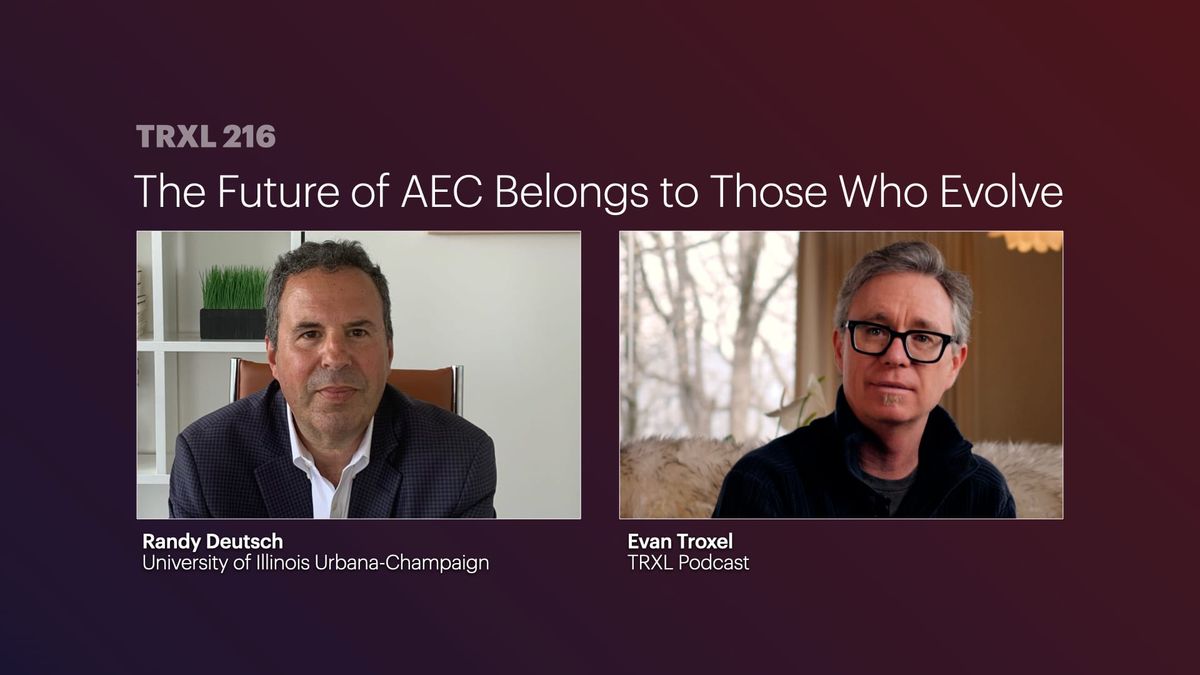
Randy Deutsch joins the podcast to talk about what real adaptation looks like inside architectural practice. Not trend-chasing. Not tool collecting. But a fundamental shift in how architects think, learn, and operate in an AI-accelerated world.
Randy draws on decades of experience as an educator, practitioner, and author to explore why resilience, convergence, and continuous learning are now core competencies, not optional extras. The conversation spans design technology, professional identity, authorship, and the uncomfortable truth that the firms who survive the next decade will be the ones who change before they’re forced to.
This is a clear-eyed look at where architecture is headed and what it takes to stay relevant when the ground keeps moving.
Original episode page: https://trxl.co/216

Watch This Episode on YouTube:
Some links on this page help fund our work, and we may earn a commission from purchases at no extra cost to you.
Connect with the Guest
- Randy Deutsch
- Randy's former students mentioned:
- Aaron Laniosz https://archinect.com/aalaniosz
- Ben Feicht https://www.benfeicht.com
Recommended Reading
- The Agentic Architect: AI and the Resurgence of Practice (Routledge, 2026)
- Randy's 7th book is coming out in the Spring of 2026
- Adapt as an Architect: Building Resilience and Agility in Practice by Randy Deutsch
- Amazon Link
- Focuses on resilience and adaptive strategies architects need in a changing world.
- Think Like an Architect: How to develop critical, creative and collaborative problem-solving skills by Randy Deutsch
- Amazon Link
- A foundational book on architectural thinking and design mindset.
- Superusers: Design Technology Specialists and the Future of Practice by Randy Deutsch
- Amazon Link
- Explores how design technology superusers are reshaping modern practice.
- Convergence: The Redesign of Design by Randy Deutsch
- ARE Hacks: Learn How to Pass the Architect Registration Exam by Evan Troxel
- The Creative Act: A Way of Being by Rick Rubin
- Amazon Link
- From the legendary music producer, a master at helping people connect with the wellsprings of their creativity, comes a beautifully crafted book many years in the making that offers that same deep wisdom to all of us.
About Randy Deutsch:
For over thirty years, Randy Deutsch FAIA has been an architect and educator, and more recently, an author, international keynote speaker, and AI researcher. As a licensed architect, Randy designed over 100 large, complex sustainable projects for which he received the AIA Young Architect Award Chicago.
In the last decade Randy has authored 6 books, most recently Convergence: The Redesign of Design; Superusers: Design Technology Specialists and the Future of Practice (a “Best Future of Technology Book of All Time” recipient); Think Like An Architect: How to develop critical, creative and collaborative problem-solving skills; and Adapt As an Architect: A Midcareer Companion. In 2026 Randy will publish his 7th book, The Agentic Architect: AI and the Resurgence of Practice.
In addition to teaching at University of Illinois at Chicago starting in 2001 and University of Illinois Urbana-Champaign starting in 2012, until 2019 Randy served as Associate Director for Graduate Studies in the School of Architecture. He previously served on AIA Chicago Board as Director and Vice President; on Architect Magazine’s 2018 R+D jury; led an annual Executive Education program at Harvard GSD; and served on the 2023 AIA National Design Awards jury.
In 2020, his team received an NSF Grant and DPI Seed Grant for planning a first-of-its-kind institute for the application of AI in design, construction and operations of buildings and infrastructure. He is the co-founder of the Built Environment Futures Council (BEFC). In 2020 Randy was elevated to Fellow of the American Institute of Architects and Senior Fellow of the Design Futures Council.
As a book author, international keynoter, workshop leader, administrator, mentor and educator Randy aims to help current & future design professionals understand impacts of emerging technology on future practice, to plan for and navigate a fast-moving, uncertain future with confidence. More about Randy https://www.randydeutsch.com
Connect with Evan
Episode Transcript
216: ‘The Future of AEC Belongs to Those Who Evolve’, with Randy Deutsch
Evan Troxel: Welcome to the TRXL Podcast. I'm Evan Troxel, and in this episode I welcome Randy Deutsch back to the show. Randy is an architect, FAIA, educator, AI researcher, and author whose work has influenced how many of us think about BIM, data-driven design, Superusers, and the evolution of architectural practice.
He has a rare ability to connect the dots between technology, culture, and the long arc of a career in this profession. And we cover a tremendous amount of ground in our conversation today. In this episode, we talk about the seven year career cycles Randy uses to intentionally reinvent himself and how those cycles have repeatedly pushed him into new territories, including his now well-known focus on ai, which began when he asked his own students what his next side pursuit should be.
We get into the importance of cultivating insight, the role of deep work and the deliberate space required to do high quality thinking in an age of constant distractions. We explore the shifts from architect as creative problem solvers to what Randy calls checkbox checkers and the long pattern of tools, cad, bim, computational design, and now AI being sold as time savers, while often having the opposite effect inside firms,
We discuss what it would take to flip that dynamic and move the rote, repetitive, and risk driven tasks to machines so that humans can focus on judgment, creativity, and real value creation. Randy shares what he's seeing firsthand as a teacher: students eager for AI automation and advanced tools, but who still need the real world grounding of craft practice and professional judgment.
We talk about mentorship, the power of storytelling, and the tension between the work students imagine they'll be doing, and the reality of how firms actually operate today. We also explore AI as a means of augmenting who you are as a professional, not just what you produce, and how that opens the door to new roles, the new Superusers and hybrid career paths.
We also get into leadership and culture. The longstanding gap between visionary designers and healthy management. The need for better role models and the opportunity for this next generation of architects to build more supportive, sustainable, and human-centered practices. As usual, there's an extensive amount of additional information in the show notes, so please be sure to check that out.
If you're a paid supporting member of TRXL+, you can find that directly in your podcast app, and if you're a free member, you can find those over at the website. Which is trxl.co. Lastly, you can really help the podcast by sharing these episodes with your colleagues, and please leave a comment over on my LinkedIn posts or over on the YouTube channel where you can engage with me and the other listeners.
So now without further ado, I bring you my most recent conversation with Randy Deutsch. So, Randy, it's been four and a half years
since the last time you were on this podcast, which is crazy to me.
It feel, it does not feel like it's been four and a half years, but Wow. Does it feel like that to you?
Randy: Yeah. It, it, it does, um, in part because the first two times I was on the, uh, your podcast, episode was, I don't know if it was number 3, 4, 5, something like that. It's really in the early days.
Evan Troxel: Number four? Yep.
Randy: yeah, and then within a year, less than a year, I believe, you know, it was on again.
Evan Troxel: Right.
Randy: um, uh, back to back.
Um, you know it was on the tail of, uh, my book Superusers.
Evan Troxel: Right,
Randy: it was at the
beginning of the pandemic, which I know
this is a pandemic project for you
Evan Troxel: right.
Randy: on to fame and
fortune, which is fantastic.
Um, and so lots happened in that amount of time, but uh, it's fantastic to be.
Evan Troxel: Thank you so much for coming on the show again, and, and I was listening to you on another podcast and I was
intrigued to find out that you kind of treat
your professional,
trajectory in seven year increments. And
I don't know how much you hold directly to that time, but it sounds like ballpark,
you've switched gears every seven years, and I wanna talk to you about
the latest one that we're, I mean, we're, we're getting to the end of the latest seven year stint.
Is that correct?
Randy: That's absolutely correct. Yeah. Just taking a step back for a second. don't know my mindset at the beginning of my career 49 years ago, but I treat, I told myself I was gonna treat my career not like a David Letterman stunt so much as a, an experiment. I was gonna, you know, this is before social media back in the day when I first started out. But still, even then, there were people complaining that they were not making a lot of money in our field. So I was gonna see, you know, is it possible to make a lot of money in our field? Is it possible, um, to constantly grow? Is it possible to be in our field for 49, 50 years without being bored even one day? Um, so yeah, I tried a lot, you know, a lot of different experiments throughout my career. And one of them is what I've, uh, called a seven year career. Basically, I have the career of, of an architect that carries through. uh, the end of high school all the way. Obviously not a licensed architect at that time, but, um, had made a decision in 1977 that I was going to be an architect. once you make that decision, you take a deep breath and say, now I have capacity to come up with a side gig. you know, having a podcast might be a side gig, um, for me every seven years, almost to the day. Um, I have, uh, switched the side gig out and there's a lot of benefits for doing that.
Evan Troxel: Yeah, that's, that's really interesting. I,
Randy: I
Evan Troxel: I feel like I've tried to do those in parallel and I think it's interesting that you do them in series.
Uh, and so because it allows you to fully
commit and like go deep instead of doing everything at some, you know, lesser level
and therefore never having the ability to take the time, I mean.
Selfish isn't the right word. Right. But it's like you are doing this for you and you get to do it deeply, and I think that's super interesting, which has led to some pretty incredible outcomes. Can you kind of go through
some of those seven years stints and, and talk about what the outcomes have been of them previously and, and then maybe how the,
did it lead into the next one or not?
Was it something that you just wanted some contrast all of a sudden?
Randy: Sure. Um, I have found there that, um, I never had a plan for the side gig
Evan Troxel: Mm-hmm.
Randy: as
once I was committed. To whatever it was going to be. Um, even if it didn't relate with the previous one, I was gonna throw myself in a hundred percent. I'm somebody who's not motivated by money. I'm motivated by
Evan Troxel: Mm-hmm.
Randy: as anyone who's
ever. Not been mo motivated by money would understand. You can make a lot of money being not motivated by money, sort of taking the attention away from it, it, it will appear.
Evan Troxel: Yeah.
Randy: so I didn't worry
about that so much. But
Yeah.
I started off at the beginning as a cartoonist. I paid my way through school, uh, working for local papers.
I'm not gonna go through all seven of them at this point. But yeah, the, um, I was the cartoonist for the Daily Alini where I now teach when I was a, a student, um, back in the 1970s. And after that I did a seven year stint as a playwright. I think the aren't the fact that I have plays that have been performed in won awards and now are sitting in my closet.
I think one of the outcomes is, is I am a person who has. Done a deep dive of seven years as a cartoonist and in part as an editorial cartoonist who had to collaborate with, um, editorialists, who had very strong point of views many times that were not the point of views that I held.
Evan Troxel: Cartooning on a deadline, also, right?
Like
Randy: I, and on a, and on a
Evan Troxel: right?
right,
Randy: Absolutely. Um,
and trying to come up with a salient idea. So one of the takeaways there is I learned that insights were much more important than just coming up with knowledge or information. Um, probably the biggest takeaway for me from all of these, uh, side gigs is that there are certain insights that I use every day.
I use insights from playwriting, cartooning from book writing and so on. So that, those are for me, the big takeaways. Um. this idea that one builds on the other. Um, I have a lot of people who say to me, well, of course you're a professor, so of course you're going to do public speaking. You're going to write
books. for me, uh, as somebody who's been teaching at the
university level for 25 years, I don't know a lot of professors who write books and publish books, it seems like a cliche that they would publish or perish, for example. And I don't know a lot that actually cross over from academia to public speaking. Um, so it is a little unusual in some ways, um, to, to do that. yeah, so it's kind of oppression time. I don't know if it's a coincidence or not that I'm talking to you now, Evan. Um, but I'm about to wrap up the 49th year. So I've had, you know, I'm about to complete seven side year, uh, seven year side gigs. then there's the 50th year, which. Um, should be really interesting because either I jump into another seven years. Um, and without getting too, uh, bizarre in terms of references here, but there's something actually in the Old Testament that talks about the jubilee year, Jubilee years where farmers historically would let the land life follow for the 50th year because all that planting that's been going on,
Evan Troxel: Yeah.
Randy: is a great way to like
steal the nutrients from
Evan Troxel: Yep.
Randy: right?
Evan Troxel: Right.
Randy: using that as a
metaphor and I kind of
feel that way, um, that, um, coincidentally I'm at the end of my teaching contract, um, this coming spring, and so I don't actually know what I will be doing in that 50th year. I don't know if you want to talk about the AI one, the one that I'm currently going through.
Evan Troxel: Yeah.
Randy: um, that was a little bit of an interesting story since I picked up on the fact that one side gig doesn't lead to the other. That, um, six and a half years ago, I opened it up to my, uh, 150 sophomores. I just literally asked them to yell out what I should be doing as my side
gig for the next seven years. And yes, there
were yoga instructor or food truck operator, you know, some of the suggestions from people who didn't necessarily know me really well. Um, but someone yelled out, AI researcher,
Evan Troxel: Hmm.
Randy: said, I'm just gonna do
that. And
you can argue I'd written some books on technology, and it would seem, again, as a natural segue into
Evan Troxel: Yeah.
Randy: But it
it wasn't, it was like
starting from scratch.
Evan Troxel: Yeah. I, I am really intrigued in, in that, in the current one. And just kind of going back on this idea of going back to the idea of insights and, and how that, to me is also a common thread in these cycles is you sharing in a very public way these insights, right? So it starts with cartooning, but also in speaking that's something you do through speaking, it's also through writing.
It's something you do through writing these books. And I'm curious where, like, how, how does that work for you? So I'm reading the book Rick Rubin's book right now, the Creative Act. Have you have, you know, you're aware of this and I mean, you, you're talking about this 50th year. I just turned 51 2 days ago.
So, uh, this was my 50th year and I would say I'm in a similar place. And I find it super interesting that you even brought that up because it's like. One of the things he talks about in that book is like, if there's no room for something, like, like if you're full, if you're fully engaged in a thing all the time, there is not room for anything else to kind of work its way in.
And so again, going even back to the earlier part of the conversation where I say I'm trying to do multiple things all the same time in parallel, there's no room. Like, there's literally no space for, of course you can, little tiny digressions here and there,
but, but no
big digressions that like you offered up to your students, what should I do?
Like that is a inspirational moment. You could of course take it or leave it with what they throw out at you, but why not, um,
open yourself
to that opportunity
to, for intrigue and for inspiration. I think that that's super interesting. So back, back to my idea of, of, back to my con the concept of insight.
How does that work for you when it comes to what you're doing? Like where is that coming from? How are you drawing on that? Is it subconscious?
Are you actively pursuing insights? Are you using ai? You know, so I'm just curious, like how, how does that actually work for you as Randy Deutsch?
Randy: Sure. Thank you for that question, Evan. Um, so just to be completely transparent, in 1987, I, uh. A costarter co-founded a, uh, startup and it's called Deutsche Insights. And while there is a lot of market research involved, there's also naming companies and coming up with new products and so on. And so that, that doesn't occur anywhere on this the, uh, seven year career,
Evan Troxel: Hmm.
Randy: uh, successive sigmoid, uh, curve chart. that's just something that I do on the side, but I, I think what's important about it is as architects, and I see this in my students as well, we're all trained indirectly, yes. In, uh, design thinking, but also in pattern recognition. It's this idea of recognizing patterns. And I started to notice after writing my first couple, you can call 'em textbooks, um, before I wrote the book Convergence that came out in 2017, noticed just when I took a deep breath, I go on long walks every day, and when I took a deep breath, I would realize. That in every podcast, in every article in white paper, in every presentation, at every conference, somebody would mention things are converging, but nobody would define what that is. Nor even go so far as to say, converging in what way. So it's looking for gaps just like anyone with the startup would do.
Look for a gap, something that's missing in the world, and maybe you can be helpful in some way. That's an insight. Yeah. I just connected the dots when I collected more than one thou, you know, this proverbial pile of scraps of paper, which now becomes proverbial, uh, files within a folder in your laptop.
And when that hits a thousand, that's a salient idea. This is something that has got enough traction, has got enough depth to actually be worthy of a book. And that's actually how conversions came about. That's how Superusers came about. Um, you can't worry about the fact that you're making stuff up, right?
So if I was in physics, if I was a psychologist with a PhD, I probably wouldn't feel as comfortable, um, connecting the dots the way I do in architecture
Evan Troxel: Mm-hmm.
Randy: historically you
don't really need a PhD to
be a researcher. and ai, interestingly enough, it's very hard to imagine what an AI expert is when you can't literally get it to do the same thing twice.
Evan Troxel: Right.
Randy: so while,
yes, there are people that we recognize as AI experts, it provide a little bit of freedom, I think, with the seventh, um, side gig or seventh uh, side career to just say, you know what? I'm gonna give this a deep dive and try to get this to happen. So I think it is about pattern recognition. I think it's about. Recognizing that anecdotes and platitudes, like we see a lot of times in TED Talks, um,
are things we pick up on all the time, but there's more value out there. And the value we can really provide is trying to find a way to connect the dots and create something new that has never been said before. just to give you a real quick example, um, because I think it's helpful sometimes to have an example. One would be, I hear a lot of times that ai, will enable us as design professionals to create time and what are we gonna do at this time? So I listen to podcasts and again, white papers, presentations, well, they'll say there's one or two things we can do at this time. You know, we can create more projects and more work to make more money. Um, you could do more while work for less money. And that's about it. That's about as far as it goes. And so this idea that. as I say in my book, uh, think like an architect. are amiable skeptics, we're always skeptical. I'm skeptical when I hear there's only two things you can do with your time. So working with a few others and collaboratively. Um, and then just on my own thinking through this, uh, with a blank pad of paper. Yeah. Come up with five or six different things that you can do with that time that are just as valuable. Um, you know, a cynic may look at those saying, no, those aren't real.
You know, uh, self-care is not really something or work life integration, work life balance isn't really something you can do with your time. It is, that's a value to Gen Zs and those, uh, coming up right now. Right. So, and you know that from a RE Hacks, your incredible book, you, you allude to it without using the phrase, when you talk about. Um, this idea of take of studying for the exam, the a RE exam in a RE hacks, um, not just signaling to an employer that you're serious about the field, but you're signaling to your significant other, you're signaling to your family that you really care about, uh, them in their wellbeing. You're will willing to do a deep dive into this and become a licensed architect. I think that's really an important message. So I think there are these, you know, getting back to this, I think there are these other things that go on to the point that we can be skeptical more frequently without being cynical, I think is a great space to be in, to come up with insights.
Evan Troxel: Th this example that you just cited, what are architects actually gonna do with that extra time? And are they are, or do they not even see it that way? Do they not see it as having extra time?
Randy: Sure. So of course there are going to be some that say it's a myth, it's a fantasy to think that AI. will not that AI will create time. So I'm trying to avoid a double negative there. So in other words, um, there are those who just feel like they've heard the story over the years that CAD will create extra
Evan Troxel: Yeah.
Randy: it didn't.
And
BIM will create, and computational tools will, now it's just the next tool. No, I think there's plenty of evidence that ai, uh, even if computation continues to automate the low hanging fruit,
AI will do a great deal for us. shame on us. We don't recognize that there's additional time? Some of us,
Evan Troxel: Mm-hmm.
Randy: uh,
have anxiety about
this additional time.
Either it's gonna look like we're sitting on our hands in an
Evan Troxel: Mm-hmm. Mm-hmm.
Randy: look. Um, or we're anxious because we're not, we don't have side gigs and we don't know how to fill in that time. Um, or we haven't thought about it. But this is something that, you know, I've lo I've thought about long and hard.
I'm currently, uh, you know, completing the writing of my seventh book where I
talk about the six or seven different ways that we save time. I'm not gonna go through all them here, not, not because it's in the book, but because it, it does start getting into details. But I think the example of work-life integration is a perfectly good one where most people just think you're gonna, with this additional time, we're gonna do more work,
or, you know, we're gonna charge less for the work that we did.
And so, and we'll be able to compete more. There are a number
of things that we can do beyond that
Evan Troxel: Mm-hmm.
Randy: that include work-life integration and
includes things like, um, doing more with less. The
Evan Troxel: Mm-hmm.
Randy: we do not
feel like we
can focus on sustainability and, uh, saving our planet because we're too busy putting fires out in the office.
It actually frees some people to do, you know, to do that. Probably the most surprising one is this idea that AI will enable us to address quality. so that's something you can do with your time. You can
Evan Troxel: Yeah.
Randy: um, look at the work
that you have on the boards, so to speak, and, um, put more time and attention into really thinking through from a material standpoint, structural standpoint, and so on.
Um, maintenance standpoint. How can I make decisions here that address longevity for the project and quality?
if that's what is important to the values of your organization, to you and to those you're designing for, that is a worthwhile thing to focus on.
Evan Troxel: That one seems super, I don't wanna say obvious, but, but as a worthwhile, because I, I've, I've used the word meaningful, like, so you spend your time on more meaningful things, but, but quality is what we're talking about. And what's interesting about that one in particular to me is that because the tools, the literally the same tools are available to everybody, the quality level is actually just gonna be at a kind of a static level.
Everybody gets the same quality. So what are you gonna do? To stand out from that. And, and what I think is so interesting also, Randy, is that we're totally drowning in mundane crap all the time. And I, I wonder if we even remember what it's like to do the quality stuff, because it's like, yeah, you could spend that offset amount of time diving deeper, spending more time slowing down, which is what you're talking about.
It quality equals time. Right? And so in order to be able to do that, you have to literally shift gears and, and we have now been trained, all of the feeds are coming at us all the time. The phones are going off, notifications and distract. The, the distraction engine is, is at a hundred percent, if not higher all the time.
And so it's, you know, it's, it's like. Maker's schedule versus manager's schedule, right? Makers need solid blocks of time to do things. And when that time strikes, when the inspiration strikes, it's not on a clock. Like it's not at the same hour every day. It's when it happens, and you have to take advantage of it when it happens, whereas
manager's schedules are in 15 minute increments, right?
So it's like checkbox, checkbox, checkbox, checkbox. But I think more people over the years, even in this super creative field of architecture,
have shifted into the column of checkbox, checkbox, checkbox, checkbox.
And now we're
slowly boiling the frog to just, everybody's a checkbox checker, right? And, and so now it's an intentional,
maybe difficult shift back to,
you know, let the machines do the checkbox stuff so that we can show where the value truly is in this profession.
That's gonna be a really difficult shift for some people to make if they can make it at all because.
We're so used to checking the boxes.
Randy: Absolutely. So I'm gonna address that in a second. A couple things I wanna address before I forget. One is, um, hitting over 200 episodes is pretty amazing for
Evan Troxel: Hmm.
Randy: who came
up with a podcast
that's just gonna be around because of the pandemic. So kudos to you. That's
Evan Troxel: Thank you.
Randy: Um,
and then second of all,
hitting the age 50 or 51.
So by far my fif, my fifties were. Uh, a renaissance for me. They, I mean, I
Evan Troxel: Hmm.
Randy: know,
Evan Troxel: Yeah.
Randy: knows what to
expect, but,
um, I turned my whole life around and I discovered that, um, there were so many things I can create during that time. So I'm jealous about the fact that you're entering your fifties now officially. No, really. it's
Evan Troxel: I better make you proud, Randy.
Randy: yeah, you will, you will, and you always have. So no worries there
Evan Troxel: I.
Randy: Um,
but this
idea of quality is something I see all the time. Um, it's almost a shame for me. It.
The fact that after teaching for 25 years, I'm going to be forced out due to my contract to not after the spring because something has happened where
for the last
half decade or so, every time I teach a senior studio, if we enter the A CSA competition, my students win. Or if they don't win, that they win the top prize in the school. And sometimes both. And what I'm getting at is, is
that going back to this idea of quality, I'll have seniors that I've had as
sophomores or as juniors, then when I see them in their final year of their undergrad pre-professional program, in the fall semester in particular, but it could also be the spring semester. Yeah, they will start working, if not in SketchUp. Sometimes they'll start working in Sim City. Whatever they feel comfortable with modeling or um, rendering in, um, that's what they'll use. And there is something in me where I, again, it might be pattern recognition, where I am just able to see the genius in each and every one of them and able to connect the dots where maybe if I just show full faith that they can do it, they, they will do it and it happens again and again.
Those that have won the competitions are not the ones, that are the top two or three, you know, students in, in the studio frequently. Um, they're the ones where the light bulb goes off because they didn't have the wherewithal to understand that quality is something that either they could be part of or that was even needed.
You and I have the perspective to know that. Yeah, you, you know, this is a, a, a typical bias of anyone that's been around for a couple decades that things are worse now in so many ways than they were several decades before.
Evan Troxel: Yeah.
Randy: say in architecture, they
actually are. But the reality is, is that architects are only responsible for two to 3% of the built environment.
So what are we really talking about here? Uh, it could be the non-architect, you know, um, uh, design projects. Um, yeah, it is a huge opportunity. And I guess what I'm trying to say here, a couple things. One is that, um, yes, we see it, um, uh, in our students as they go out into the field that now they graduate with this understanding that they're completely capable of designing something at the highest level, which is, you know, something coming into the studio they could never have said or believed
Evan Troxel: Right.
Mm-hmm.
Randy: thing is a really interesting thing happened, uh. before the pandemic, but it definitely blossomed. Um, I know you had Corey Squire on the show and his book is really outta this world. Uh, hopefully in your show notes you'll link to it
Evan Troxel: Yep.
Randy: Um, it, to
me it's probably,
you know, Eric SLE wrote the best book a decade ago, um, down Detour Road,
Evan Troxel: Mm-hmm.
Randy: Corey
Squire wrote the best book in the
last 10 years. It's just unbelievable. I hand hand out free copies to my students all the time, and I keep rereading it over and over again. But where I'm going with this is, is that, um, the framework for design excellence is the kind of thing, you know, it's put out by the a i a,
you can
roll your eyes at it, but. We have left this paradigm where we think aesthetics is really why we're in the field working for wealthy clients, uh, and so
on, and it creates a whole new level of design criteria that we're aiming for. And that design criteria, yes, it can include aesthetics, but it doesn't talk about that directly. You cannot give a design
award to a home any longer, no matter how exceptional. water could not win an a i a award because it's a home. And unless it became something open to the public like it is now, it is in, it's considered inaccessible.
And the whole idea is that we make buildings, uh, um, addressing social and racial justice where it's part of the community, it invites the community and so on. So I guess what I'm trying to say here is that with the framework of
design excellence, we have a whole new way of looking at quality. It's not saying to us that we have this design criteria now
Evan Troxel: Right.
Randy: we're not creating pleasing projects.
We're creating aesthetically pre pleasing projects that are also accessible and part of the community and do a thousand other things that are
Evan Troxel: Yep.
Randy: to people.
Evan Troxel: Yeah.
Randy: I think
quality
does become this really important, uh, thing for us to focus on.
Evan Troxel: Let's talk about your, your latest seven year stint that you're wrapping up and, and, and what kind of,
I don't know how you wanna frame it. The, the discussion. I would love to just kind of see what, what's top of mind for you as far as like takeaways from this. There's obviously like the reaction of our industry and our profession
to this, that we're just steeped in all the time, and that's probably a moving target as well.
Um,
I'm, I'm just curious your kind of, let's just start big and then maybe we'll zoom in on a couple things with, with your AI focus for the last seven years.
Randy: Sure. So thanks for the question. Um, to start off, um, because while I did not believe six and a half years ago, there was such a thing as an AI expert, I wanted to at least immerse myself as much as I could in it. And so things that I did, I got a phone call one day to join an incredible team. I'm in the architecture school, of course, we're down at the far end.
Um, on the south end of campus. We have 60,000 students at University of Illinois. Champaign Urbana at the
North End is the engineering
campus, and it was the civil engineering and computer science group that wanted me to be part of their team.
Evan Troxel: Hmm.
Randy: I said,
without getting too spiritual, um, or mystical here, um, as soon as I said to myself, yeah, I'm gonna ate myself to ai, I got a call saying, we are going to. Uh, create this initiative. We're gonna go after a Discovery Partners and a National Science Foundation grant, and we're going to create an institute for AI in Chicago and so on. Will you be part of our team? And so we started with a, you know, less than million dollar grant, um, for the planning phase and went after a $20 million grant. Um, our current administration is making it a little bit
difficult, um, to get National Science Foundation grants or NIH grants, which we've tried both, um, for the second part. Um, but being part of that
team made all the difference in the world. And I did get to keynote one of our conferences where we had over 200 firms, cons contractors, architecture firms, engineering, consulting, and so on. Um, we had a series of, um, conferences that we rolled out, um, where we shared notes and we looked at how AI is being used in the field. So right there, it created a Mil u Um, from which I was no longer just reading articles online about ai. At the same time, I created a course called Design and Construction Futures focused entirely on ai, invited really smart people, much smarter than me who are using it in the field, and if they're not using it, to come and talk to students, explained why they're not, what's keeping them from doing that. And, and that lasted a couple years. The internal politics in my school, I am not a tenured professor, um, meant that, um, my class was competing or stealing students away from. Tenured professors classes. So that was short-lived. It lasted only four years. But because of that, the students were exposed to really remarkable research, and I was as well.
So I learned a great deal even just teaching that class. Um, the Built Environment Futures Council, I know you've had, uh, Matthew Crystal on your incredible podcast, and, uh, he and I co-founded the, uh, BEFC several years ago. Um, again, inviting really smart people, a very diverse group of people. I wanna mention that my design construction FUS class, equally diverse, multifaceted, multi-disciplinary group, um, not not what you would expect at all.
And I think the B-E-A-F-C likewise, uh, that diversity really, uh, helped. Group and we all benefited from the different points of view, view and background. Um, so what I'm going with this is, and this is um, not to belabor the history here, but immersing myself in real things with real people has made all the difference in the world.
Even in my current book, as I did in Superusers, I've interviewed 19 people from around the globe and to understand how they're using, uh, ai, but more importantly on the subject of agency, human agency, um, how important it is to be genic while using it before the rise of genic ai. Um, so there, I think what happened is, um, immersing myself in this topic, I just let it go.
I met, I've been meditating every day for 45 years, and I think that's a really important thing because a lot. Of what you said earlier, um, alluding to this idea of letting go and creating from some free space. I think there's this thing during the pandemic called quiet quitting. I am a loud quitter. Um, I belong to five, five mentoring groups,
Evan Troxel: Uh huh.
Randy: in recent
years, and I'm down to one.
And it's only because, you know, we, we signed a contract saying we will be part of this organization, this group one mentoring group, um, until you, you basically,
Evan Troxel: Exhausted.
Randy: you're exhausted,
right?
Um, but short of that, yeah, I've, I've overcommitted it different
Evan Troxel: Mm-hmm.
Randy: but
yeah, there's, so just tells
me, you know, that. There's nothing more important to do than to sort of cleanse the pellets. So, while filling myself up with all of this, I heard myself last spring say to myself, um, saying actually to another couple, they, they flew in from San Francisco, we're having dinner, and they said, so what book are you working on next?
What book are you
writing next? And I remember saying to them, I'm not gonna write another book. I'm done with all of that. Um, I went home that night and wrote a book proposal. Who knew? And I submitted it. It, uh, to a publisher in the
uk, one that I had burned by working with another UK book publisher. I went back to the previous one, so
right there, they could have ignored me from having blown them off earlier.
Um, I did really well by them and they did well by me and I didn't work with them again.
Evan Troxel: Hmm.
Randy: on me.
So when I'm going with this is,
is immediately they, they asked for a little more detail and then after that the next thing they sent me was a book contract. And why I'm mentioning this is, um. None of that would've happened, nor the talks or keynotes that I've given and the insights I've shared, if I didn't sort of empty everything every single day. I think that's an incredibly important thing, whether it's quiet or loud quitting, whether it's meditating, I think we all need, or going on long walks. I walk 10 miles a day. Um, I think it's incredibly important to constantly empty ourselves and then trust the fact that there's going to be something there on the other side. Um, so couple that with
pattern recognition. Couple that with, um, this idea that, um, we're skeptics or aimable skeptics, and whenever we hear these things, here's a real quick one. So, you know, of these 19 people I interviewed for my book, yes, there are several that are leading technology or digital technology or design technology initiatives within their very large, very familiar organizations where they're not allowed to use ai, right?
It's shut down because of, ip, uh, intellectual property or copyright or other threats, uh, perceived threats. And that's a shame because while some of those threats are very real at the same time, uh, we need to compete with each other. We need to step things up. We need to work with each other shame on these organizations because, um, in the code of ai, code of ethics, one of the, uh, things that we all sign off on is making sure that our employees are kept up to date. Um, not just with the standard of care, but with the latest technology so they remain employable. Um, that's one of our responsibilities as firm leaders is making sure the people that work for you are not held back. Not that because, not because you want them to leave your organization and, you know, work for your competitor and then compete with you, but because that's part of our responsibility is making sure they go to conferences and they're exposed to these things. the firms that are not using AI are not going to give the opportunity, uh, to their employees. They're just gonna have to on their own, find ways to keep up with ai. And that's not as easy to do from a financial standpoint for a lot of architects. So I have found this to be the most exhilarating six and a half years of my life.
It's just been an amazing. Process. I would say the thing I've benefited most from, or the product that's really come out of this is not a book so much as the q and a period after these keynotes or talks that I give. just, I mean, you can tell when people are signing up for a talk because they want learning units, especially the
Evan Troxel: right.
Randy: very
rarefied hsw. Um, there's no q and a afterwards, but I always allow 20 to 30 minutes including hanging around afterwards. And one that I gave recently in Colorado and one I gave recently in Salt Lake City, Utah. Um, yeah, we talked for an hour afterwards about AI in the q and a and it's not listening to myself talk, I don't know the answers to a lot of the questions.
You just trust that you're thinking together in real time and
Evan Troxel: Yeah.
Randy: will appear
and I feel like. is the real benefit from all this. I would never have been part of that, even as an audience member, um, had I not taken this on. Um, so shame on me for not being a yoga instructor or
food truck proprietor, but I do think, uh, this, you know, being alive at this time on this planet and being exposed to the things I've been exposed to, um, including talking to you right now for the third time on your podcast, um, it's a real gift.
And if I do nothing else after this, I think it's been an incredible life. So thank you.
Evan Troxel: Well, that was an amazing, I I'm ready for a digression though. Are you ready for a digression?
Randy: Please.
Evan Troxel: Because, because the what, what you're, it's bringing up things and, and it was actually today that I've started to change my mind about the future of this profession a little bit. And, um, it was through reading one of the very short chapters in Rick Rubin's book, which I mentioned earlier.
So, uh, page 117, beginner's Mindset is the name of the chapter. And it, it made me think about the profession of architecture, especially with a conversation, you know, context, a little bit of context. The conversation I had yesterday, kind of where I have already started to shift my thinking in one way. But then today it kind of radically shifted again around. There's always this question at all the conferences and, you know, in LinkedIn posts and what's gonna happen with architecture, with ai, right. What's gonna happen? And what my thinking used to be was, uh, I was always fearful for the older generations in the firms of, you know, because, because architecture is delivered digitally, right?
And the older generations don't have the skill sets because that wasn't their training because it's, you know, look at the modern user interfaces, at least for desktop applications. They're, they're like, it's like looking at the dashboard of a, of a jumbo jet, right? It's like, just controls everywhere. It's not intuitive, you know?
And, and it's only been in the last, you know, 15 years maybe people actually started thinking about user interface, user experience kind of conversations. And so, I get it, and I, I used to be concerned for those people that, that they were gonna age out of the profession early. Now I'm super concerned with the younger generations just never getting the experience and, and being brought into firms solely for the purpose of operating technology and being forced to do very mundane stuff for a very long time.
But that is also how you become an architect, right? You, you gain experience through the doing. And I went to a polytechnic University. It was learning through doing, and I was an early technology adopter. And so that just became part of how I operated, but it was the rarity. And now obviously that's completely flipped, but my concern then became about the younger generations not, I mean, how many students or, or young graduates or early professionals get to go on site visits where the rubber meets the road, right?
Where the line you drew actually meant something. And we're gonna go talk about it and we're gonna look at it and we're gonna look at precedent and we're gonna look at examples. And that is so rare, right? Um. But now I'm, because of technology, I'm actually concerned that the, that the younger professionals are completely at risk because the software does almost all of the things that they could do hired as a recent graduate.
Right? It's like all of that stuff is not all of it, but I'm gen, I'm generalizing to an extent, but a lot of that is unnecessary. Like, and, and the learning curve is now embodied in the software, right? Like it just, it knows a lot of stuff. And so I'm c I'm, I'm interested where, what you think about that.
And I want, I wanna throw in my, my new additional twist, which is this beginner's mindset chapter that I read this morning, which is I think that this profession has been suffering for a long time, of not allowing a beginner's mindset, not allowing the ability for. New graduates to experiment and explore and say, what if we did it differently?
There's been, they've been completely shut down for a long time in that regard. And now that the software is picking up a lot of the weight of the day to day, there might be room for that again. And I think it's very interesting as of today, and I may, you know, maybe other people are way ahead of me on this,
but I think this profession is ripe for reinvention
because I think the old version of this profession
kind of doesn't deserve to exist anymore.
And I know that that would be really hard to swallow for a lot of firms that have been around for a very long time. But
the world is changing way faster.
Then architecture is, and I think architecture is going to hit a wall very soon. I'm, I'm curious what you think about all of that that I just threw at you.
I know there's a lot, and I'm not framing it very well because this is all very new to me to even be thinking about, but I'm throwing it out here now just to, I think you're the right person to talk about all this.
Randy: Thank you. So again, without plugging my think like an architect book in 2020, when the book came out, I have several chapters on the, that focus on beginner's mind. I think that it's an incredible mindset to have no matter what we're doing. And
Evan Troxel: Mm-hmm.
Randy: talked about it
today to some extent.
Also in the show notes, hopefully you'll have a link. He's not a competitor, but Rick Rubin has an amazing podcast called, uh, te Teton.
Evan Troxel: Tetragrammaton. Yes.
Randy: Right. And what I love about it is he approaches. If he does prepare in advance for his podcast, he, um, he comes in with a beginner's mind and just pure curiosity.
So I will listen to one of his guests on another podcast with somebody who's very intellectual and over prepared. And then I'll listen to him for four hours, over two volumes or two episodes talking to the same person.
And his are a hundred percent of the time always better discussions because he's living in real time.
He's emptied himself, he's open to the moment, he has beginner's mind and curiosity. So I think to the
extent that whether
it's from his book that you're alluding to or just from his example, I think it's something that we can all do, uh, uh, do really well for ourselves to emulate it. Going back to your question, I have concerns about the field of architecture, in part because to a fault. have dedicated the last 20 years of my life to architects staying in the field.
Evan Troxel: I Absolutely.
Randy: talking about,
right. Talking about
Evan Troxel: Yep.
Randy: books, talking
about startups, or talking to people
in startups. know, I
Evan Troxel: adapt as an architect,
right? Your book.
Yep.
Randy: right. Uh,
adapt as an architect, which you're
part of. Um, and, but even in, uh, 2018, um, in this month, November, 2018, seven years ago, uh, I spoke at Harvard, GSD, uh, I was invited to speak there and I spoke about staying in the profession, and that's very controversial to those who feel like they wanna leverage their education or transferable skills into another area.
Evan Troxel: Mm-hmm.
Randy: be free to do
that, but I think
Evan Troxel: Mm-hmm.
Randy: a
real deficit.
So, real quick factoid.
Up until our new rollout of our curriculum, four years ago,
97% of our
students. That I surveyed is the former head of the grad
department. Year after year, I would survey them, 97% of our students said they wanna become licensed. And with the new rollout of the curriculum, which could be described as being more general, more about transferable skills, less about professional skills, it's gaming the system, a little system. And for that reason, 50% want to be or see themselves as licensed architects. that is the industry average in education is that most schools
aim for 50%.
So where I'm
going with this is, is I'm a little concerned that when I survey my students, now I teach the, so the whole sophomore class, I don't think the. School, I'm in the college that the school is in, or even the university knows. As I've been teaching this for 15 years, I have the entire sophomore class and at the midterm point I say to them, nobody knows we're in this room. We're in a huge lecture hall, 150 students, and I say, we can do whatever we want in this class. What do you wanna do? so I give them 30 or 40 ideas of, of what we can talk about the rest of the semester, or we can talk about building performance. And they always opt for the more exciting stuff. They wanna talk about AI and so on.
Where I'm going with it, with this is up until this year, group of students would say they want to hear about how to become licensed. And a certain group would say they wanna learn about how they can leverage their transferable skills and do different things. year for the very first time, those two groups were the exact same students. In other words. They're just sort of keeping, you know, like you would expect Gen Z to do, keep all their doors open,
Evan Troxel: Yes.
Randy: um, right, and all their options
open
forever and never close the
door on any of them. So, um, yeah, I bring people in from NCARB to talk about licensure. I would talk with them about transferable skills and set them up with all the wonderful resources that are out there. It concerns me that, um, they're not entering the field dedicated to what they are trained to do or why they went to, to went into it to begin with. another interesting factoid. It's anecdotal, so don't hold me to it in the sense that while it's accurate, it may not represent everybody else's experience. of my male seniors. Are leaving
architecture for construction management
Evan Troxel: Whoa.
Randy: and it's not.
Yeah, and I've taught construction management classes not to these students. They don't know that. Um, I teach construction, I teach building performance. It's not because of that. When I survey them and take them one at a time aside, it's because they do not see themselves having a future in architecture and shame on architects and our professional organizations for not painting a picture of what that might look like.
Evan Troxel: 100%.
100%. I, I have thought, because I, I think about this kind of as a parent child relationship too.
If you don't model
what
they could become in like
the best way possible,
what what are you doing? You're totally squandering your position to be to,
and, and, and that is super selfish
to me. It's like
if, if you don't model.
If you if you can't show a model of what the potential is that somebody could become with excitement and vision, and I'm talking about this at a very conceptual level, right
then, then what do they have to look forward to, and why would they choose to do that 100%.
Randy: Exactly. So whether it's Tatiana Bilbao, whether it is Richard Rogers or even Wes Jones, the architect, I from time to time will create these little 10 or 15 minute long. Biographies and present them to my students. As you know, here's Will Sup as a student hitchhiking through Europe. Here he is as a 40-year-old who's primarily an artist more than anything else who designed the, the Sharp Center for Design in Toronto, one of the most extraordinary buildings ever created that you could only do if you were an artist.
But he found a way to get it so it doesn't fall down and it lives up to all his values. But the point I'm trying to make is, yeah, give them serving suggestions for who they could become.
Evan Troxel: Yeah.
Randy: we used to have
posters up on the wall. Yes, they
were probably rock posters more than anything else of rock heroes, but, or sometimes celebrities.
But it's this idea, you need to be able to have a picture of what
Evan Troxel: Yeah.
Randy: You can always abandon it if it's not a good
match for you. Um, but you need to start somewhere. So I agree. And I don't feel like our professional organizations are painting that kind of picture. Things are very fragmented right now, and
Evan Troxel: Yep.
Randy: ai,
the main concern of
the students I had in designing construction futures class is this idea that first computation and then AI would take care of the low hanging
Evan Troxel: Mm-hmm.
Randy: I'd have a
student just really sincerely say yes. But that is literally what I was planning on doing
my first three years in a firm. just learning from somebody in the organization, now something else is gonna do that. So I think the beginner's mind is really the answer in some ways as well as human agency playing up agency, building it first, recognizing it in yourself, and then developing it further because. Yes, things will change. We are no longer drafting bathroom details or whatever it is in these horror stories that people had
at the beginning, um, of their careers before they stepped up. You don't any longer need to go through this long pro, you know, uh, projection where you are paying your dues
at the beginning. I think it is possible to enter an organization for the wrong reasons, because you are a digital native and no one else in the firm knows how to start a computer or whatever. Um, but once you're there, one of the things I teach my students, it's, it's such a meta thing to teach, but now you're in the, the firm.
I, I explained to them Daniel Burnham, I'm in Chicago right now. Daniel Burnham was, you know, get the job, get the job, get the job. So you've gotten the job, you've got your foot in the door. That's the most important thing. And now that you're there, yes, for a couple weeks, possibly months, you're gonna be doing some things that may not be your favorite things to do. But you're gonna see from the corner of your eye, another team as you're leaving at five or 5:30 PM because that's all you need to do. If you're carrying banker boxes to the warehouse or whatever it is you're asked to do, you are noticing this team's got a fire to put out. They've got a project due the next day.
Could you volunteer for them? Now you've got another manager seeing what you're capable of and so on, and they will vouch for you in the next, yeah, they see you've got a good attitude and so on. Don't work for free. Hopefully you'll get paid for the overtime for doing that. So I'm not suggesting that people work overtime or, you know, I, I do think they should have work-life integration or work-life balance, but at the same time, there are lots of opportunities to step up. I don't see this whole idea of victimization of people entering the field and it being this dire, you know, it, it will not match what you and I experienced in larger or mid-size organizations in our career. For sure, it will not be the same, but at the same time, I also don't think that's the end of the world.
I do think the architecture profession needs to change. Perhaps
Evan Troxel: Yeah,
Randy: a whole nother conversation because that's,
uh, you've had it several times I think on the show, so kudos to you. um, um, I don't know who needs to hear that, but I don't think they're listening. Um, but, but I think
importantly, at the same time,
I think there's a lot of opportunity for our graduates should they choose to continue on in architecture.
Evan Troxel: And, and to be clear, I totally agree as of today,
and it's, I've, I've, I've never gone, I, I didn't just flip over 180 degrees, but,
but because the current incumbent nature of our profession is so opposed to the kind of change that we're seeing, like for, for example, Autodesk is huge in our industry. It is a drop in the ocean of what's actually going on with technology worldwide, right?
Globally. And, and so we look at it as kind of, this behemoth is not even close to a behemoth of anything. And so.
Randy: that a step. I would take it a step further, and that is the work that Autodesk does in the a EC industry is a drop in the bucket
Evan Troxel: Yes. Of,
Randy: Autodesk
Evan Troxel: of even Autodesk. Correct.
Randy: Okay.
Evan Troxel: Yeah. And, and so I, I, I see tremendous opportunity for the students of today to completely disrupt this profession in a very, a reinvention kind of a way, because most of the time and effort. Of, of anybody who's going into this profession is spent cracking the culture code of this profession, right?
It's school, it's, it's like the indoctrination of all night. You know, maybe these aren't even recent examples anymore of like the tropes of architecture students, but all-nighters work your ass off. If there's more time, there's more work to do, um, et cetera, et cetera, et cetera. And then there's licensure, and then there's the profession itself, which is, you've gotta do it the way that I've always done it, the way that we do it, the way that I've done it before, you've gotta pay your dues.
All of those things. I think that stuff is basically ready to completely go away and, and the current profession is not ready for that, but who cares anymore? Like the, to me, like the, all of the opportunity is in those brilliant minds that the genius that you see in your students to start something in Sim City instead of.
Revit or Rhino or whatever
to come up with new ideas with a complete beginner's mindset because the software is going to fill in many of the gaps. Not all of 'em, of course. I mean, to me, like an ideal partnership would be,
you know, a,
a student or a student group
with incredible ideas and somebody who's willing to take the risk and a complete integrated partnership happens where it's like,
you guys
do the amazing work.
I'll make sure that we can actually
make it work for real when the rubber meets the road, when this thing needs to get built. And we are gonna do things that this profession
rarely, if ever sees. I think that there's huge opportunity there,
Randy: I completely agree, and I don't think it is limited to design technology specialists,
Evan Troxel: right.
Randy: I am seeing,
really sharp, smart former students doing really amazing things. If you allow me just for a minute, uh, not to digress, but to provide to examples, um, one is a former student, Ben Fe, F-E-I-C-H-T.
He's in the, uh, Pacific Northwest and he is an exhibit designer now. He's been an architect for a long time. Yeah. He just goes home and starts messing around with AI and he asks. Can AI do every, this is a year and a half old question for him, but he asked, can AI design a whole museum from scratch?
Because a lot of people were saying it can't design buildings or does working drawings really poorly and yeah. Um, he was able to go through the whole process. But one of the takeaways from that experiment, which I think is really fascinating, is just a simple tool, using chat JBT and it's called, um, GPT Redline or
Evan Troxel: Hmm.
Randy: GBTI believe it's
called. And all it is is
he uses this tool to look at his wall sections and make suggestions for upping the R value, um, without raising the cost. And it does all the time. And that's just like so amazing. It even goes a little bit beyond this assignment that he created for himself. So that part, this idea of the beginner's mind, the curiosity, messing with the tools at home are all the things we love about, um, you know, this upcoming generation.
Another one just actually last week came to our school. He graduated eight years ago. Aaron, uh, Ash is how his last name's pronounced. Um, he actually designed whole convergence book for me in 2017 when he was a student, uh, including the cover, um, as well as the cover for my current book. Um, the Genic architect, um, he, um, he's just experimenting all the time.
I mean, just doing, just really. Amazing things, um, where, you know, he wants to come up with an electric motorcycle that's really easy, inexpensive, and really easy to build or switch out the parts. He won a competition for doing that, so he does a lot. He's trained as an architect and he's designing architecture, but at the same time he's trying dozens of different things.
He's actually, uh, a full-time curriculum designer for these really innovative high schools all over the globe, um, which is very cool. Um, so yeah, he's leveraging what he does. He's, he's very happy in his career. He's empowered. And also he, as he points out all these things he does other than maybe the motorcycle side, are very lucrative.
So he's really happy that, uh, that part of his career is nothing to be ashamed of, so kudos to him. So, yeah, I, I think, um, we're gonna see a lot more of this. I would prefer that some of this time and attention from some of our graduates is put back into the field or into the profession. Um, but there's, you know, I, I'm also a parent and it's very hard to see.
It's a little bit like pushing rope a little bit. Um, it's very hard to get it to happen. You can tell them what your wishes are, but they need to just follow the dictates of their own
Evan Troxel: Yeah.
Randy: and right. So, um, you can paint that picture. There's no guarantee they're going to follow it, but I'm always pleasant, pleasantly surprised to see the results when they're done.
Evan Troxel: Yeah.
It, it gets back to the idea of like, of course there's that relationship where like the kids are, are never gonna do what, what you say. So if somebody else says it, sure. Even if it was the same thing. Um, but, but to have those models as. That possibility and that the potential of what could be. Um, that to me is that, that is, like, that is huge.
And I, you know, with, with all of the push into equity and inclusion and having people in positions that people could see themselves becoming, um, is, is amazing. And there's still a dearth of excellent examples. I, I feel like, and, and, and in many ti many cases, the examples
are not great culturally, right?
They might be great in a category, design, visionary,
um, whatever that may be. But culturally, as far as like what it actually takes to get the work done
is there,
that falls on the negative side in the negative column many times. And so you gotta pick your, your idols, you know, very judiciously. But, but there's not that many in our field of.
To, to really shoot for. And I think that, that it, it's, it's interesting that you pull examples in that aren't what you would consider like the usual suspects as as examples and actually kind of paint the picture. I think that's super interesting.
Randy: Part of that is design technology. Right? So, you know, not to pull AI back into this, but some of us have had experiences with AI where the only way you can explain it is it's magic.
Evan Troxel: Hmm.
Randy: mean, maybe, maybe
you pat yourself in the back for
giving it the most remarkable, perfect prompt you possibly could have given.
Evan Troxel: What are the chances?
Randy: yeah, what are the chances
exactly, but the results sometimes that you get back gives you hope that it's just. Yeah, it, it's very self-empowering
Evan Troxel: Yeah.
Randy: that at your fingertips.
Same with computation. I mean, the way I see my students in studio work now where I give them an impossible assignment to change the material, put, you know, we're doing steel competition right now, so to put more steel in their project, and one of them just has the wherewithal with Dynamo or Grasshopper to get it to do what I asked them to do, the impossible. And it's just done
like they're using charcoal or a pencil. I
Evan Troxel: Yeah.
Randy: no more to it
than that.
Evan Troxel: Yep.
Randy: it's,
it,
it's just an extension of themselves. So,
um, this was always the dream. So I guess what I'm trying to say here is. Um, I do think just having that experience other than drinking coffee and getting a good night's sleep,
I don't know what el I mean,
you mountain climb, right?
So
Evan Troxel: Yep.
Randy: you, have these exhilarating experiences out there, so you know what it can be, but, um, that gets you to that next level. But I do think these design tools, um, give from time to time this experience for people that otherwise won't be able to experience this higher level possibility for them. Um, and I'm sure there's a better way
of describing it than that.
Um, it's a, you know, it's in some ways it's very California. Idea, um, where they are able to operate on the level they never have before. And my job as a professor is just to get them to, to stop, take a deep breath and look at what they've done.
Because it's just like at the beginning of the semester, you're the same person, but there's no way in the world you would've ever thought that you
Evan Troxel: Hmm.
Randy: what you create.
So I think these
two examples, um, with Ben and Aaron that I had just mentioned and many, many others, I think those are the ones that are the most relatable to our students in the most inspiring. I feel like the media shame on them play up too many of the. You know, the more, um, central casting views of what an architect who competes with the other partners to get the better project and then gets the, you know, the reporter or the journalists on a one-on-one so they can tell their version of the story,
Evan Troxel: Yeah.
Randy: And yes, they
created it all by themselves,
Evan Troxel: Right,
Randy: a team of hundreds Right.
Evan Troxel: right,
Randy: Yeah.
I
don't, I don't think that's very
helpful and
Evan Troxel: right.
Randy: it's
very empowering,
and I don't think that's the,
the story that is gonna mean a great deal to, um, our students. I do teach in a program, university of Illinois. In a, when I teach the whole sophomore class, it's called Anatomy of Buildings. And I happen to have collected, whether it's Gene Gang or um, many other brilliant architects, you know, uh, Caesar Pelley, um, have uh, taken this course in our program years ago as a student. And so that's like a way to get students also to see, you know, it's not a
guarantee. You take
Evan Troxel: They were in that chair.
They were in that same chair. That that chair Right,
there,
Randy: Exactly. Exactly. But I
Evan Troxel: same as you.
Randy: Look to your left and look to
your right.
There
might be a cesar, probably might be a gene gang
Evan Troxel: Hmm.
It might be you.
Randy: not even be the right message. I try to have one-on-ones with students during office hours or after class to try to figure out what it is. That would inspire them,
Evan Troxel: Hmm.
Randy: would've inspired
me. know, to
think that it's not, it, it humanizes things and makes it more relatable, but for them it's, it's, it is just different things. They, they're bombarded with imagery, stories, narratives all day long.
Evan Troxel: Yeah.
Randy: very hard to
compete. Even when I'm talking to
'em, you think I have a hundred percent of their attention. I teach in a way that's much like Phil Donahue
did talk shows. I'm
constantly walking, weaving in and out of the aisles,
walking around the whole room. two or three students out of 150. With their full
attention, and they're the ones who make teaching absolutely worthwhile because
Evan Troxel: Hmm.
Randy: say
Evan Troxel: Mm-hmm.
Randy: are doing right
now in recognition, you smile back.
That's immediate
feedback. It keeps people going a lecture for an 80 minute lecture or discussion class. It keeps you going. But yeah, the 147 others are multitasking. Even though I explain there's no such thing, you
Evan Troxel: Right.
Randy: it.
Evan Troxel: Yep.
Randy: Um, Yeah.
they're
doing three or four or
five different
things at the same time.
It's not just. or whatever. It's, they're doing many, many different things. And other than the phone dropping from time to time echoing through the lecture hall, you know, it's, it's all happening. And I know how to get their attention. I, I semi facetiously start a sentence with, this will be on the final,
this will be on the
midterm. All 150 heads look up
Evan Troxel: Perk,
Randy: same time. But
short of that, nothing does.
Evan Troxel: right.
Randy: yeah. And so we are
all sharing this world, not just in lecture halls. Um, you know, it's a little bit like our airlines say to us. They know we could have flown with another airline.
So they, they express their gratitude. We feel that way on our podcast. Um, or when they're reading a book, uh, that we've written or, or recommended. Um, it is true. I think to that extent. Um, the fact that shame on us if we're just providing our own example, you know, my telling my story, which may or may not be, you know, uh, not relate to it. I, I do wanna
mention one thing.
I open my conversation with you responding
to the question having do with the success of Sigmoid Curves in my seven year side gig. I don't talk about that with my students directly, but yet Aaron Ash, who just came to our school, opened with his own framework for his
Evan Troxel: Mm mm.
Randy: He's only been eight
years out, but he has a
framework that he's using.
So it's amazing to me
to see that, that, you can think of your career conceptually instead of just sort of randomly going from one job to another. I got laid off here. I found a job there, and so on. It, you know, it doesn't have to be this random story,
Evan Troxel: Yeah.
Randy: very colorful. I read a lot of memoirs and these
random, supposedly random things that happen to people like Patty Smith and others.
You know, in Just Kids you could read this random story and yes, it's interesting, but to, as an architect, to conceptualize it, the way you can have a concept for a building, I think is a fascinating way to go through a career. Harder
to do when you're in your 51st year on this planet
perhaps. But for those just listening right now who are starting off, it's this incredible thing. I liken it a little bit to every now and then you'll see a photograph of somebody's collection of journals or diaries or sketchbooks, an artist, you know, uh, I remember Herman, her, uh, Hertzberger had
244 sketchbooks that he kept in this photograph of the bookshelves with them. think, boy, I'd love to be able to do that well in almost in my 65th year. And that is very hard to start if you haven't started it. Whereas if you're 19 or 24 years old, it's much easier. So yeah, when you're starting off, this idea that you can actually create your career as a concept is much more important of a message than to say, switch out your side gig every seven years.
Evan Troxel: and and it seems to me like now, like when I was a, that wasn't an option. Like you went to work, you graduate, you work for a company and you just work there forever, right?
That was,
there was, my grandfather was a company man, right. Um, my dad, not so much, but, but it's not that far back where that's exactly how
it worked for a lot of people.
And now it's like,
man, the world is your oyster. There is so much opportunity out there to, to do it exactly what you're talking about.
Randy: Okay, I, I agree. It's harder to do that now and it was easier back in the day. But that said, I know while not being judgmental of my colleagues, I did secretly. You know, privately frowned upon those who were in the company for 20 or more years
Evan Troxel: Hmm.
Randy: I wondered
if they lacked curiosity as somebody who's literally in my career hired thousands of individuals, whether in my own firm or as a leader in other people's firms. Um, yeah, I teach all that, how to get a job, how to really get a job, and the signaling that goes on. And I teach students when we go, uh, you know, university, bless their hearts at the university level, teach students how to make resumes at the college level, which is fine. And applied Arts where I teach, they teach you as a designer how to design your resume and the school of architecture, they even have workshops. And then I basically say to my students, throw it all out. This is literally how it works. Without being full of myself. Yeah. The research I've hooked diodes up to prospective employers. I know that a larger margin, the white space is as important if more important than any particular line on your resume. I know that the bottom line, your resume, is really important. I mean it's, I mean, talk about digression, digressing, but bottom line, your resume should mention that you're a rock climber. Why? Because when I'm interviewing you, I'm gonna ask you about rock climbing as you tell me about it because it's about the hobbies. as you tell me about, or bungee jumping or water scheme as you tell me about it, you're much more likely to be yourself. And my job is to hire. The version of yourself that I'm talking to right now as the one that will show up day one. I am the world's best interviewer. I have gotten like incredible jobs in my career I did not deserve to get, and I got called to the woodshed on day one or day two of those jobs where it's like, I thought you said you designed hotels that talk that you never wanna hear several times in my life. It's not that I've lied, it's that. Um, I know how to interview and get a job. What I'm getting at is an employer wants you to be very natural in the interview. And so having a large white space means you're comfortable not just bombarding people with information. A good design is gonna be selective, A good resume will be selective and so on. So all I'm trying to say here is, um, have a lot of hope for our students. I think there's a lot of things we learn along the way, but of a lot of our lessons that we learn, we throw out and we don't apply to our careers, and we have this opportunity to do that. And kudos to my graduates and students, um, over the recent years that have applied these concepts to their careers. I think it works.
Evan Troxel: There, there's a parallel that I've been thinking of, maybe, maybe final subject here. I, I am very curious to hear your thoughts on this, but a lot of people approach tools. I mean, now is no exception with AI to just use it as a tool to do a thing that you've already done.
And maybe, maybe it's faster, maybe it's giving you an angle you didn't see before or whatever.
But then there's a, there's a completely different way to use these tools, which is to complete you or help you become
the person that you want to become,
the v
the vision you have of yourself
in this profession. I mean, we just limit it to architecture.
I don't know that tools ne or, or if that kind of thinking has been applied to this before.
I think there's individuals who thought that way, but I think now
there's just so much more potential
to do that.
With the augmentation of these kinds of tools,
I'm curious what you think about that.
Randy: Yeah. So using tools, uh, to augment ourselves, to amplify ourselves,
Evan Troxel: Yeah.
Randy: ourselves with
our goal is the best
use of tools.
Evan Troxel: Mm-hmm.
Randy: my
take has always been, and it's
a little bit of a cliche now, but. Every tool is just a tool in your toolkit and sometimes a wrench or a hammer is what you need to get the job done.
Sometimes it is Revit or, or grasshopper. Um, there is my take, it's a little extreme, but basically there is no tool that's better than another tool.
Evan Troxel: Hmm.
Randy: pretty much anything you can do
with any tool,
um, if, if it's what the tool is designed for, but yes, on this whole other level, I completely agree and I think there's probably no better example for in my life than the cover of my very first book, BIM and Integrated Design. I basically sold my soul to get a project that was in my firm at the time
on the cover. Um, um. You know, which was a museum up in Winnipeg, um, designed by Antoine Preoc. And our firm was just basically a glorified wood shop kind of model maker, except we were using Revit to make a 3D model. And then, needless to say, I got a lot more responsibility from there. But yeah, I
walked through the architecture school. We have several buildings, but the graduate building that I walk through, there are always professors telling their students either sitting cross-legged on the floor, like a guru or just lecturing to their students, no tool is gonna save you or Don't use Revit in my studio because it's just gonna create a shoebox. Um, that's actually not true. It is harder to get Revit to make your building look like a cathedral or, you know, um, you, you've gotta play with it. You've gotta lift the hood sometimes and, um, personalize it. But yeah, we can find much. More profound versions of ourselves. Um, and this was alluding to a moment ago with AI where once in a while you'll prompt something and you'll get something
Evan Troxel: Yeah.
Randy: and
Evan Troxel: Yep.
Randy: yeah,
this prompt that I created
got this result. And I am empowered now.
Evan Troxel: Yes.
Randy: Share
that you, you are collaborating with AI on it. You didn't just make this up, but yes. Um, nothing ever before that, um, allowed us to do that. And same with computational tools as well. And so I think, um, this is a, this is a huge thing. Much more quickly or sooner. In our careers, if we can see there, there's this more enlightened, empowered version of ourselves. Um, by augmenting ourselves the weak points that we're go naturally have, you know, following school. It
takes us a
long time. I heard you say this in a recent, uh, podcast. Um, I think it was with,
uh, the folks from, with, uh. Rob and Alex from Thornton Thomasetti that it takes 10 to 15 years before you're up to speed on something. Yeah. I even say then adapt as an architect, you're, you're at the beginning of your career and to reach the five, 10, or 15 year mark. And I think it's really important that we find a way not to get to the 15 year mark in one year, but to get little hints, little breadcrumbs along the way that keep us going, keep persevering.
We're gonna have bad days. The world is offering us bad days outside of the work we're doing in the careers we have. And so we need to have these little bright moments reminding us. Of how special this career is that we've chosen. And not to switch construction management unless that's really, really what you're, have your heart set on. And um, and I think the tools enable us to do that in a way now that, yes, you and I would never have this discussion 20 years ago about, you know, whether it was Revit or certainly AutoCAD doing that for us, MicroStation tech law is not going to necessarily back in the day do that for us. Um, so. that to happen and just recognize, I think that's the part with having the wherewithal or living in the moment is waking up or having a mentor or a professor point out to you what you created and to recognize that.
I am seeing this, by the way, a lot more, we see it on award shows. I'm using this as an analogy with celebrities. I see it at rock shows. I've been attending a lot of, you know, I saw David Byrne in concert here in Chicago the other night. And he lingered on the stage. I could hear his therapist, I'm making this up.
I could hear his therapist saying to him, David, you need to just count to a hundred on the stage until the clapping dies down and the standing ovation dies down because you never really let that sink in. You had
Evan Troxel: Mm.
Randy: up there.
Evan Troxel: Mm-hmm.
Randy: this
vulnerable little kid up there,
and he is taking it all in.
You can see him, and I'm seeing it much more frequently. So I believe it or not, really recently with an academy, a Special Academy Award. I think it was the Governor's Award for Tom Cruise, where he just allowed himself to stand up there and let it sink in. Sink. I think all of us need that when we have the little wins along the way.
And I think in our careers, for better or worse, they're gonna come from software. They're gonna come from our tools. We need to recognize that. Have people, mentors, and professors
Evan Troxel: Great question. Great, great.
I like how the chat, GPT, it just, it's out reaffirming. yeah,
Randy: it is. But that, yeah, I mean, that's just right. That
pleasing we know is just to keep us, you
Evan Troxel: Right.
Randy: uh, keep
us on. Right.
No, but it's
just, it's, to me, it's more than an attaboy or atta girl, because I know you're just joking around here, but you cannot be motivated by somebody else in our field. I don't think the gift cards, the attaboys and the Atta girls are, or even the balls of m and msms that firms have, I don't think that does it.
It's gotta come internally. But what's missing is somebody pointing out to you
Evan Troxel: Hmm.
Randy: Did
well. Yes, it's true. Uh,
chapter VT in particular,
um, is a pleaser.
Um, as long as we can recognize that, I think we can get past it
Evan Troxel: Mm-hmm.
Randy: shame
on us if we are not
recognizing the good work we're doing along the way.
I try to have one-on-ones with each of my students just to make sure if there is a spark, if the light bulb went off during the semester and they never thought it was going to, that at least to my eye did. And I think that becomes a really important thing because it may get them to that next stage. And I think that is what we have to offer if senior people within our field,
Evan Troxel: Yep.
Randy: more than doing
a mind dump and just sharing
information and knowledge.
Evan Troxel: Yeah, no, I, I appreciate that that call kind of a call to action there in, in, in some way that, that is, is much needed. I think you're, you're right, and, and. I don't know. You're, you're an an optimist. You're a cheerleader. Randy, this, this has been a fantastic conversation. I ca I'm very much looking forward to your, your book, your forthcoming book, and, uh, and I don't, I don't know if there's anything else that, that I really wanted to talk about today.
But again, thank you so much for taking the time to have this conversation four and a half years apart. We, we need to do it in, in closer increments than that for sure.
Randy: Evan, as always, fantastic to talk with you. I appreciate it. Take care and All the best to you.